Weedwacker

We can all get in the weeds sometimes.

It’s often hard to spot, because “in the weeds” isn’t the same as wasting your time. Usually when you’re in the weeds, you’re doing things that actually do need to be done, and that’s the trap. Often (especially around the house) I’ll find myself making small tweaks that are definitely improvement gains, but that aren’t necessarily big ones. But if the option is that or nothing, isn’t it better to make some improvement?

I think the answer is yes, but that makes the weeds that much more dangerous. Like real weeds, they consistently re-grow no matter how often you cut them down. In order to really get out of them, you have to either make the choice to do a lot of harder, real work to completely dig them out and treat the ground so they don’t grow again, or to just walk away from them.

Both are valid options at different times.

Putting in the extra work is often difficult because in the short term, it’s easier to just run the weeds over with your lawnmower – cut them down, and then at least they’re done for today.

Walking away means just abandoning a project. I think that we don’t do that enough, honestly, but of course it’s not a good idea in every circumstance.

So given that the weeds mostly need to be dealt with in some capacity, how to we give ourselves the tools to deal with them in healthier, long-term ways?

I like metrics. Tools I can use to evaluate my decisions. I usually trust them more than my instincts. My tragic flaw is that I often find myself making tweaks to the metrics!

One way I deal with the weeds is this: I let myself wander there for a set amount of time each week. Sometimes pulling weeds is satisfying, and sometimes doing literally anything can be a source of inspiration and motivation. The trick, I think, isn’t to never deal with weeds. It’s to get in there and get your hands dirty a little bit, so that you know what you’re dealing with. But put a timer on it, and then come up for air and use that information to design a better plan.

It’s a hard process – if it were easy, the phase “in the weeds” wouldn’t be in our minds so often. But it’s worth the work.
Good At

It’s tough to observe yourself being objectively good at something from the inside.

Some things are binary – if you try to chop down a tree, it either comes down or it doesn’t. In that case, it doesn’t really make sense to say you’re “good at chopping down trees” just because it came down – because everyone who brings down a tree is therefore “good” at it, and “good” is by nature a relative measure.

So already, in order to be good at something, it needs to have a sliding scale of success. But in addition, that success has to be observable in some way. I could say I’m really good at imagining what apples look like, but how could anyone know that?

To be “good at” something, it has to have an effect on the world. That could mean it’s measurable, but it might not be. Am I good at writing? What does it even mean to be “good at” writing?

It could mean that it persuades people to a certain point – shifts their opinions, entices them to buy something, etc. But I’m not really trying to do that here, so I can’t really measure that. I’m not selling anything on this blog (though feel free to send me money if you like), and I’m pointedly not concerned with whether or not you agree with my thoughts here.

It could mean that people enjoyed reading it, but people enjoy reading a lot of stuff that’s bad. Or do they? Is the fact that someone enjoys it the only real measure of whether or not something is “good?”

Some people have recently told me that they enjoyed reading something I wrote; that it made them feel good or boosted their confidence.

That’s worth doing this whether I’m good at it or not. I hope your day is a little brighter, my friend. I hope you share what you’re good at.

Carving Out

I am a big believer in self-determination. I consider it one of humanity’s highest aspirations, greatest challenges, and most noble virtues. Steering your own ship is a mighty task, but you are mighty in turn. And it’s worth it.

Some people mistakenly seem to think that “steering your own ship” has to mean “can do absolutely anything at any time without consequence or effort,” and if life falls short of that ideal they give up. They say, “What’s the point of steering my own ship if I can’t sail up a mountain?”

Or a more realistic example: “What’s the point of working hard, if some people are just born super wealthy and I’ll never be as rich as them?” Or perhaps you’ve heard: “What’s the point of trying to improve myself in the eyes of potential mates, since they’ll never overlook [some specific quality].”

That last one I heard from someone I was having a conversation with. He was a short guy, about 5′ 3″, and because of that he’d just completely given up on improving absolutely anything else, because according to him only that mattered.

Here’s the thing – the starting conditions of your life aren’t fair. They’re either random, or they’re the result of choices made by people who aren’t you – in either case, that’s just the hand you’re dealt. But once the boundary conditions of your universe are set, all of your options within that realm are still yours.

The fact that a ship can’t sail up a mountain is part of the starting conditions of your personal universe. Now within that immutable universe, you have two choices – a ship adrift on the water, ultimately dashed upon the rocks or sank beneath the waves; or a ship in full sail, exploring every inch of a beautiful sea and bringing you ever-closer to an adventurous horizon. Neither result is the top of Mount Everest, but so what?

Back to the guy: being short is just what it is. I’m not going to pander and say that all else being equal tall guys don’t have it a little easier. But there’s the rub – absolutely nothing else is equal. There is no guy anywhere on the planet that’s exactly like him in every way except a foot taller. All else being equal, smart guys do better. Funny guys do better. Wealthy guys do better. In-shape guys do better. These are all things you can work on. Your height is a boundary condition, but within it you have two choices: you can be an awesome, wealthy, funny, educated, in-shape short guy, or you can be a broke, dumb, short jerk. Which do you think does better in the dating game?

If you want ultimate freedom and autonomy, you just have to carve out the right sized universe to do it in. Constructing your own universe sounds difficult, but it’s actually something anyone can do. It does take work, but it’s work that’s worth doing.

If you want to play the drums super loud – if that’s your dream, what makes you happy – then soundproof your basement. There, you’ve taken a step towards building a universe where you have ultimate freedom. Maybe more steps are required: maybe you don’t even have a basement yet, maybe soundproofing costs more money than you have, etc. But those steps can be taken, and every little piece of the universe you build for yourself increases your freedom within it.

It doesn’t have to be physical space, either. That short guy could carve out a universe where he’s the most awesome 5′ 3″ dude there ever was. You figure out where the borders are, and then you do whatever you want within them.

As a father of three kids who frequently attend or host birthday parties and other kid-centered get-togethers, I’ve noticed a certain kind of kid. The kind of kid where you can have rented out an entire indoor gymnasium with a million activities, video games built into the walls, trampolines and rock walls and all sorts of stuff, and given free reign to do anything they want within that space, and instead they’ll get mad about the one door marked “Employees Only” that they’re not allowed to go in.

They’ve chosen to look at the one area where they’re not the captain of their own ship, instead of the unlimited freedom of their personal sea. That sort of kid is always miserable.

Don’t look for the few factors outside of your control and gripe about them. Instead, carve out your own universe and rule it. Which sounds more fun?

Choose Your Own Adventure

When I was a kid, I loved this type of book called “Choose Your Own Adventure.” Basically there would be a young-adult genre fiction story written from the point of view of a main protagonist designed to be “you.” But at various points in the story, you’d be told to make a decision for that protagonist along the lines of “If you choose to open the door and go into the basement, go to page 16. If you run for the garage, go to page 22.” There would be a fair amount of these choices and some would loop back on each other, but thus you had some control over the direction of the narrative.

I was a huge fan of these books, and they were reasonably popular with a lot of kids my age. However, I discovered as an adult that most kids read them very differently than I did. Most adults I know that were familiar with them laughed about keeping their fingers in pages at every decision tree (or else employing a myriad of bookmarks) in order to backtrack any decision that didn’t turn out well, constantly moving forward and backwards through the narrative in an attempt to find the “best” ending.

I found this ridiculous. You couldn’t do that and maintain any sense of pacing or storytelling; the story would stop being a story and just become a series of pages with information on them. There would be no connection, no risk, no danger, no setbacks to recover from. No thread running through it all, telling a story you could enjoy and connect to.

No, when I read those books, I committed. If I went to the basement, I went to page 16 and that was that. Sometimes I got eaten by a monster, sometimes I met my anti-matter clone and exploded, and sometimes I discovered the secret crystal and became King. And often I would read the books again, choosing different paths, but always within the context of a fully new narrative.

I think commitment to a course of action is a highly underrated virtue. Not every choice will be right, but keeping one foot on the deck when you try to jump into the water is a good way to get really hurt. More plans fail because you didn’t fully commit to them than because they were bad plans.

Choose your own adventure. But once you choose it, live it.

Ten Percent

Imagine that there was a hard-coded rule in the universe: You Can’t Improve Anything By More Than Ten Percent.

Let’s explore this alternate universe for a minute. You took a history test and got a 40%; you can try again, but you know you can’t get better than a 44%. You currently make $50k/year; you can ask for a raise and get it, but you can’t go above $55k/year. You can’t lose more than 10% of your body weight from a diet and exercise plan. You can’t move to a house that’s more than 10% better than your current one. You can’t be more than 10% more satisfied, happy and fulfilled than you are right now, in any sphere of your life, from the most mundane and minor to the most foundational.

Would that discourage you? Would it keep you from working hard for that tenth?

For many people, it might. But not you – because you know the secret. You know the power of the increment.

The question isn’t what percentage you can improve. The question is – from what?

You ask for that raise, and you get your 10%, and now you make $55k. But now $55k is your baseline. The next time you ask for a raise, even with the 10% cap, you can get $5,500 more, putting you to $60,500. The next time you improve your history knowledge, you move up 4.4 points instead of only 4. And so on.

The lessons here are powerful:

  1. Don’t let the increment scare you away. People want big, dramatic changes, but our universe is very similar to this hypothetical one. Change happens in degrees, and before you’re 100% better you have to be 10% better.
  2. 10% better at every iteration means ever-accelerating growth. The actual amount that the 10% represents will be bigger each time. Momentum is real.
  3. Start early. The more time you have to repeat the cycle of “incremental improvements -> adjust to new baseline -> incremental improvements again” the more powerful each cycle becomes. Soon a 10% improvement for you will be more than a 100% improvement would have been when you started.

10% might not seem like it will be a drastic improvement in your life, and for that reason many people don’t try it. They have an all-or-nothing approach. But that 10% is the fertile ground in which your dreams may be planted, my friend. It drags the whole universe 10% closer to your ideal. And you can’t climb a mountain without climbing the first 10% of it.

Too Good to be True

Today is a topical post! I don’t do these very often, but something has been floating around the news a bit today and I want to make a larger point about it.

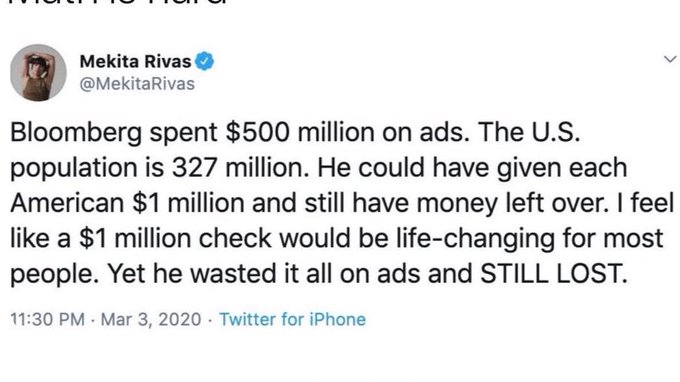
To keep this relevant for future readers, let me give you the quick background. In the 2020 Democratic Primary race, candidate Mike Bloomberg spent a lot of money on his campaign for the party nomination. Like… a lot of money. Like half a billion dollars. Then he dropped out of the race after mediocre performance, so take that as you will.

Then someone tweeted this gem:

Image

So, okay. They’re bad at math. But honestly, I don’t care about that. Lots of people are bad at math. Being bad at math is actually okay if you’re good at being reasonable.

Consider the following situation: you’re attempting to calculate the weight of your cat. It’s often hard to get pets to stay still on a scale, so a common method is to weigh yourself, then pick up your cat and weigh yourself again, and then subtract. Usually you get a close enough figure for what you need.

Now, let’s say you did that, and when you did the back-of-the-napkin math, you accidentally made a simple error and instead of your cat weighing 11 pounds you calculate it as weighing 110 pounds. Even if you didn’t spot the error in your math, what you should immediately catch is the absurdity of the result. No reasonable person would accept that their cat weighed over a hundred pounds without raising an eyebrow, which should in turn tell you that your math must have been wrong, even if you didn’t think it was. You’d go back and check again because the result was so bananas.

Now, when someone doesn’t get the right answer to a particular problem they’re working on, there’s usually one of three causes:

  1. They didn’t have the correct inputs/knowledge in the first place. It happens.
  2. They made a mistake during the process and didn’t pay enough attention to spot it.
  3. They were highly motivated to get the wrong answer.

That last one happens a lot. Sometimes the wrong answer is exactly the answer we want. “Can I afford to quit my job and retire early,” you ask yourself. You do some math, and you make a mistake. As a result of the mistake, you believe that your current retirement savings will be enough to live comfortably, when in reality you’ll be stretched very thin and you should work for another 5 years. But because you really, really wanted the answer to be “yes I can,” you don’t spot the mistake.

Train yourself to be suspicious of good news. Extra suspicious, in fact. I love dispelling folksy truisms, so let me reverse a classic one: You should absolutely look a gift horse in the mouth.

First off, it might be filled with Trojan soldiers, so there’s that.

But second, if you really want something to be true, you will be less cautious than your baseline. So you should get into the habit of being MORE cautious than your baseline when you get good news, so hopefully the two effects will roughly balance out and you’ll be as smart as you always are.

In the above tweet, the person should have known that one person being able to casually send a million bucks to every American is as patently absurd as your cat that you just picked up and stepped on the scale with weighing a hundred pounds. But it supported the worldview she wanted to have, so she wanted it to be true, so she didn’t check hard. If someone with the opposite worldview had done the same math and gotten the same erroneous result, they’d have scowled and done the math again – to them, the answer would have been too bad to be true.

If you can train yourself to be as skeptical of news you want as you are of news you don’t, you’ll make far fewer mistakes.

Teachable Moments

My boss said to me the other day, “don’t coach someone out of a burning building.” She was making an excellent point about ‘teaching a man to fish’ versus when it’s appropriate to just give the poor guy a fish.

I strive for teachable moments as often as possible. For one, it’s literally my job to help people help themselves. But for two, I’m a parent – and if there’s one thing I believe as a parent it’s that there’s no faster path to ruining your kids than to do too much for them.

My two oldest are 8 and 3, and they’re both enormous “helpers.” It’s all they want to do. I’m cooking dinner, they want to be in every step of the process. And I love it! I let them; I encourage them. I give them jobs to do – open these cans, mix these things, put out silverware, and so on. It makes the whole process fun (and they eat much more eagerly if they “made” dinner!). Even if it takes a little longer, it flies by.

When they want to use a sharp knife, I let them. When they want to work an appliance, I show them how. I don’t do it for them – I take the time to show them the right ways.

Well, most of the time.

Tonight, as I was opening the (pre-heated) oven to put a casserole in, my youngest (not yet 2) DOVE for the open door. This was Danger Baby’s moment, and he WENT for it. I caught him by the scruff and immediately deposited him into his playpen so I could resume dinner. We didn’t have a conversation about how hot things can hurt you, I didn’t take the time to carefully supervise him getting progressively closer to the oven until the increasing heat made him want to pull back on his own, etc. I just picked him up and moved him.

Not every moment is a teachable one. Sometimes you just need to keep your toddler out of the oven.

Why There Aren’t Instructions

Let’s say you buy yourself a chair, only you buy one of those things that’s technically only a chair in theory – what you actually get is a box of wood and screws.

Actually, you get wood, screws, and instructions. (Usually.)

There will be a nice, neat (sometimes comically-poorly written) pamphlet that tells you how to assemble a chair.

Chairs are nice that way. Most things in life, however, don’t come with instructions. That’s very, very awesome.

You heard me: awesome!

Why is that so great? Because of why instructions are written in the first place.

The reason your chair comes with instructions is simple: there are more ways not to build a chair than to build one. Given the pieces that come in the box, there are maybe 2-3 ways tops that will result in a usable chair and minimal destruction to your immediate surroundings. The simplest of those 2-3 is probably the one detailed in the pamphlet, but a really skilled carpenter might know a better way to assemble the components. The point is, though, that there are probably several million ways not to build a chair out of those pieces. So if given the choice between writing a pamphlet that tells you all the ways not to build a chair versus all the ways to build one, the latter uses significantly less paper.

But that calculus exists for everything. There’s no pamphlet of instructions for most activities because the number of ways you could do them is vastly, vastly larger than the number of ways you couldn’t.

Why is there no instruction manual for falling in love? Because you can fall in love in a few billion ways – given regular, unplanned exposure to the human race it’s almost impossible not to, at least once. Why is there no instruction manual for “how to make money?” Because there are as many ways to do that as stars in the sky.

So when you find yourself confronted with an activity and you think “I’m woefully unprepared for this – I’ve never received any instruction at all” – rejoice! That means you’re about to do something that has a million different ways to succeed, and a million more. When you’re at the South Pole, no matter which direction you walk, it’s North. When you’re at the bottom, everywhere is Up.

Most people worry about lack of instruction not because they’re worried about not doing “it” right, but because they’re worried about doing “it” (whatever “it” is) horribly wrong. But you can’t! Your only outcomes are varying degrees of “right,” and you can improve as you go.

There. Let this be your instruction manual for all of life. You don’t need more than this to get started.

Pigeonholed

Sometimes you do something for a long time without really meaning to.

It’s okay – some functions of your life have to be on auto-pilot. If you put conscious effort into every single decision every single day you’ll burn out incredibly quickly. But the balance is tough to strike, and often people end up putting too much of their lives on auto-pilot before deciding they want to make a change.

Change is good and you shouldn’t be scared of it. Often a major change comes with a decrease in a current level of something you want, but also a big rate of increase in that same thing.

A typical example is salary. You might make $100k a year currently, but your salary growth is a steady 1% annually. If you took a different job it might pay only $70k, but if it had a 10% annual growth rate, it wouldn’t take long before you’d be doing much better than before. You can replace “salary” with more intangible things, too – happiness, stress levels, prestige, etc. Sometimes you have to give up a little of your static benefit in order to invest in trajectory.

I hear pretty often that people don’t want to be “pigeonholed” or put into one specific box; they want to be seen as multi-faceted. But meanwhile, the thing people are labeling them with is the only thing they talk about; it’s their whole life. I’ll say, “Hey, if you don’t want to be seen as just ‘the web developer guy,’ then stop talking about that.” And they’ll respond that web development is 95% of their skill set, years of experience, etc., and that without it they don’t have anything.

That might be the choice you have to make! If you want the benefit that twenty years’ experience gets you in social capital, you have to accept what that twenty years was spent doing. You can look for transferable skills and adjacent experiences, but it’s still twenty years’ experience in those things. If you want people to see you for your modern art, then that’s what you have to talk about, even if you’ve only been doing that for a month.

You may have to give up some of your static reputation, some of your static identity even. And it’s natural to be wary of that, but of course it’s exactly the crucial ingredient in change. In exchange, you get a new trajectory, the ability to invest in a new style of identity and reputation, unfettered by the box that everyone has built around your old one.

The Past

I tend not to dwell in the past. Once something has happened, the waveform has collapsed and it’s no longer able to be influenced by anything I do. As a result, I usually treat any event that’s happened in the past as simply background – the boundary conditions of my current universe. It sets the stage, but I have no more emotional investment in something that happened to me yesterday than I do to the events of World War One.

A strange consequence of this that I’m noticing lately is that I have a terrible concept of how long ago something happened. I’m responding to emails today (the standard Monday excavation) and as I’m responding, I’m starting to feel guilty for how long it’s taken me to get to something, when I realize that this email came in at 8 PM on Friday and wasn’t urgent. Very little actual time has passed and I’m nowhere near “feel guilty” territory, but it feels like forever ago. Events that happened last week feel like the distant past to me.

The future is the opposite to me. It feels like every event in my future is going to happen five minutes from now, all the time. Then once they happen, they happened ten years ago. It’s like the Doppler effect but for time instead of sound.

Despite being the kind of kid who stretches her festivities out for several weeks, today is the actual day of my oldest daughter’s birth. On this day, eight years ago, I became a father for the first time. I know most parents say something like “it feels like only yesterday, it flew by,” but that’s honestly not how I feel. It feels like a million years ago – so far back I can barely remember it, and certainly can’t remember a time before it. The hiking trip we took to celebrate this birthday, which we took the weekend before last, already feels like a decade ago.

But you know that sensation you get when you’re late for something? The sort of panicky, anxious energy you get where you start to rush small details and review your mental checklists of everything you needed to do before a particular event? I feel like I’m already doing that for her high school graduation, her wedding day, the ribbon-cutting at her company. Like they’re just around the corner.

I can hardly wait. At least I won’t have to for long.