
“Talent” sometimes gets used in the business world as synonymous with “headcount.” You’ll hear recruiters referred to as “talent acquisition specialists,” for example. Saying something doesn’t make it so, however. Talent is fundamentally different than headcount. Using them interchangably as terms hides the fact that most organizations have no idea how to do actual talent management.
There are two essential formulas that you need to internalize if you want to create a great organization. Here’s the first:

That’s your Workforce Quality Score right there. That’s the number you want to maximize. Total headcount times average quality of talent, divided by your total cost (“payroll” is shorthand, but all the direct costs of employing someone go here). [To make things easy to read, we’ll take the final number and multiply by 100,000 to get a visible score.]
Headcount and payroll are easy to measure, and so that’s typically all companies do measure. They also try to make all the adjustments there, too. If their output isn’t good enough, the first lever they try to pull is often payroll – and that’s almost always wrong as a first call. If you pay more than you need to you’re making bad business decisions, and if you pay less than you need to… well, you’ll see how that affects you as we talk about that third variable, “Average Quality of Talent.”
Ready for that second formula? Here you go:
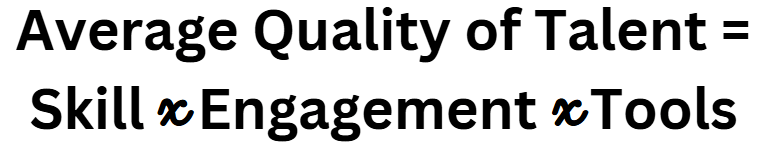
The Average Quality of your talent is equal to their skill level relative to their role, multiplied by how enaged and motivated they are, multiplied by the tools they have to do their job well. Each of these variables is expressed up or down from a base of 1. So if someone is exactly as skilled as their job requires, no more and no less, then their Skill is a 1. Same with Engagement and Tools.
So if someone has exactly the skills they need, no more and no less, and they’re at a baseline level of engagement, and they have precisely the basic tools necessary, then the total “Average Quality of Talent” will be a 1. And in that case, when you plug that back into the first formula, your Workforce Quality Score will be exactly headcount over payroll and that’s that.
Wouldn’t that be nice? I mean, you’d be absolved of all responsibility as a leader if that were the case. In fact, you could even improve your WQS by reducing how much you paid people!
To understand why that typically doesn’t work out to well for organizations, you have to look at that second formula. Note that those things are multiplied, not added together. So if the average engagement of your workforce drops from a baseline of 1 to a 0.7, you’re down to 70% of your Workforce Quality Score right there. You’re paying the same amount of money for 30% less output!
And let’s be clear – your Workforce Quality Score is your output. It’s the driver of every other thing in your business. It’s the most important metric you have, and it’s not even close.
So what are each of those three “force multipliers?”
The average level of knowledge and expertise in your workforce. There are plenty of ways to affect this: You can get better at identifying skill accurately in your hires (especially in hidden places), you can have systems in place that encourage your employees to upskill themselves, and you can even train them directly. Training is a cost, sure – but check the formula. All you have to know to see if it’s worth it is how much it raises the total WQS.
Plus, training (if done correctly) can really improve Engagement. Put simply, this is how much your employees want to do well. It affects how long they stay with your company, how much of their ideas they’re willing to bring to the table, how hard they’re willing to push to reach goals. And it goes both ways! All else being equal, doubling your average level of Engagement doubles your WQS. But halving it is like firing half your workforce but continuing to pay them.
Tools are the objects, systems, and infrastructure that let humans work better, and this variable represents the average quality of the ones you have. Anyone can tell you that it’s better to dig a canal with excavators than with spoons, even if excavators are more expensive. Tools aren’t just physical objects, either. Organizational systems, effective program management tools, and thoughtful communication routines are all tools.
True Talent Management is about maximizing these three variables. In order to do that, an organization first has to recognize that these formulas are true, and that these things matter. If a leader doesn’t recognize that you can get better at finding talent for the same price, for example, then they’re never going to aim to maximize that score; how skilled their employees are will simply always be function of how much they pay for them, full stop. If you don’t see investment in internal communication systems or project management techniques as affecting your output directly, you’ll continue to have sloppy, disorganized teams without the tools they need to succeed. And don’t even get me started on engagement, which a shocking number of leaders don’t seem to believe is real at all.
Let’s put this all into an example!
The CEO of WidgetCo has one hundred employees, with a total payroll cost of 5 million dollars. Multiplying by 100,000 to get rid of awkward decimal places, we find WidgetCo has a Workforce Quality Score of 2. They’re a pretty average company overall, with a net profit margin of 10%. Their Average Quality of Talent to start is a 1 – because their average Skill, Enagagement, and Tools are all 1 as well. So far, so good!
But the CEO doesn’t invest in these things. The world advances and his employees’ skills don’t keep up without training and better identification of new talent, so Skill drops to a 0.9. He ignores anything to keep his employees engaged, and they start to grow listless, reducing Engagement to 0.9 as well. And while he’s kept up with the easy-to-understand factory machines, he hasn’t kept up with project management tools to make organization easier, so that’s dropped to 0.9 as well.
Each of those factors dropped by only 10%. But multiplied together, that reduces his Average Quality of Talent – represented by the same actual humans – to a 0.729! Which in turn reduces his Workforce Quality Score to a 1.458. He’s lost more than 25% on the most important metric of his business, and he probably doesn’t even realize it. Instead, he’ll see declining profits, and the spiral will begin. With no idea what’s really behind the decline, he’ll “tighten his belt,” reducing raises and bonuses (decreasing engagement), denying requests for things to improve their workflow (decreasing tools), and hiring cheaper labor (decreasing skills) to replace the people that abandon the ship. The decline will continue until WidgetCo collapses.
If he did realize what was behind the decline, he could do two things: First, he could look at how much profits decreased and be able to draw a direct line from his WQS to his profitability, giving him clear direction when deciding in the future which methods of improvement were most cost-effective. And then he could begin to implement those improvements!
First, the CEO takes a cost-effective approach of hiring replacement staff from typically marginalized or under-appreciated backgrounds, finding higher-skilled workers that other companies miss, and bringing his company’s Skill score to a 1.1. He dedicates a large portion of his own work time to sending messages of appreciation to all his staff (new and old alike), listening to their ideas, and using the best ones to recover lost business, bringing his Engagement score up to a 1.1 as well. Finally, he takes the risk and invests in management software with modern best practices built in and gets his managers trained on its use, bringing his Tools score to a 1.1.
He’s up to only 10% above his original baseline – these aren’t dramatic improvements! They aren’t overhauls of his entire business by any stretch. But they’ve made his Average Quality of Talent into a 1.331, which makes his total WQS into a 2.662. That’s a vast difference from the state of things prior, and when he sees the new profitability numbers, he’ll be able to measure exactly how effective it was against the costs.
From there, he’s learned his lesson. He’ll continually reinvest in a People Operations team and make actual Talent Management a core part of his business.
So should you.
 The Opportunity Machine