
A very helpful tip to guide your interactions with others:
If you find yourself about to criticize anything, instead ask, “How can I help?”
And if you find yourself thinking, “But I don’t want to help…”
Then why are you criticizing?
A very helpful tip to guide your interactions with others:
If you find yourself about to criticize anything, instead ask, “How can I help?”
And if you find yourself thinking, “But I don’t want to help…”
Then why are you criticizing?
One year ago today, my dearest and oldest friend left this world. Not a day has passed in the last 365 that I didn’t think about him. I have shed many, many tears for him; probably more than he would have told me to. He wanted us to be happy. The last time he was able to speak, all of his words to me were about how to make sure all of his friends and family found happiness and joy in their futures.
He had dedicated so much of his own life to that same goal. On top of being a shining light for those that knew him, he had just completed his Master’s in mental health counseling – a vocation he was tragically robbed of the opportunity to pursue by his illness. He would have been great at it; he already was, for all of us.
On his last day on Earth, he couldn’t speak. He communicated to us with hand gestures, kind eyes, hugs and held hands. He couldn’t write much, but he scrawled out a few notes that night. At one point, he saw me losing my composure very badly. Despite my attempts to be strong and stoic for him and for the others, I was failing. The sadness of it was overcoming me, and I started to choke with sobs. He took my pen and notebook from me, and he wrote the last word Charles Carrado III would ever write:
“Breathe.”
I will, Chalie. I will.
When there are too many people surrounding a problem, each individual person becomes less likely to act. There’s a social pressure, for one – “no one else is acting, so maybe I shouldn’t either” – plus the fact that people will naturally assume that surely someone else will, in fact, intervene.
It’s human psychology, but it’s a heavy curse. The more connected-but-not-really-connected we become, the more I think this just plays out in society at large. We see problems, sure – but there are so many people who can also see them, surely someone else will solve them, right? And so I’ll just do what everyone else is doing, which is join in the echo chamber of complaining about the problem online.
Fight this. Fight it with every shred of you. Go outside, look at a problem you can touch, and solve it like you’re the only person in the world who can. Especially when the problem is your problem.
Tough to find a job in your industry or demographic? No one is solving that for you; change your strategy. Cost of living is high for you? No one is solving that for you; change your strategy. People are just so mean nowadays? No one is solving that for you; go outside and be nice to someone.
This advice isn’t for anyone else. This is advice for me, and advice for you, and that’s it. We’re the whole team. Let’s go.
If you quit your day job to become a DJ, spent five years doing it, and then came back to more traditional full-time employment, did you fail at being a DJ?
Heck no! Things aren’t successful or not based on how long they last. I had a successful career in sales; I can say that despite the fact that I no longer work in sales. It was successful in that it served my life during the stage of my life where I needed exactly what it provided, and in that it taught me many skills that made the transition to the next stage of my career just as successful.
Once upon a time, I also had a successful career as a stable hand. I can tell you that zero horses died under my care! I also have a ton of great stories from that time and learned many valuable lessons. I’m not a “failed stable hand.”
Your life is going to look very different across its whole span. Its wild to think that shifting your career to suit those changes counts as “failing” at something. I consider it way more of a failure to dogmatically stick to something that’s no longer serving you just for the sake of doing so. Maybe being a DJ ruled when you were single in your 20s and then you swapped back to full-time employment (with benefits) once you got married and had kids. That’s about the story of my sales career, so it makes sense to me. It also makes perfect sense to me to swap to being a DJ in your 40s (or 50s, or 60s…) because you’ve done enough full-time employment work to get what you needed out of it and now you want something that energizes different parts of your brain. The point is, there’s no wrong answer here.
If your life is being served, that’s success.
How do you tune your conscience? What do you do if you think it isn’t working right? Does your conscience have a conscience?
Countdown timers do wonderful things for your focus. If you tell someone, “We have to leave in five minutes,” they meander. Tell the same person “We have to leave in 300 seconds,” and watch them suddenly leap into action. 300 seconds sounds like an actual countdown timer instead of a vague synonym for “soon.” When we see the fuse burning down, we know the time for procrastination has passed.
Sometimes it’s very, very helpful to be able to set a fuse for yourself. Something that, once set, is no longer under your control. Give your roommate 20 dollars and say, “If I don’t do the dishes by 5 PM, that twenty bucks is yours. If I do them by 5 PM, give it back.” Assuming you have a decent roommate, this can be a good incentive for you to stop putting off the task.
(Pro tip: For this trick to work, the amount of money has to be large enough that you care about it, but not so large that your roommate can be guilt-tripped into giving it back to you because it would inflict a catastrophic loss on you.)
Whatever you’re trying to do, if you’ve been putting it off – try lighting a fuse.
We had our second annual post-Halloween family camping trip, and it was wonderful. Spending that time out in nature with my children while they romp and enjoy themselves is unparalleled joy. While I was there, I spotted this tiny bit of sublime vandalism on our picnic table:
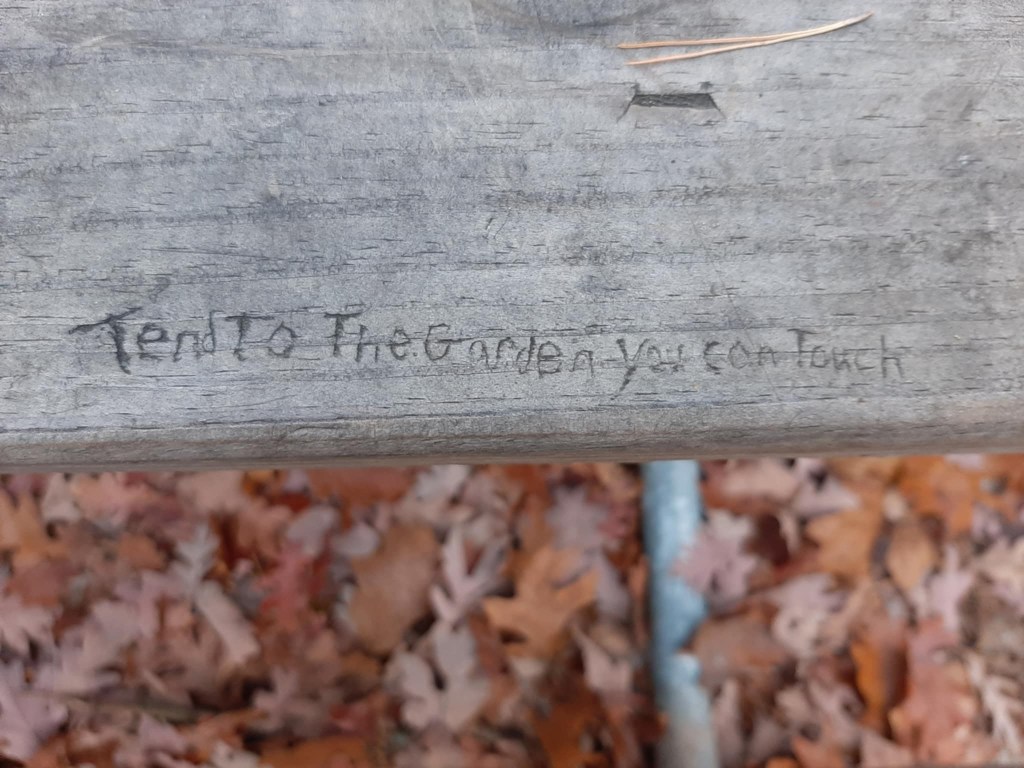
What a wonderful note! What wisdom!
The world is large – too large for you to ever “tend” directly. You can’t solve all the problems. But you can find joy, meaning, and even purpose in the corner that’s yours.
I spent the weekend tending my garden, and my three wonderful flowers are coming up nicely. May we all be so blessed.
My kids asked – asked! – to go camping this weekend. How blessed I am!
Funny enough, looking at pictures from last year, this is the same weekend we went then. A tradition is beginning to form! First weekend after Halloween reserved for camping each year? Perfect! This is the weather I love the best, and the timing works out great.
Time to go bond!
I love a good hunt. When I’m trying to find some exact, specific tool or trinket for a project, I can get very lost in the search itself. It’s probably the easiest way to pass time for me; I can blink and hours or days have gone by while I try to track down the exact item that fits my needs.
While I enjoy this very much, it also means I have to be careful not to indulge too often. You can find anything eventually… except more time.
There are two ways being “undefeated” can affect you. One way can make you a nervous wreck, a target. Heavy is the head that wears the crown, and everyone wants a piece of you. You’re destined to go down a peg.
The other way is better: being undefeated becomes a shield, a warning. You’re untouchable. Your record speaks for itself, and anyone going up against it finds themselves a nervous wreck instead.
What’s the difference? The realization that the “undefeated” label, like anything else, is a tool. You can use it well or use it poorly.
If you’re on top of the heap, don’t make more enemies than you have to. Don’t gloat; share. There will be plenty of people angling for you anyway – there’s no reason to add to the pile. Confidence comes from knowing your own abilities, not disparaging others. If you assume everyone else is bad, you’re bound to get surprised.
When you’re undefeated, the most important adversary is yourself. Any day you aren’t better than yourself the day before you’re getting closer to the upset. It’s a responsibility – but the trail of the defeated left in your wake needs to include the avatars of your own growth, or you won’t be undefeated for long.
 The Opportunity Machine