
Few things are as satisfying as convincing a skeptic not to blindly believe you, but to commit to an experiment. To open their minds to a possibility. And then to watch the experiment prove you right.
Blog
Into Did
As an adult, you should ask the same questions of “can’t” that too many adults tell children NOT to ask.
“You can’t do that.” Why not? Who said? Why did they say that? When will I be able to?
We think kids are being petulant, but asked with genuine curiosity those are exactly the questions you need answered if you want to turn “can’t” into “did.”
Responsibility Over Caution
Responsibility, not caution, is what earns trust. Imagine two neighbors each ask to borrow a tool from you. One neighbor is extremely cautious with your tools, definitely beyond a reasonable amount. But accidents happen no matter how cautious you are, and one time this neighbor broke a power tool he borrowed. Because of his claims of being extremely cautious, however, he claimed that the accident “wasn’t his fault” – and therefore he should have no obligation to replace your tool.
The other neighbor uses tools in the normal way. Over the years, he’s broken three of your tools; each time unintentionally of course, but these things happen. He replaced each one immediately with an equivalent or better model, without having to be asked, and delivered them to you promptly, always with a small extra token of gratitude & apology, like a meal or a six-pack or something.
Which neighbor do you actually want to lend the tools to?
It’s not about being cautious. It’s about being responsible. Accidents happen that are nobody’s fault, but they’re still someone’s responsibility. If you take the responsibility along with whatever favors you ask, you’ll find your font of favors will always be full. And if you don’t, it runs dry quickly, no matter how “careful” you are.
Click It
If you tell someone that they drive more recklessly because they have an airbag and seatbelt, they’ll loudly object. And they aren’t lying, per se: they definitely don’t perceive themselves as being less cautious just because they have those safety features. But ask them a different question: “If I disabled your airbag and seatbelt before you had to take a drive through busy traffic, would you be more careful?”
The point is this: Everyone behaves the way they do because of what they (consciously or unconsciously) perceive to be the costs & benefits, the risks & rewards, of doing so. They don’t always like knowing about it, but they do. Change the conditions, and you’ll change the behavior.
Knowing this formula, changes in behavior are easy to predict, even if people get really mad at you for predicting it. So hey, keep it to yourself – but act accordingly.
Mining Failure
I love the concept of “failure as a resource.” Engineering your attempts so that they’re always giving you information or skill or something, even if they don’t get you to the goal on that attempt. There’s so much to be learned by flipping the wrong switch!
There’s a strategy to it. Setting up the failures that will reveal the most information first, for example. Being prepared to track results so you don’t have to re-tread failed ground.
Whatever you do, get closer to the lightbulb. Then it’s never a failure: it’s a resource!
Fire & Water
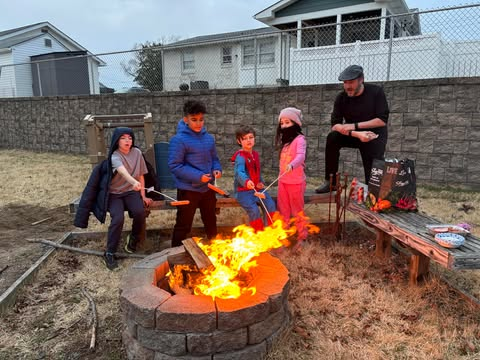
A little rain? Bah! Won’t stop us from our first fire of the season – the kids all came hungry, undeterred by weather. We roasted hot dogs and s’mores and I watched with great glee as children laughed and played and experimented and learned. Together, outside. They weren’t forced; in fact, they were unstoppable. Darkness fell and still they called out and played. They earned their rest with play, rain be damned.
The world is in good hands.
Slow Is The Point
Sometimes I see people roll their own cigarettes. I asked a person who did this if they liked them better. They said (surprisingly to me) that it was the same when smoking them more or less, and not especially cheaper, either. But they enjoyed the ritual. Plus, they said, as an added bonus they smoked fewer of them overall because of the extra effort.
What struck me is that they separated those two benefits. But really, those are the same thing. The point of ritualizing something is to add consideration to it – both during and before, when you’re deciding if you’re willing to put in the effort.
Making yourself food is slower than getting takeout, but that’s the point. If it’s healthier or cheaper than takeout, it’s because you slowed down to do it. To take time to involve yourself in the process. To think about it more deeply.
The actual added benefit is that the rest of your life gets pushed away for a bit. While you’re rolling a cigarette or cooking a meal, that’s what you’re doing – not answering emails or scrolling your phone. You’re just present in the act of doing something for yourself.
Take the time and do it more. It’s good to slow down and smell the cooking.
Empirical
I think arguing is fundamentally silly most of the time. I think it’s especially absurd when the thing people are arguing about is available information.
There are basically three “levels” of disagreements you can have:
- Matters of pure taste/opinion. This is silly to argue about, obviously. But it can be interesting to discuss – if I think The Wall is the best album of all time and you think it’s something else, we can have a great time exploring music together, even if we don’t actually “convince” each other to change our tastes.
- Matters of philosophy. This is the one area of argument that I think is worthwhile, because debate is how we test out ideas of morality and purpose. However, the number of people who can debate this intelligently is vanishingly small, so I don’t recommend doing so unless you’ve vetted your debate partners very thoroughly.
- Matters of objective fact. This seems to be the most common type of argument, despite being the stupidest! I hear people getting absolutely heated in arguments, fighting for days on end, about something that would take 30 minutes to research, verify, and understand.
“Is Mexican food good,” is a matter of opinion, so there’s no sense in arguing. I’ll treat you to my favorite Mexican place and if you still don’t like it, oh well. “Is it worthwhile to pursue experimentation in our personal diets,” is a matter of philosophy, and therefore good to discuss with the right people. But “are there any Mexican places near me” is a dumb, dumb thing to argue about.
A Heart to Burn
Tonight I ate three bowls of an absolutely delicious garlic potato soup. And now I have heartburn. You could say, “Well silly Johnny, of course you do – that much garlic would give anyone heartburn, you shouldn’t have eaten it.”
And to that I say: Bah! Bah, I say!
If you’d told me at the first bite that I would suffer this discomfort, I’d have said, fie! Bring it on! I choose life! Life, again and again. I want the spectacle and smorgasbord that life has to offer. May I never run from heartburn, for it shows I have a heart!
Dirty Hands
Imagine that you want to become better at baking, and a great baker you know is willing to talk to you. If you ask “How do I become a great baker like you,” you aren’t likely to get very helpful advice. Their advice will likely be generic and broad, stuff like “Practice every day,” etc. But that’s because the question was generic and broad, and so there wasn’t anything to latch on to.
Instead, bake a cake yourself, give them a slice, and ask them what they would improve. You will get detailed, relevant, and extremely helpful information – info which you can understand even better in the context of having just made a cake!
The point is that discussing actual work will always yield more relevant and specific insights than talking general theory. Get your hands dirty, and then show the dirt to the master. They’ll have more to offer you; more to say than they could about clean hands.
 The Opportunity Machine