Assume Battle Poise

In a boxing match, it’s bad to get hit. You’d rather not! Getting hit is painful and decreases your chances of winning the fight, not to mention potentially leaves you with lasting injuries. It would make sense to say “I’d like to minimize my chances of getting hit,” but if you actually choose actions that minimize your chances of getting hit every second of the match, you will definitely lose.

Why? Because throwing a punch of your own means taking at least some posture, energy and attention away from your own defense. Every time you open up your guard a little, you increase your odds of taking one on the chin. So in order to tuly minimize your chances of getting hit, you’d have to never throw a punch. But if you never throw a punch, you’ll obviously lose the fight.

There’s a term called “Pareto-optimal.” Named after economist Vilfredo Pareto, it refers to a situation where you’ve reached the best equilibrium between multiple conflicting options such that no change in any direction would reflect a better trade-off. In other words, while you might in a vacuum prefer to have both $100 and 100 cups of coffee, when forced to choose between the two there is some combination of dollars and cups where you would neither trade one more dollar for one more cup of coffee, nor would you prefer one fewer cup of coffee to get one dollar back. That point, whatever it is for you personlly, is your “Pareto-optimal” ratio of dollars/coffee.

In a fight, you’re not really trying to minimize your chances of getting hit, but you’re also not trying to maximize your chances of hitting the other guy, either. You’re trying to find the Pareto-optimal balance between the two, such that no decrease in your chances of getting hit nor increase in your chances of hitting the other guy will make it more likely that you win the fight overall. What that optimal balance is can shift from fight to fight and even moment to moment within a fight, but that’s the line you’re trying to toe. That’s what will win.

Think of every major challenge in your life like that – like a fight against an opponent. There is always a “safest” course of action, relatively speaking. Rarely is that the course of action that is most likely to overcome the challenge. Moment to moment you may feel safer, but you’re losing the fight with every second that passes while you’re up against the ropes.

You can’t adopt a fully defensive posture. You must acknowledge that you’re opening yourself up to a few blows to the head in order to increase your odds of winning overall. You must acknowledge that this means, over time, you will get punched. Hits will land, and they will hurt. You will suffer losses and setbacks.

There is no road to victory that maximizes safety.
Lifeline

Regardless of our abilities or our proclivities, we need other people. No matter how much we’d love to live in a cave somewhere, we cannot survive in isolation. Even beyond our physical needs, it is through other people that we find meaning and connection. Love and family and friendship and generosity and all the things that make life a worthwhile endeavor.

That doesn’t mean people can’t scare us, or hurt us, or make our lives a little worse for a time. And it can be hard to say who’s who before you know them – hence why we sometimes want to just live in a cave.

But you need to leave yourself something even when you hibernate. A tin can tied to a string, a line of bread crumbs, a periscope, something. There needs to be an escape route. Because there’s only one truly isolated perfect little cave that you’ll ever truly inhabit in your life, and that’s your grave. Don’t be in too much of a rush to get there.

And Find Out

In your personal life and in the spheres over which you have influence, you have to decide how you’re going to punish those who violate your standards of behavior.

You aren’t the arbiter of other people, but you are the arbiter of your life, and so a perfectly just “punishment” is to exclude people from the parts of your life that they disrespect. If you are the manager of employees, you must decide the just and correct ways of reacting to transgressions. If you help oversee a club or organization, likewise. And always, you must keep your personal circle upright.

In considering this, I notice that many people make what I believe to be a tactical error. They often punish the violation of norms with nothing more than a return to the status quo.

Let me paint a hypothetical for you: imagine that in the legal system, the only penalty for stealing something was having to give it back. That’s all. If you rob a bank for a million dollars and you’re caught, the punishment is giving back the million. No jail time, no other punitive measures, just a return to the status quo. What would that likely do to the rate of robberies?

Of course, it would skyrocket. Maybe you’d avoid robbing heavily-armed places where you might get shot, but most places would be prime, easy targets. Apart from personal scruples (which many people lack), there’d be no reason not to at least try, since there would be some chance you’d get away with it and if you didn’t, you’d be no worse off.

Transgression against the code of behavior for any given sphere must be punished by a worse fate than the previous status quo in order for that code to be meaningful.

What does that mean in your personal life? If your friend slanders you behind your back, spreading false, potentially hurtful rumors about you, we might be tempted to accept an apology and “setting the record straight” as an acceptable solution. But that’s a return to the status quo and does nothing to curb future incidences of this behavior. A more appropriate punishment might be removing that person from your circle of friends.

You teach people how to treat you by your responses to their behaviors. Never forget that you have a responsibility to the maintenance of your own life, and that requires discipline – in every sense.

Anti-Bravery

Sometimes people will do something that seems phenomenally brave to outsiders as a way of avoiding what would appear to those same outsiders as an incredibly minor fear.

We all fear things differently. What seems brave to you might be because of your level of anxiety about that topic. If you’re afraid of heights, it might seem very brave to you that I climb onto my roof to fix something. But if I’m not afraid of heights, then it’s pretty routine.

So maybe someone is base-jumping, but maybe they’re also base-jumping as a way of avoiding a difficult conversation with a loved one – the thing they really fear.

Go where you’re powerful, sure. But don’t hang bravery over your fear like a portrait covering a hole in the wall. Some things need to be fixed directly.

Titled

You have many titles, and you’ll have many more throughout your life. Your title generally denotes your role within a given organization – my job has one title for me, but my kids have another, and the club I belong to has another, etc.

The more important you consider the title, the more value you place on that organization within your life.

Consider carefully which titles you’re most proud of. Which ones you want to define you. Which ones you want people to carry with them in their minds when they remember you.

Consider carefully.

An Order of Chaos

I wonder how many other people are like me in this sense: when it’s time to clean and reorganize the closet, the first thing that has to happen is every single item has to get pulled out of the closet and thrown onto the floor.

Individual boxes are emptied. Drawers pulled out. It all goes into the One Great Heap. No rhyme, no reason. The closet becomes barren, and the floor becomes a maelstrom.

Then, patterns emerge. I can see the volume and shape of things. I can see from my mountaintop what deserves to return, and in what order it will do so. I can hold the whole of it in my mind, and it falls back into place so much easier than if I tried to simply move things around and re-organize from within.

This is true of everything, not just closets.

To restore order to a broken system, you must destroy that system. The realities of life sometimes necessitate that you don’t do this – but more rarely than you think! Quite frequently, depending on what you define as the borders of the system in question, you can rip it all up to see the true shape of it, unhindered by the detritus it’s gathered along the way.

It’s clarifying. Regenerative. It’s like conquering a new land, homesteading your own life. Don’t dismiss the power of it.

Gates & Keepers

Humans play status games. All the time. We take things that are essential components of survival and we attach those things in weird ways to societal status, and then we argue.

What we tend to argue about is how the status symbol is applied. What we should be arguing about is why that particular component of survival is attached to that status symbol in the first place.

In other words – we put things behind gates, and then argue endlessly about who should and should not be allowed through those gates. What we should be doing is tearing those gates down.

We don’t do that because whoever owns the gates spends a lot of time convincing you that the reason the whole situation is bad is because someone else is keeping the gates badly or whatever – not because of the gates themselves.

It makes sense, in its way. If I own a pair of gates and everyone who doesn’t pass through them makes half as much income as everyone who does, I don’t want people questioning those gates. Those gates are worth a lot of money to me, because I can get away with charging a lot of money to go through them! And if people get mad at me for letting the wrong people through, or even for making that decision in a bad way, that’s awesome for me. Because as long as people are arguing about that, nobody’s even entertaining the idea that maybe the gates just shouldn’t be there.

Whenever you’re mad about what you perceive to be injustice, see if you can move your anger upstream a little. Find the root causes of the injustice – and not just the gates that conceal them.

The Central Gear

A machine may be made up of many gears, doing many things – the machine as a whole may have many functions. And yet, it may all be turning due to motive power applied to a single, central gear.

That’s you. You’re the central gear.

You’re the motive power; the gear that turns all the others. All the other functions of your life happen because of that central effort.

Now, if we look at a machine – a watch, a car, whatever – and it isn’t working, we might first check the motive power. Is it on? Is power being applied to the turning of the central gear?

If it is, then one of two things is wrong. The central gear might not be properly connected to other gears; it might be spinning freely, with nothing to catch its effort and power. Or there might be too many gears connected to the central one, such that they’re jamming each other up and working against one another.

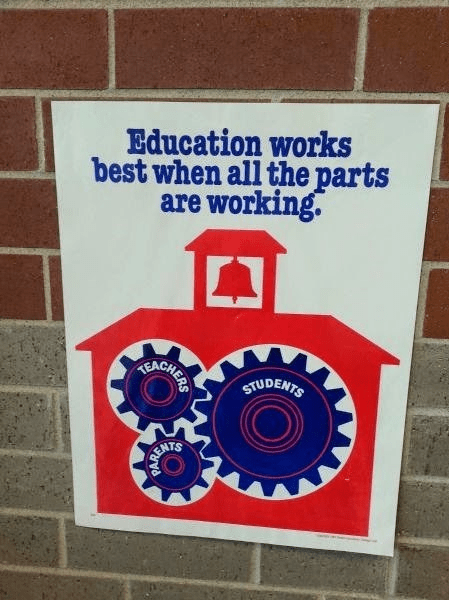
Like this hilariously ironic image… those gears won’t turn!

The incredibly important point is this: neither of those problems are solved by applying more motive power to the central gear!

If the gear isn’t connected to anything, then spinning it faster isn’t going to do squat. And if it’s jammed, then applying more motive power is just likely to break something.

Reconfiguring is necessary. If you’re putting in your effort and you’re not getting results you want in your life, then you need to install different gears. Your goal shouldn’t be to change the way you’re spinning, either! You’re spinning just fine – but you might be hooked up to the wrong machine.

Take a look at the things you put effort into in a given week. How many of those things are being ignored or wasted? How many are generating secondary effects that are acting against you in some other way? Don’t change the amount of effort you put in until you’re sure that motive power is the problem.

It likely isn’t.

Spectacle

Seeing things that you don’t usually see is worth it.

It might hold very little direct value – it’s still worth it. Expanding your imagination, sharing experiences with your fellow humans, and even just stretching the muscle of your wonder are all worthwhile endeavors. They’re a good thing to spend a few minutes or a few hours on.

Seeking out moments that have spectacle. Invite others. Laugh about it. Gaze in wonder.