
There’s a really hilarious sight gag from The Simpsons, and I’m going to use it to illustrate a point:
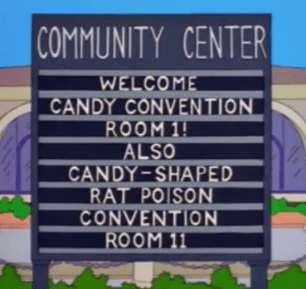
If someone ended up eating rat poison at this community center… whose fault is it? And is that really a good question?
Here’s a simpler version. Let’s say you accidentally put salt in a recipe that called for sugar, and the resulting food was inedible. That’s your fault, right? After all, you made the mistake. But what if your roommate put both sugar and salt in identical, unlabeled glass jars?
Fault is fuzzy. What matters more is why – because “why” is how we get to something not happening again. Assigning blame doesn’t make the sugar easier to distinguish from the salt in the future.
What you often need to do is move upstream from the accident to what’s called the “latent error.” The systemic cause of the accident, baked into the system. If a busy intersection has poor sight-lines and no traffic light, then accidents are inevitable. Figuring out who’s to blame in each individual accident isn’t nearly as useful as realizing that the very structure of the intersection is largely the cause of the accidents, and fixing it.
So don’t rush to blame, even yourself – and don’t rush to defend, either. Move back a few steps, and figure out what to change about the system. Don’t put the candy-shaped rat poison next to the candy in the first place!
 The Opportunity Machine