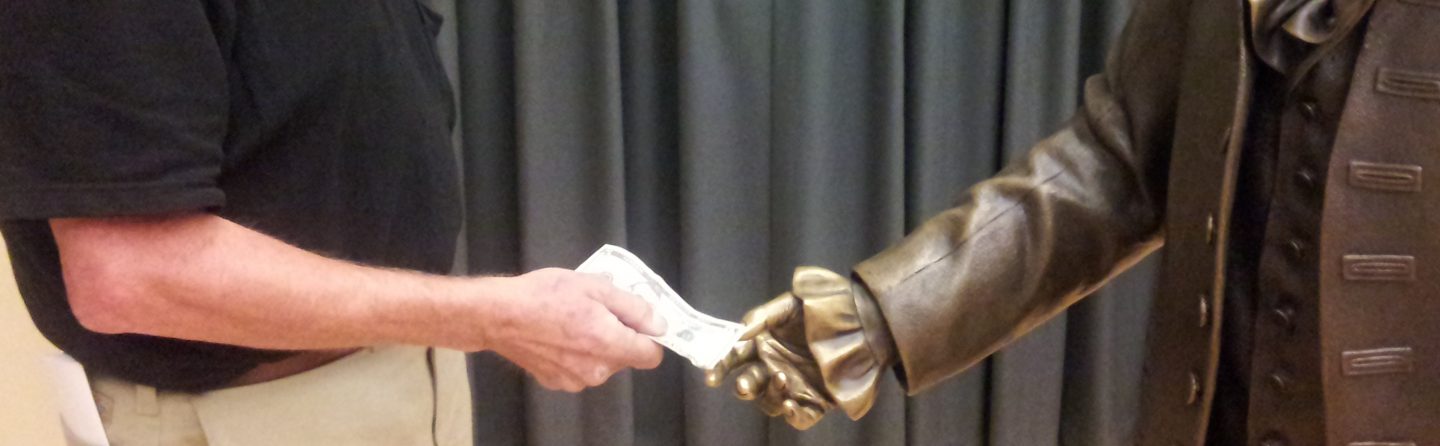
Slightly Better

I don’t want to get punched in the face. But if I have to, then I’d rather be punched in the face and get a dollar than get punched in the face for free.

The point is, slightly better is still objectively better. Sometimes you can’t avoid a disaster. But “disaster + cup of hot chocolate” is objectively better than just “disaster.” So make yourself the cup of hot chocolate.

If nothing else, it reminds you that you have agency, even if only at the margins. It lets you know that there are corners of life, however tiny and fleeting, that are beautiful and wondrous. You can live in those moments even if everything else burns down around you.

Those moments aren’t an escape or a crutch – if you can act to avoid the big disasters, do so. But if the bombs ever truly start dropping and there’s nothing else to be done, I’d rather put on my favorite music and goof around with my kids than spend the last few minutes screaming “woe is me.”

You can make anything – for you, for others, for everyone – slightly better. Do it every day.

Think Onto Paper

Don’t ever think about stuff.

Wait, let me make that a little less deliberately provocative: you should rarely just think about stuff.

“Thinking” is realistically one of two things: planning, or daydreaming. There’s nothing wrong with a little daydreaming if that’s what you need right now, but way too many people imagine that they’re planning when really, they’re daydreaming.

What’s the difference? Whether the thinking produces any forward motion. You can think about stuff all day without ever reaching any new conclusions, putting any plans into action, or even making any plans to begin with. When people say “let me think about that,” they typically aren’t about to approach “that” in a systematic way that will produce any results.

How do you avoid this trap? Think onto paper. Don’t just think; write.

Writing produces something tangible. It shows your thoughts to you. It allows you to show your thoughts to others. It exposes their flaws and sharpens their good edges. And writing is the beginning of actually planning. If you think onto paper and then decide to take action, you’re already halfway there. And if you decide not to take action, you’ll know why.

I write every day because I think every day. You think every day, too! I just commit to not keeping my thoughts in my own head where they aren’t doing any good. You don’t have to do that every day – but you should do it more.

Offensive

I strongly dislike the word “offensive.” I also dislike the concept that it tends to represent in modern discourse.

I don’t like it because I think it focuses entirely on the wrong thing. There are many things, entire categories of things, that you shouldn’t say or write – not because they’re offensive, but because they’re cruel. You shouldn’t say these things, even if you wouldn’t offend anyone by saying them. Even if you’re in company that would like you to say them. You shouldn’t say cruel things without great justification, because you are an honorable person.

Other things need to be said. They may be unpleasant to hear for someone who is hiding from a painful truth, but that person may be someone you’re sworn to help – a loved one, a trusted friend, or someone else who needs you. There are things that you may need to say to them that are true, and just, and helpful – but which will offend them. Which may offend others who overhear. This shouldn’t stop you.

If you take care to never be cruel, to always be just, to never speak just to hear the sound of your own voice, and to always speak when your words can be helpful – then you will not need to care about offending.

Rigged Games

There are a billion games that you can play in the world. In your wildest dreams, you won’t play even a tiny fraction of them.

Some of these games, though the fault of no one in particular, are rigged in favor of certain people and against others.

Since you can choose, by and large, which games to play – don’t play the ones that are rigged against you. Play fair when you can, and don’t cheat others. But there’s nothing wrong with just opting out of the games you can’t win.

This isn’t just “pick your battles.” This is also “don’t make your life harder than it has to be.” You’re going to have to play a few rigged games in your life. You’re going to have to fight a few battles where the odds aren’t in your favor. You’re going to lose some of those. So take your wins where you can, and play the games that are fun.

Be Yourself, Don’t Repeat Yourself

In the same way that you’re never truly the same person on two separate occasions, no two interactions with you should be identical.

From one day to the next, you’ve grown and changed. Let that reflect how you interface with the world. Bring something new to each conversation.

My father used to say, “you don’t need new jokes, you just need new friends every so often.” That’s true! If you’re really comfortable with a particular set of ideas, don’t waste them by beating them over the heads of the same few people. Expand!

And if you’re still evolving your core concepts, then evolve them. Talk about new things. Leave your comfort zone with the people you feel most comfortable with.

But change it up a bit. Every time. How else can you grow?

What You Didn’t Sign Up For

There’s a particular kind of scenario that can – and will – happen to you. A scenario that frightens many people, but is actually a tremendous opportunity if you know how to approach it. Despite its ubiquity, I’ve rarely heard anyone talk about this specifically, so here’s a perhaps unique little packet of advice.

The scenario is this: you’ve signed up for something. A job, a day of volunteering, helping a friend move, writing a book, whatever. The point is that you agreed to some task, whether long-ish term or short-ish, and you think you have a pretty decent idea of what the individual bits of that task will look like. But then, suddenly and without warning, you’re asked to do… (dramatic pause) …something else!

Seriously, this really freaks people out, no matter the level of the task. If the President of the United States is elected during peacetime and then war gets declared, I guarantee you that he’s feeling something analogous to when the new cashier at McDonald’s gets asked to fill in on the grill during the rush because someone had to go home sick.

So I don’t really have advice if you’re the President. But for pretty much everyone else – breathe. Being asked to do something unexpected is the exact opposite of a personal emergency. You’re sweating bullets, but you shouldn’t. It’s awesome, and I’ll tell you why.

First – consider that the fact that you’re even being asked means that someone thinks pretty well of you. You don’t ask incompetent buffoons to help out during emergencies. The whole scenario is starting with a compliment.

Beyond that, being put in this situation is awesome for you. You think it’s high pressure, but it’s actually close to zero pressure. Consider that without you, the whole thing would have been a disaster. If you weren’t there to fill in on the grill, there’d be no one to fill in at all – so no matter what you do, you’re ahead of the curve. You’re a lifesaver in any circumstance.

Even the worst-case scenario, where you’re so little help that you might as well have not helped at all, is still better than nothing! Why? Because you never made any claim that you could do it (so you’re blameless in that aspect), you’re still a hero for rolling up your sleeves and being willing to give it your best shot.

So the absolute worst that can happen is that you’re given a hearty thanks for being a team player. But the majority of the possibility space is far superior. You could discover something new that you love and you’re good at but wouldn’t have had the opportunity to do before due to lack of experience or credentials. You can make new friends or allies as you demonstrate competence and save the day. You can come away with awesome stories to tell.

And all at pretty much zero risk in terms of social capital!

So the next time someone asks you to do something unexpected, don’t grouse that it isn’t what you signed up for. Dive in, have fun, and walk away a hero.

The Cheating of Importance

Things are exactly as important as they are. I have never seen an attempt to artificially inflate something’s importance that didn’t immediately result in fraud, cheating, or other hacks.

“Importance” means its relevance to real-world goals. Let me give you a hypothetical example:

You have to eat; that’s a real goal. Food is important, exactly to the point where it keeps you alive. Proper nutrition is also important, exactly to the point where it meets your health goals (which are different for everyone). So eating, and eating right, are already important. And people respond to that appropriately.

Now let’s say the Mayor of your town wants to “help” people eat better by adding a little extra incentive. You have to pay 10% more in taxes if you eat poorly, and you get a 10% tax break if you eat healthy stuff. This is an example of inflating the importance of something beyond its actual impact. What happens?

Some people, no doubt, eat better. Encouraged by the incentives, they’ll cut back on the junk food and eat a few more veggies. But some people will – you’ll be shocked to learn – lie. They’ll report less junk food and more veggies but change nothing at all about their actual eating habits. They’ll cheat.

This is a sliding scale. The more you try to inflate the importance, the more cheating you’ll get (imagine a 90% tax swing instead of 10%!). Also, the more you distance the results from the individual, the more cheating you’ll get as well – you can’t lie to yourself about your diet and how it affects your health (well, you can try), but you can certainly lie to someone else for a tax break.

Remember that when trying to motivate others. It’s a careful balancing act between incentivizing the desired behaviors and encouraging grift. The right move is often a subtle one – find the things that are discouraging desired behaviors, and remove them!

Means, Motive, Opportunity

I know that phrase is about crime, but something about it has always struck me as a fascinating view into how people treat the things they want to do in general (legal or not).

Opportunity comes last. When people are talking about this as a formula for crime, the point is that the opportunity to commit the act had to come after the person already had the means and the motive. But when talking about non-criminal activities, people seem to think that if only the opportunity to do something great would suddenly appear, they’d instantly develop the means and the motivation at that very moment. Surely the opportunity would not be wasted!

If you want opportunities not to be wasted, then you can’t let the fact that there might not be an opportunity in front of your face right this very second stop you from developing the means and fostering the motivation to take advantage of it when it does.

The Blank Page

I find that one of the biggest impediments to creative thought is the presence of a big blank space. An empty whiteboard, piece of paper, computer screen. Apart from the intimidation presented by the thought of putting the first mark, the first blemish, to this perfect expanse of potential is the challenge of coming up with anything meaningful when there’s nothing to connect to.

We create by connecting. By altering. We take an existing thing and interpret it, or improve on it, or deconstruct it. We take the world as it is, and navigate it. Hopefully, we improve it along the way, but at the most basic we look for the corners that are most palatable to us.

So if you just look at a blank page, with its borders constraining you to a world entirely vacant, that’s not exactly a great way to get unstuck from a mire in which you find yourself.

If you’re looking for a new job, and you’re not sure what you want to do, then taking a blank page and trying to just design a job from scratch is a really, really terrible way to start.

Fortunately, the counter-solution is much easier than you think. First, recognize that you can get anywhere from anywhere else. As long as you have a method for navigation, all the different corners of the world are more closely connected than you think. (Think of the game “Six Degrees of Kevin Bacon.”)

So go grab a job ad instead. Literally any one. The most recent one you’ve seen, or the first one on the page when you log into a job board. It doesn’t matter. Print it out.

Now we have somewhere to start! Grab a red pen, a highlighter, and a normal pen. First, take the highlighter and highlight any passages that, all on their own, you like. You don’t have to like the whole thing, just individual lines, phrases, even words. Aspects. Then, take the red pen and circle anything you really hate – things that give you an instant aversion. Now take the regular pen and draw a little question mark next to anything you’re not sure about – whether it’s because you don’t know a term, or aren’t familiar with a skill, or just would love to ask something to clarify before you make a decision either way.

Now you can make three lists very easily – a list of “things I would like in my next job,” a list of “things I want to avoid,” and a list of “new things to learn about.” Start with that last list, and start searching! As you learn more, sort more things into the first two lists. They’ll grow, maybe even change. That’s good! Then the list of “good things” becomes a search point: try searching for “jobs that have…” and adding terms. Then, whatever you find, do the exercise again! You’ll refine, and move closer. Only instead of Kevin Bacon, you’re moving closer to a job you want.

You can use this kind of exercise for anything. Jobs, cars, houses, anything you want. The important thing to remember is that starting anywhere is fine because everywhere is connected to everywhere else. But “nowhere” doesn’t connect to anything. So don’t start there!

If Money Were No Object

You know, there’s a funny thing about the phrase “if money were no object.” Every time I’ve ever heard someone say that, whatever they followed it up with was actually something super realistic that they’d dismissed for some reason that had nothing to do, in reality, with money.

For instance, I’ve never heard someone say “if money were no object, I’d live in a solid gold rocket ship constantly orbiting Mars.” It’s always something like, “if money were no object, I’d open up a deli.”

But… lots of people open up delis. And they aren’t rich when they do it. And then they make a living with it.

Here’s what people are really saying: “If time and effort were no object…”

Money is just the substitute for time and effort. But we don’t like to say that, because then we may have to grapple with the idea that we actually can pursue our dreams, risking failure at something really meaningful to us. That it’s possible to have the life we actually want, but we have to accept that we’re starting today, and not ten years ago.

Those are tougher than they seem. Many people can’t do it. But I promise you this: the thing standing in the way of your dreams absolutely isn’t lack of money. Someone might say, “yes, I’d love to run a little deli. But I wouldn’t make as much money doing that as I do right now with the job I hate. And even though I hate the job, it lets me afford this car, this house, this vacation, etc.”

Maybe that’s the right call for you. I’m not you, I won’t judge. But if a genie appeared right now and offered you the chance, all at once, to swap your current situation – job you hate, but money you like – for running a deli, would you take it? All of life is trade-offs. Maybe you like your vacations more than you would like running a quiet deli, and that’s okay. But make sure that’s the actual decision you’re making, and that you’re not just automatically assuming, as so many of us do, that less money is always automatically bad.

It’s what you actually get that’s important. Money isn’t anything. It’s no object at all.