The Blank Page

I find that one of the biggest impediments to creative thought is the presence of a big blank space. An empty whiteboard, piece of paper, computer screen. Apart from the intimidation presented by the thought of putting the first mark, the first blemish, to this perfect expanse of potential is the challenge of coming up with anything meaningful when there’s nothing to connect to.

We create by connecting. By altering. We take an existing thing and interpret it, or improve on it, or deconstruct it. We take the world as it is, and navigate it. Hopefully, we improve it along the way, but at the most basic we look for the corners that are most palatable to us.

So if you just look at a blank page, with its borders constraining you to a world entirely vacant, that’s not exactly a great way to get unstuck from a mire in which you find yourself.

If you’re looking for a new job, and you’re not sure what you want to do, then taking a blank page and trying to just design a job from scratch is a really, really terrible way to start.

Fortunately, the counter-solution is much easier than you think. First, recognize that you can get anywhere from anywhere else. As long as you have a method for navigation, all the different corners of the world are more closely connected than you think. (Think of the game “Six Degrees of Kevin Bacon.”)

So go grab a job ad instead. Literally any one. The most recent one you’ve seen, or the first one on the page when you log into a job board. It doesn’t matter. Print it out.

Now we have somewhere to start! Grab a red pen, a highlighter, and a normal pen. First, take the highlighter and highlight any passages that, all on their own, you like. You don’t have to like the whole thing, just individual lines, phrases, even words. Aspects. Then, take the red pen and circle anything you really hate – things that give you an instant aversion. Now take the regular pen and draw a little question mark next to anything you’re not sure about – whether it’s because you don’t know a term, or aren’t familiar with a skill, or just would love to ask something to clarify before you make a decision either way.

Now you can make three lists very easily – a list of “things I would like in my next job,” a list of “things I want to avoid,” and a list of “new things to learn about.” Start with that last list, and start searching! As you learn more, sort more things into the first two lists. They’ll grow, maybe even change. That’s good! Then the list of “good things” becomes a search point: try searching for “jobs that have…” and adding terms. Then, whatever you find, do the exercise again! You’ll refine, and move closer. Only instead of Kevin Bacon, you’re moving closer to a job you want.

You can use this kind of exercise for anything. Jobs, cars, houses, anything you want. The important thing to remember is that starting anywhere is fine because everywhere is connected to everywhere else. But “nowhere” doesn’t connect to anything. So don’t start there!
If Money Were No Object

You know, there’s a funny thing about the phrase “if money were no object.” Every time I’ve ever heard someone say that, whatever they followed it up with was actually something super realistic that they’d dismissed for some reason that had nothing to do, in reality, with money.

For instance, I’ve never heard someone say “if money were no object, I’d live in a solid gold rocket ship constantly orbiting Mars.” It’s always something like, “if money were no object, I’d open up a deli.”

But… lots of people open up delis. And they aren’t rich when they do it. And then they make a living with it.

Here’s what people are really saying: “If time and effort were no object…”

Money is just the substitute for time and effort. But we don’t like to say that, because then we may have to grapple with the idea that we actually can pursue our dreams, risking failure at something really meaningful to us. That it’s possible to have the life we actually want, but we have to accept that we’re starting today, and not ten years ago.

Those are tougher than they seem. Many people can’t do it. But I promise you this: the thing standing in the way of your dreams absolutely isn’t lack of money. Someone might say, “yes, I’d love to run a little deli. But I wouldn’t make as much money doing that as I do right now with the job I hate. And even though I hate the job, it lets me afford this car, this house, this vacation, etc.”

Maybe that’s the right call for you. I’m not you, I won’t judge. But if a genie appeared right now and offered you the chance, all at once, to swap your current situation – job you hate, but money you like – for running a deli, would you take it? All of life is trade-offs. Maybe you like your vacations more than you would like running a quiet deli, and that’s okay. But make sure that’s the actual decision you’re making, and that you’re not just automatically assuming, as so many of us do, that less money is always automatically bad.

It’s what you actually get that’s important. Money isn’t anything. It’s no object at all.

Energetic(k)

Sometimes we have a lot of natural enthusiasm, warmth, and energy. This flows outward from us and makes us personable and friendly. The rapport with others seems to build all on its own.

Other days, not so much.

But we still want the results, right? We still want meetings where we forge relationships and give the impression that we genuinely care about the other person or people. How do we do that when it seems like even putting on a smile takes all the energy in the world?

First, an acknowledgment: very few things take as much energy as pretending to have energy that you don’t. That will drain you like a deer tick, sapping what little strength you have. At best, you maintain the facade but you fail to retain anything and you leave feeling more drained than when you began. At worst, the facade cracks.

So don’t pretend.

Honesty is a marvelous substitute for energy. A cracked facade is repulsive, but deliberately letting your guard down creates a rapport; the other person sees that they can let theirs down, too. “Thanks so much for meeting today. I want to apologize in advance if I’m a touch slower taking notes today; my kids were sick so I was up most of the night. But meeting with you was important to me, so I’m running on two cups of coffee.”

You don’t have to always be “on.” You also don’t have to signal or indicate your dedication – you’re allowed to just say it directly. “Meeting with you is important to me” is as good (if not better!) than wearing a thousand-watt smile if you’re running on a sixty-watt battery.

And when you do that – when you let yourself be honest with people – something marvelous tends to happen. You actually do tend to get a little more energy. As soon as the battery-draining burden of faking it is lifted, you get the opportunity to just let the natural flow of what you’re doing refill you.

Because this all assumes that you do genuinely care about the outcome, about the relationship with the other person. If you do, then working towards that will naturally give you a little lift – enough for a smile at least, even if it’s somewhat less than a thousand watts.

The Code to the Safe

If I said “write down everything you know and remember,” you would probably stare at me, wide-eyed, and start to drool. Even if you wanted to, you can’t access your own memory like that. You need to access specific memories with specific triggers.

Sometimes the triggers are less than obvious. But we all have weird memories from decades ago that we haven’t consciously thought about in forever that will suddenly leap into our brains because of a random sequence of words, or an image, or a sound, or a smell, or whatever.

The point is that the memory was always there. It was just in the safe, and you didn’t have the code. You couldn’t get at the memory; you couldn’t even see inside the safe to know what the memory was. But you have to have a little faith that the memory is in there.

Why? Because the code to the safe is never the phrase “I don’t know.”

You have a tremendous wealth of information in your brain. Most of it locked away. Practice unlocking it – take a notebook and go do weird stuff. Stuff you don’t normally do; different music, different places, different food. Write down the things you remember that you didn’t before.

About two years ago I got into a great musician named Keb’ Mo’. I told my dad about him, thinking he would like him too. My dad said, “Oh, when you were a kid you LOVED Keb’ Mo’! Do you remember we went to that music festival when you were 8? You stayed and listened to him all day.” And suddenly I did remember – it all came flooding back, a vast number of details. Isn’t it funny that I didn’t remember when I “discovered” the musician as an adult? It took my dad telling me about the festival specifically to bring back all the associated memories. That time, his story was the code to the safe.

There’s too much value in that safe to leave it locked away forever. So go do some weird things, and discover what you already know.

Who’s Lying?

(Warning: coming in hot today.)

When someone says something that isn’t true, there are two possibilities: they mistakenly believe that it is true, or they’re deliberately lying.

People have all sorts of reasons to deliberately lie, but people have all sorts of ways they can come by a false belief “honestly” and repeat that belief. Telling the difference is a very useful skill. If someone is honestly mistaken, then accusing them of deliberately lying isn’t very helpful – it may damage relationships that you otherwise would want to salvage and even at best it tends to push the person deeper into their position, rather than opening them up to accepting the truth.

Meanwhile, if someone is lying deliberately, then trying to “correct” them is probably just playing into their hands. I see this particular pattern play out all the time with otherwise very smart people I know. A politician will say something that is obviously untrue to anyone with the tiniest bit of expertise on this subject. Some perfectly smart friend of mine will say, “Gosh, how do politicians that dumb get elected? They clearly don’t know anything at all about subject X.”

And I will look at this person like they just said the moon is made of cheese. If I were the kind of person who got into arguments, I might say: “You think that politician actually believes that thing they just said? They’re a politician. They said it because they know 51% of their voter base wants to hear it. There’s nothing more to it. They know perfectly well that it’s false.”

Believing that everyone lies will make your life very hard. Believing that no one lies will do the same. But it’s not random – there are patterns. They mostly follow incentives.

The random person on your Facebook friends list that tells you how great homeopathic medicine is? She probably genuinely believes it. The company that sells homeopathic “medicine?” They know perfectly well that it’s sugar water, and they are lying. How am I so certain of these things?

“Incentives versus proximity to knowledge.” Your friend Sam on Facebook has no great incentive to lie about the efficacy of snake oil; Sam gains very little personally if you believe it. And most other people have very little motivation to try to correct Sam, knowing that the battle isn’t likely to be fruitful. Sam also probably doesn’t do much research of the non-confirmation-bias-enforcing sort, so Sam’s incentives to lie and proximity to truth are both very low.

But now let’s look at a company that makes and sells this stuff. First, they obviously have a huge incentive to lie. If they told the honest truth about their product, they’d go out of business. So the incentive to lie is very high. And proximity to truth is also very high – you can’t be in the business of making and selling something for very long without finding out pretty much everything about it, and your position means that people will readily tell you when you’re wrong. So those folks know that they’re just pouring sugar water into bottles because they’ve been challenged a hundred times or more and they’ve had to lie their way out of those challenges. Just like in politics, it’s possible that someone initially got into it believing that their particular brand of snake oil was legitimate, but they would rapidly discover that it wasn’t once they were inside the actual snake oil factory. And at that point, some people quit in disgust, their position changed and their worldview perhaps a little more cynical; but most other people just start lying to uphold what they once may have honestly believed.

Here’s a little thought experiment I like to do to consider whether I think someone might be trustworthy: I think about how much that person would lose if they discovered evidence that they were wrong and admitted it. Example: Senator Smith got elected on Issue X, holding position X1. X is Smith’s signature issue, and X1 is Smith’s signature position; Smith’s entire brand is built around it and Smith’s voter base is rabid about it. If concrete, irrefutable evidence that X2 was the correct position and X1 was completely false & damaging, what would Smith do, do you think? Get up on the pulpit and say “mea culpa?”

Nah. Smith would lie. That doesn’t mean X1 is false by itself, mind you. It just means that Smith saying it is neither evidence that it’s true nor evidence that Smith even thinks it’s true.

My father used to tell me that people were likely being honest if they got more trouble than reward for what they said. They might not have been right, but they probably weren’t lying. Your average person on the street probably doesn’t lie much about stuff like whether a particular policy is a good idea or whether a particular kind of medical intervention works well. They might be right or wrong, but they probably believe what they say. In order to really lie about something, you often have to be pretty deep into that thing. You have to have wrapped up enough of yourself into that thing to suffer personally if that thing falters.

But here’s the slipperiest, trickiest part of this: it can sometimes be very hard to tell the difference between someone who personally profits if they are right about X, versus someone who personally profits if people believe their particular position on X.

Both types of people may present as “experts in the industry.” Both might even be experts! But expertise often comes with entanglements, and those entanglements aren’t always obvious. So check those incentives.

And also, don’t buy anything with the word “homeopathic” on it.

Four Weeks

Some things take four weeks (or three, or five, or whatever – the point is that some things just take the time they take). You may not like it, because you’re impatient or lazy or whatever.

So you try very hard, counter-intuitively, to find a way to shorten the task. To make it take, somehow, less than four weeks.

Six months later, you’ve made no progress. The task is still in front of you, and it will still take four weeks. Maybe you’re so frustrated at this point that you quit. Even the best-case scenario is that you complete the task, but it took far longer than necessary out of desire for a shortcut.

This doesn’t mean that you should always blindly accept the world as it is and never seek inefficiencies! Heck no! But this is the crucial wisdom: the best way to learn how to do something better is to do it the hard way first.

Take the four weeks and do the thing. You’ll definitely find ways to improve while you’re doing it. It may be too late to enact those changes this time, but you can enact them next time with little friction. And maybe you can sell the techniques, while you’re at it.

The wisdom of a thing is inside that thing. Experience, the greatest teacher, requires that you step into the classroom – not observe it from outside, before the lesson.

Skip the Embarrassment

Today, while walking with my daughter, she slipped her arm into mine and asked me to skip with her. A sidewalk along a busy road, all those people! Oh no, what if I get embarrassed?!

Hahaha, just kidding. That stuff never even crossed my mind, I just started skipping. Why would I be embarrassed?

I’m not immune to embarrassment. I just have a good handle on what people will actually think. If I was in a situation that might genuinely lessen others’ respect for me, I’m sure I might feel (or at least fear) embarrassment. But what are people actually going to think when they see me? “Oh, look at that jerk, playing in the sunshine with his daughter! Capturing the sublime beauty of the all-too-fleeting years of childhood and fostering a stronger bond with his family! Pssssh, but he looks silly, what a loser!”

No one thinks that. You wouldn’t think it, either. Heck, as I skipped along the road with my daughter, people applauded. Obviously, this is good parenting advice – indulging your kid is more important than imagined social standing – but it isn’t just good parenting advice. It’s good advice everywhere. People want to cheer and support. No one cares if you skip, so skip caring.

Rare Species

What made you happy today?

If you watched a playback of your day today, minute by minute, studying it like a conservationist studies a rare animal species, I guarantee you that you would find moments of joy. Smiles, even on an otherwise bleak day. But since you probably don’t study your day like that, those moments may simply have passed by without notice. Without your awareness, they gave you a little more energy or a little more hope and then slid by, and you went about the rest of your life. If the day overall was bad, you may even slump down at the end of it and say “what an awful day, nothing good happened at all.”

The rare species is endangered. Someday it may go extinct.

We pay so much attention to the things that make us miserable. Ideally, we do this in order to avoid those things in the future (although a certain kind of person seems absolutely addicted to seeking those things out). But you can’t become happy by avoiding misery. That’s not how it works. You have to seek the happiness directly. The world is full of misery – with each new type you evade there will be a new one to take its place. Unless you simply fill your life with happiness to plug the gap before it gets a chance.

Pay as much attention to the small moments of joy. Duplicate them! Don’t leave your happiness to chance, to the whims of the world. If the thing that made you happiest today was when you randomly saw a puppy that was being walked downtown, then tomorrow go visit the animal shelter and volunteer. Go to the dog park to eat your lunch. Visit a friend that has a new puppy. You can control these things!

Be greedy about your happiness. When a smile crosses your face, say to yourself “more, please.” Write it down, record it, send a text to yourself – whatever it takes to mark the moment. Then breed that species in captivity if you have to! It doesn’t have to stay rare forever.

The Curse of Humility

“If only I had a little humility, I’d be perfect.” – Ted Turner

If you’re going to be humble, you need to make sure that humility isn’t becoming a wall around you. Don’t be willing to spend hours or pages complaining or lamenting, and then two sentences (if that!) celebrating your wins. You can talk about success! Humility isn’t the act of hiding your accomplishments from the world. It’s recognizing their place in it and using them to help others.

If you successfully navigated a difficult situation, your modesty may tempt you to keep your mouth shut entirely or just brush it off with a throwaway line. But in doing so you not only rob others of the opportunity to learn from your path but you also imbalance your interactions with the world. When you’re upset about something, do you also censor yourself down to a single line or less? If not, then your complaints will rapidly outweigh your positivity. That helps no one.

If you get to the top of the mountain, let your hand reach down to help up others who haven’t made it yet, and let your voice ring out “this is the way!” If all your words are aimed at helping others, who can complain that they’re ringing out from the mountaintop?

Enjoy, I Shall

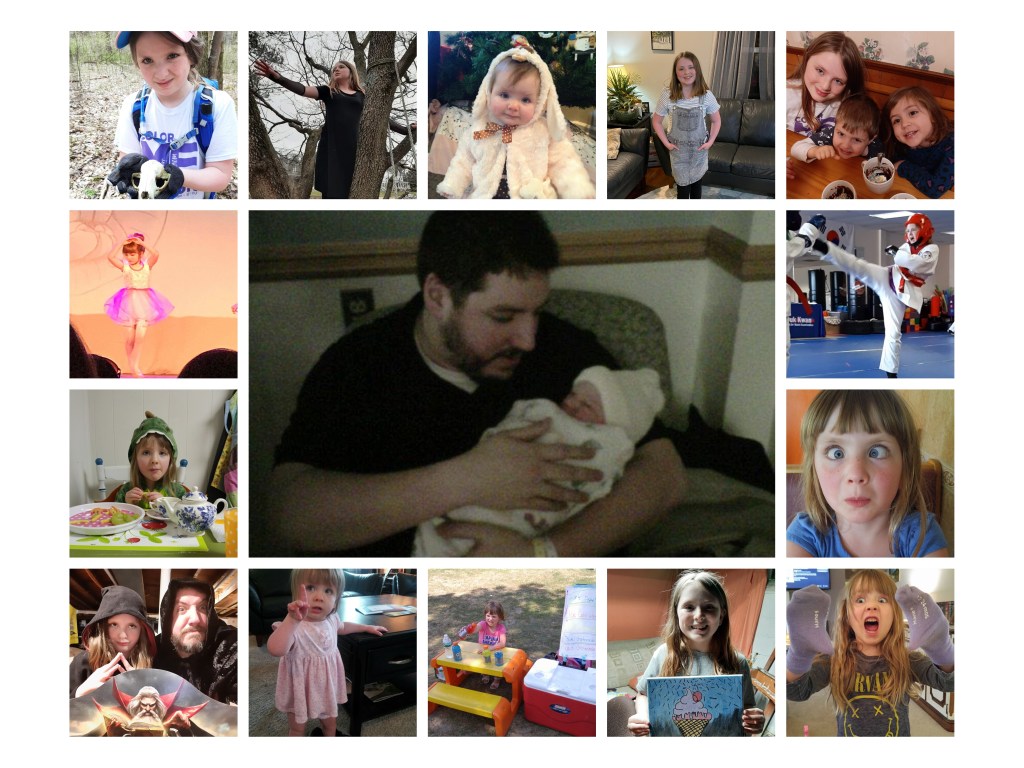
Today, I have been a father for ten years.

My oldest, my first, the perfect gift that changed my life in a way nothing else ever could was born on this day ten years ago. I have spent the last decade attempting to live up to that monumental responsibility.

I look at her today, and I feel as though I’ve done a very good job. She’s amazing. She’s kind, noble, and heroic. She’s honest and caring. She’s a warrior, an artist, a scientist. One of my fears as a parent was always that I would push my children so hard that they’d become bitter or stressed, and when I see all the things my daughter does – her excellent grades, her many extracurricular activities, all her hobbies – that fear increases. But today, I asked her what the biggest takeaway from her first ten years on this planet was. This is what she said:

“Spend a lot of time with your family, and relax and enjoy life.”

So you know, I think she’s managing just fine. She already has more than enough personality, talent, and heart to handle all that she’s doing and all that she’ll do. I couldn’t be prouder; she exceeded my every expectation. Happy Birthday!