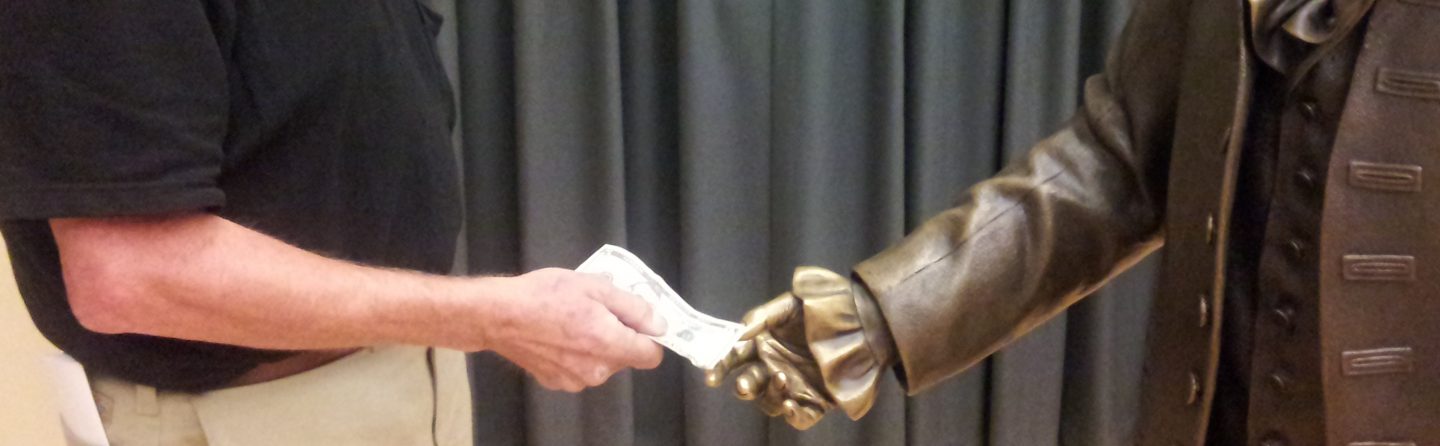
The Mountain You Make It

You will, in your life, worry about a shocking number of things you can’t fail at.

Your internal struggle is real, but it’s very separate from external reality. You may be afraid to try a new restaurant, break off a bad relationship, or send an email to a potential client, but you can’t actually fail to do those things. It’s only a mountain if you make it one.

Don’t try to not be afraid. Let yourself be afraid, let yourself be nervous, let anxiety blanket you like freshly fallen snow. And then just do it anyway, because those things don’t physically stop you.

Trade Skills

There are things you do because they are ends, and there are things you do because they are means. Don’t confuse them.

When you’re “paying your dues,” remember that you’re doing that for a reason. It’s not because you like paying dues. It’s because you’re getting something back.

The trap closes around you because there’s a certain kind of mindset that you need to adopt in order to pay dues effectively. If you’re interning at a company and you want to maximize the experience, you need to adopt a sort of “intern mindset” full of cheerfulness, eagerness, and almost sycophantic obsequiousness. If you attend to your intern duties begrudgingly, you won’t get anywhere near the full value – that of skills, certainly, but also network, lessons, etc.

The way the trap closes is you get so used to that mindset that you forget when it’s time to shed it. You don’t realize when you’ve crossed over into someone who needs to pay dues and become someone who needs to be paid them. Someone who can advocate their own unique value.

You’re trading something when you do those things. Don’t forget the other half of the trade.

One Road Leads to Rome

It’s far easier to observe bias in other people than in ourselves. Remember, only other people have accents, right? Your point of view is the “normal” one, and everyone else deviates from it somehow, obviously. We see other people as “extreme” or “fringe,” as if we were standing in the middle of some big circle that actually has edges.

Now look, the Overton Window is real and all, but you’re not in the dead center of the opening. And when you observe someone else and decide that they’re “radical,” always keep in mind that your primary basis for that opinion is how they interact with you.

If someone is very stand-offish in every interaction you have with them, you might think, “gee, that person is a big jerk.” But it could be that they just don’t like you. And maybe they don’t like you because you’re a big jerk. If the only road from your hometown goes to Rome, it’s easy to say “all roads lead to Rome.” But that’s way more of a function of you than of the international highway system.

This is really, really hard to internalize. We don’t see ourselves in the third person while simultaneously holding the greater world in our minds. We have our base frame of reference and we rely on it to operate.

But stick your head up, now and then. Especially when you’re forming an opinion of someone else. What you think is an objective observation of that person’s relationship to normalcy is actually their subjective relationship to you.

Learn Your Lessen

I’m a fan of reducing external dependence. If some part of your happiness is dependent on an external factor, then some part of your happiness will always be outside of your control. No man is an island and we’re social creatures, so I’m not advocating isolationism or even true minimalism (unless that works for you!).

What I’m advocating is… less-ism.

People often try to completely eliminate an external dependence, but all they do is create pent-up demand. People do things like “Dry January” and then go on a full-on bender on February 1st. That’s not helping anything; it might even be worsening your dependence.

Arbitrarily limiting something only to pine after it every day and then over-indulge the second the waiting period is over isn’t claiming control over your life. It’s just playing silly games.

Try, instead, to lessen. To reduce the amount of an external thing you engage with, in exchange for an equal or greater amount of inner work. You don’t have to stop watching television cold turkey, but get rid of one show and replace it with a thoughtful walk. You don’t have to stop drinking entirely, but replace Sunday drinks with Sunday phone calls to loved ones.

There are things in your heart that can make you happy, but they’re buried under many distractions. If you try to force it away all at once, you simply replace it with longing for that thing. I advocate trying to go without, but only thoughtfully – because you truly want the distance and to respect the thing. Not because you’re trying to prove something to someone else and then go right back even harder.

Take a breath, and do a little less.

The Mistake Formula

The emotional and social impact on you from your mistakes is a constant. It is divided out over the total number of mistakes that are publicly visible.

In other words, you’re going to be embarrassed by a mistake sometimes. You will be embarrassed more if mistakes are rare. So, just make a bunch of them.

You already do! But you hide them more than you have to. You cover for them. You excuse them. You avoid them or deny them. What you should do is plaster them all over town.

Assuming your mistakes were made during a good-faith effort to do good work, the witch hunt you’re expecting generally never manifests. And as I often tell my children, the worst impact of a mistake is the erosion of trust that comes from trying to cover it up.

So don’t. Put your mistakes front and center. Make them the first thing you show. People will wonder what you could possibly be working on that even gives you the opportunity to make so many; after all, it’s easy to make no mistakes if you do nothing at all. Let people be surprised and delighted when they find all the good you do. Because you do, and they will.

Hatch

Oh how they scamper and run, chasing those little eggs. The prizes inside are immaterial to their joy – they want the chase, the arms full of accomplishment, the rush of spotting a new target.

We have joy long before we decide we need to attach things to it. Things that weigh the balloons down and drag our attention away from the impulse, the joyousness in our hearts.

Don’t rush to hatch, and don’t be eager to pluck the shells away from others. Let that joy incubate a little longer, and grab a little for yourself – armloads.

Smile & Nod

Once you become attuned to the little conversational traps people lay for each other, it becomes hard not to see them everywhere. A lot of what I think about is how to avoid them because avoiding them makes me much happier. Learning to avoid them will make you happier, too.

Arguments are traps. They’re virtually never worth it – especially when you’ve already won them! This is a (slightly modified) version of a scenario I recently witnessed:

Customer: “I’d like to use this coupon to get a discount on this item I’m buying.”

Cashier: “This coupon is expired. I’ll go ahead and ring in the discount anyway, but next time make sure to double-check the expiration date on the coupon.”

Customer: “I don’t see why coupons even have expiration dates, and I don’t think I should have to check them, you should just always honor coupons even when blah blah blah blah blah…”

The cashier and the customer both made a mistake here. The cashier, perhaps unintentionally, laid a trap. The customer fell into it.

If everyone knew how to be maximally happy, here’s how this conversation would have gone:

Customer: “I’d like to use this coupon to get a discount on this item I’m buying.”

Cashier: “Okay! You’re all set, have a great day.”

Done.

Why didn’t it happen that way? Because people often make the mistake of opening their mounts before checking the words they’re about to say against the all-important metric. Have you ever heard “If you don’t have anything nice to say, don’t say anything?” Yeah, let me modify that one for you and give you a rule that will radically transform your happiness if you follow it:

“If what you’re about to say won’t get you anything you want, don’t say it.”

If that cashier had thought for three extra seconds, she’d have realized: “I’m going to give this discount anyway, I’m not responsible for this customer’s future behavior, she won’t listen to me regardless, and therefore there’s no reason for me to say anything about the expiration dates.” And even though the cashier said what she did, the customer should have realized: “I’m getting what I want anyway, and this cashier has no power to affect coupon policy as a whole, and arguing with her is worse than pointless, it’s actually wasteful.”

I suspect that humans are wired for this because once upon a time, we interacted with the same hundred people exclusively our entire lives. So there was some benefit to jockeying for status and position even in mundane interactions. But that’s not the case anymore – most people you try to score a few points off will never enter your life again. So if, in the one brief interaction you’ll ever have with a particular person, you got what you wanted? Smile and nod, and enjoy your life.

The Horse

Have you ever heard the phrase “Get back on the horse?”

It means to resume a productive activity after a setback or long absence. If you’ve flagged in your workout regimen, then you need to “get back on the horse.” If you lose a competition, you need to “get back on the horse” and try again.

I like the phrase. I like the imagery, but I like something else about it even more. I love the hidden extra insight.

“The Horse” is whatever system of skills and motivations you’ve conjured to be able to perform a specific task. Like a horse, there will be times that you need it more than others; it’s possible to go a long time without needing to be on your horse. But whether you ride the horse daily or not, you need to feed it daily. A horse isn’t something you can put away in a garage for a few years and then pull out when you need it. A horse will die if not cared for.

Sometimes you need to take the horse out for a ride not because you need to go somewhere, but because the horse needs the exercise so that it’s healthy and ready for you when you do need it. Often people stray from an important task for a long time and discover when urgency strikes and it’s time to “get back on the horse,” that the horse is dead.

Together Different Ways

“Don’t reinvent the wheel” is very good advice. You have already done most of the things you’ll ever want to do, just in a different combination.

Everything you do is a specific ordering of certain core components: the things you write, the way you interact with people, the sweat of your brow and the chime of your heart. You may only have thirty or forty “core components” like this – but that comes together into tens of thousands of different recipes you can make.

The upshot of this is: you don’t have to figure out how to do anything. You just have to figure out how you did it. Because you already have. Don’t reinvent the wheel – just scrap the last car you built and put the parts together different ways.

Velcro Personality

If you take a piece of Velcro and try to stick it to something like glass, it won’t work. It’s hard to climb a perfectly smooth surface; much easier to climb something that’s a little rough. The rougher the better, in fact.

You want a smooth surface when you’re going for speed. A smooth road is easier to pass over quickly than a rough one. There are fewer things to get caught on.

Now, consider your personality: are you trying to make it easy to pass over you quickly, or easy to interact with and get stuck on?

People often work very hard to be “unobjectionable.” The thing is, you can be very agreeable, pleasant, and kind while being unusual, weird, and even “objectionable.” You can voice strange opinions with kindness. You can step out of line without punching. You can even object while offering solutions.

And you should! While I’ll happily be the first person who will tell you that you shouldn’t be afraid of making a few people upset, that isn’t even really the core concept here. The core concept is that even if you care very deeply about what other people think, this is the best approach. Because if you’re so smooth you don’t have any handholds at all, then what other people will think of you is nothing.