
There’s nothing wrong with finding more efficient ways of doing things. If a step can be skipped without damaging the end result, skip it! We’re often obsessed with the traditional pathways to specific accomplishments, but there’s another word for “traditional pathway” – rut.
Author: Johnny Roccia
Spirit
You will not win every competition, whether against your past self or against present others. You will not always succeed. You will not always run the fastest, jump the highest, punch the hardest.
But you can scream the loudest. You can lose, honorably, for a million reasons. You can only lose dishonorably for one: you did not try with every ounce of you.
Let them point to my failures, and my head will stay high. Let my works crumble, and I will build new ones. Let them point to a broken man at the end of his days, with nothing – and I will still breathe until my last noble breath. But let them never say, “there goes a man who gave up before the very last.”
You can break everything but my spirit, and it will not matter. Spirit is the seed; all else is merely fruit.
Clean Up After Yourself
I want to help.
I want to help you, specifically. The person reading these words right now. If you reached out to me and asked me to help you solve a problem, I very likely would. (That’s different from asking me for advice, by the way, which I’m generally more reluctant to do.)
But direct help? A clear ask, with something I can contribute? I live for that, generally. I love helping.
But I really, really need to do it less. And so do you.
“Doing” is very rarely “teaching.” As a parent, as a manager, as anything – we fall into this trap where we think “I’ll do it for them this time, but during that I’ll show them how so that they can do it for themselves next time.” But that is almost never what happens. Instead, what you’ve taught is that you are the solution to this particular problem, and that’s the solution they’ll lean on next time.
If you want to both “help” and “teach” at the same time, here’s how: become a robot. Create no input, just obey orders and be a second set of hands. Let the other person provide all direction. Only answer direct questions, don’t offer more. Be there to catch.
They have to figure it out. You’re just a combination forklift and search engine. They’re the brains of the operation.
Do that once, and they probably won’t need you again.
In the interest of opening up a little… that last part is probably why so few people, including myself, do things this way. To teach well is to lessen others’ reliance on you. To make yourself a little less needed each time. And that’s what you should be doing (especially with kids), because not only do you make them better but you also replace a relationship based on dependence with one based on respect and love and far deeper bonds. But if you, like me, find yourself often valuing yourself based only on what you can do for others, then it can be hard to deliberately push that away.
When I was a young man in my late teens, I found myself (as young men of that age often do) in a bit of a pickle – a difficult situation, the exact details of which are not relevant here. I managed to resolve it myself, and only after that did my father learn about the whole thing. He was initially shocked and appalled that I hadn’t come to him when I had the problem; I generally did. He said, “Why didn’t you just tell me? I could have taken care of this in a day. You know I have superpowers.”
But really, that had been my entire motivation for resolving it myself. I knew he was so savvy, strong, competent that he could practically snap his fingers and it would have been over. But I told him: “If I never figure it out on my own, how do I get my own superpowers?”
We hugged. It was a good day. And, truth be told, it didn’t make me need him one iota less.
Lilacs
Imagine a little path through a local wooded area. It’s not an official park or anything, and it doesn’t belong to anyone – just those little sections of woodland that you can find hidden tucked in corners between more civilized areas. This path in particular gets traveled with some frequency as people use it as a shortcut or a convenient dog-walking path, things like that.
One person likes to walk this path frequently. This person also has a reasonable amount of spare time, and loves lilacs. As a result of these things, they plant a bunch of lilacs along the path. They have no way to control whether others will care for them or vandalize them, but they enjoy the act of planting alone enough to make that not matter. Soon, there are lilacs in bloom in a few places along the path.
Someone else may strongly dislike lilacs. They have a particular fragrance that some may find very disagreeable! Or they may not like the color, or maybe even they’re allergic. As a result, that person doesn’t want to walk along that path anymore. The opposite may be true for other someone else – maybe another person really loves lilacs, and is drawn to the path because they spot them from the road, whereas otherwise they wouldn’t have wandered in.
Changes to the environment of any kind push some people away from that environment, and draw others in. This is unavoidable, and I’m not sure it should count as a problem. Or at least, there should be some well-understood parameters around when it is or isn’t.
I’m thinking about this at all because topics like inclusiveness are important. There are a lot of people who have been traditionally excluded from a lot of important spaces in deliberate and unkind (to say the least) ways. When whole sectors of society and culture – important ones, like banking, employment, real estate, governmental representation – are walled off from whole demographics for no reason other than the demographic itself, that’s clearly a problem. And if we have become zealous in our attempts to remove these barriers, huzzah! But we should still make sure we aren’t being over-zealous to the point where the efforts make no sense.
Imagine a little restaurant in the village of the Sneeches. If the restaurant has a sign up that says “Star-Belly Sneeches are NOT ALLOWED,” then we have a problem. Especially if many, most or all other restaurants are following suit! But if the proprietors of that restaurant have no such sign, and in fact Star-Belly Sneeches are welcome any time and there’s no animosity towards them at all, then it’s not a problem – even if the restaurant doesn’t actually sell any food that Star-Belly Sneeches want. Not every space and experience has to be for everyone. The restaurant owners would be wrong to deliberately exclude Star-Belly Sneeches. But they’re under no obligation (and in fact it would be silly) to alter their menu until they had a relatively even mix of both kinds of Sneeches.
So, this is nuanced and thorny. How can we tell if we’re looking at problematic exclusion or just the natural result of harmless environmental preferences? While there will always be situation-dependent details, I think we can safely start with some broad questions to at least get us close.
- Is the environment that we’re talking about something “essential” to operation in the broader society? There’s a big difference between a wooded path and, say, the higher education system. There’s no clear, bright line between one and the other, but certainly it’s a reasonable thing to ask as a starting point.
- Regardless of the environment, is the exclusion happening deliberately and directly? Even something as simple as a wooded path is not immune from the immorality of saying “NO IRISH.” If you’re going out of your way to exclude people because of who they are, and not as a side effect of normal influence on the environment, then it’s a problem no matter what.
- Definitely a rider on #2 – is the exclusion de facto deliberate, even if you’re pretending it’s not? Let’s go back to the Sneeches example. Let’s say that the restaurant by policy welcomes the Star-Belly Sneeches. But the owners also put up a lot of traditionally anti-SBS art or logos, dogwhistles that everyone recognizes as such. Those things don’t serve any purpose except to chase away the Star-Belly Sneeches, and so we’re back to immoral actions.
Number 3 is the trickiest, because it’s the most subject to interpretation, and intent absolutely matters. Reasonable people can disagree about what an “anti-SBS” piece of art might be. It might be art that Star-Belly Sneeches really hate, but other Sneeches genuinely love for innocent reasons unrelated to the opinions of the Star-Belly Sneeches. If that’s the case, we’re back on the Lilac Path – it’s something that some people may wish was different, but so what? You can be welcome somewhere without wanting to go there, and the people who are (genuinely) welcoming you are under no obligation to try harder to make you want to.
I keep my house very, very cold. I hate the heat, so my AC is cranked all the time. Some of my friends don’t like that, and complain about it when they visit! They joke about bringing blankets or sweaters (or they actually do). But I didn’t turn up my AC in order to repel or exclude them. I want them to come! My AC is cranked because I like it.
But you know what? I’ll make it milder when they visit.
Which brings me to the last and most vital point. In most cases, no one is obligated to encourage everyone into shared, non-essential spaces, only to allow it if desired. But if you do encourage it, that is morally praiseworthy. Going above and beyond “allowing” and truly reaching out, inviting, and even changing things you otherwise wouldn’t want to change in order to make your fellow humans – star on their bellies or not – want to be in that space?
Well, that makes you the best on the beaches.
The Permanent Transition
I don’t want to die. But we’ll circle back to that.
Everything you do in life must serve two purposes. First, it must serve your life in this moment. It must create joy, or purpose, or wellbeing for you during its duration. Second, it must serve the future things you want to do. It must lead in a direction you want to go, clearing obstacles and guiding you along a proper path.
It is fine to trade off between those two, balancing one against the other. But all things must have at least a non-negative value in both, or you are damaging your own life.
This guideline applies to all things, great and small. The scope matches scope, but the principle is the same.
Imagine a small decision: your next meal. Perhaps inconsequential as a single decision, it still becomes part of the weave of habits that create your pattern – your existence. That meal must both improve your wellbeing now, and serve your forward progress. In order to maximize the first value, you’d probably spend an enormous amount of money on a truly opulent and very likely unhealthy meal. In order to maximize the second value, you’d probably extremely carefully measure and plan every calorie for maximum nutritional value against money spent. You can’t maximize both, but you can find a comfortable balance, a Pareto-optimal solution.
What you should not do, however, is eat something truly disgusting that you will hate, just because it serves the longer term. The values should not be negative. You are serving a future life, but you are also living a present one. You are always moving from one to the other, and both sides of a bridge must be secure in order for the bridge to function.
Larger decisions, those with broader scope or more impact, work the same way. You must choose a place (or places!) to live. Choose a place that does not make you miserable now, but also not one that destroys your future by draining your investments. Neither value should be negative. It’s fine to be frugal now in exchange for more later, and it’s fine to expend a little more now in exchange for a more frugal retirement – but never to the extreme of reducing one or the other to ruin. Don’t live in a cardboard box just to save more for retirement, and don’t mortgage your entire future for the penthouse that’s above your means.
Choose jobs that both don’t make you miserable now, and create resources (not just money!) for you to use in the future – resources like skills, networks, portfolios.
Choose friends and partners that are fun to be with now, and who have the values that will make them durable in your life.
When we get burned by something or regret a decision, we often swing the maximum way to the other side, when in actuality we should adjust by perhaps 5% (or even perhaps not at all). So if we make a friend that’s a ton of fun and makes every day an adventure but who then recklessly harms us in some way before vanishing, we may think “It’s foolish to value the present when choosing friends; I should only be friends with the most boring, tiresome and even frustrating people as long as I think they’ll be reliable companions and allies in the future.” Or maybe you spent a long time being overly frugal, saving for your retirement but avoiding living your life, and suddenly you have a personal crisis and decide “The future is uncertain! I should spend it all now while my heart still beats!” Both of these are overreactions – the proper response to the harm of one extreme is not the other extreme. It’s the balance.
You are always two people (at least). But really, that’s incorrect – because those two people are not distinct. The proper way to view it is that you are always the transition between two people. You are always in transition between the person you are and the person you will be. You are never fully one or the other. It’s a permanent transition – you live on that bridge, one way or another, and so you must know that both sides remain secure.
There is only one moment when the transition ceases, when your existence becomes static. One final time when you fully get to the other side of the bridge. I am in no rush to die, but even when I do, I hope to stay by these principles. I hope to have a death that does not make me fearful, miserable, or lonely. And I hope that in some way it serves a future that I want – one where my children live better lives in a better world.
Interesting Confusion
Like every human being on Earth, I am not immune to bias. Despite putting a lot of effort into recognizing mental tricks, logical fallacies, and decision-making noise, I am perhaps 10% better than the average person at reducing the impact of those things on my decisions.
And that’s pretty good! Honestly, if we all got 10% better at making decisions the compound effect would probably make the world unrecognizable. So I’m not complaining!
But I always look for novel ways to trick my brain into freeing itself from all the chains that bind our thinking. And one interesting way I’ve discovered is to put myself in situations where I don’t know enough to be biased.
You see, if I know anything about a topic, then I probably have at least some opinion on it. I recognize that my opinions could be wrong, but it’s still a base point that my thinking will emerge from. Likewise, if I already have a positive impression of a person’s intelligence overall, I’m likely to weight the things they say with more belief than if I heard them from someone who I thought wasn’t very smart.
(To a certain degree the intelligence of the speaker is a rational thing to use as one piece of evidence towards a statement’s truth, but it shouldn’t be the only thing and you should be very careful about it – most people aren’t “generally smart,” they’re knowledgeable in specific areas. Einstein actually said a lot of dumb, definitely wrong things about topics that weren’t physics, but because he’s the universal avatar of “smart people” in most folks’ imaginations, they take everything he said as gospel. Don’t do that!)
So what I’ve done lately is just find interesting-seeming writing written by people who I don’t know anything about, on topics I don’t know anything about, just to start puzzling through it and see what I can absorb. I can’t tell if I’m reading utter nonsense or the next great work of genius that will define our time. I don’t know if I’m standing in the presence of a true master or entertaining a crackpot. It doesn’t matter! In any case, I learn something.
The fun of this is that I have no “skin in the game,” no preconceived notions about any factor, and no agenda for my learning. So bias is pretty much at a minimum, at least in as much as it can be with our particular kinds of brains. I am often confused, in a fun way. My ego is in zero danger, so while I can get confused, I never get frustrated.
This is good practice for learning. Try it, and then remember what it feels like. Then when you find yourself doing something else that looks like learning and should be learning, see if it feels the same. Do you feel confused but interested, psychologically safe and curious, mind changing and possibilities swirling? Or are you nodding along, saying “uh huh, that’s what I always thought” and feeling righteous?
Because that second one? That’s not learning.
Day of the Dads
My day started with a pile of children attacking me with kisses, and it ended with that almost mythical occurrence: my children actually falling asleep as I read them fairy tales.
We are surrounded by magic, if we stop and look. Happy Father’s Day, everyone.
Otherwise
There’s a little mental game I like to play when I find myself forming an opinion, making a big decision, or investing intellectually in a particular belief. I like to ask myself: “what would make me believe otherwise?”
If I can’t think of what would make me change my mind, then I back off from formalizing the decision. I’m not ready. I’m being emotional, irrational, and biased. It’s one thing to say, “I have this opinion because I believe it’s true,” but it’s quite another to say “here is the specific evidence I would need to believe the opposite.” Most of the time, we’re not prepared to do that.
Fair Thee Well
[I know it’s “fare thee well.” It’s a gimmicky pun.]
I’ve noticed that most people are way more concerned about being treated fairly than they are with being treated well – or with just having a good life in general.
Furthermore, this mentality often seems coupled with a dire short-sightedness. People who are extremely concerned with “fairness” tend to only look at the fairness in a single encounter or exchange, even if that means huge sacrifices in potential upside elsewhere.
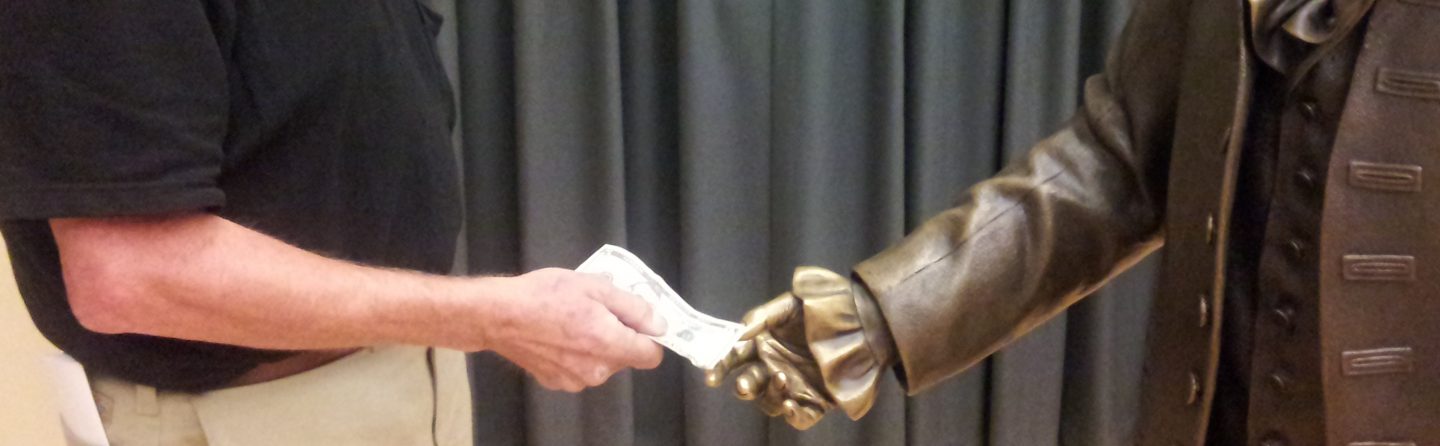
For instance, imagine you’re a shopkeeper, and a semi-regular customer is a dollar short on his $21-dollar purchase. You’re within your rights, of course, to refuse the sale and/or demand the extra buck. But doing so, while focusing on fairness, may easily lead to a marked decrease in that customer’s loyalty or desire to do business with you. You could lose a customer entirely, plus maybe others who witnessed the exchange or hear about it later. Meanwhile, spotting that guy the dollar could be a cheap way to buy a lifetime customer (who may even just hand you back the extra dollar the next time he sees you, as often happens).
That doesn’t mean there aren’t a thousand possible exceptions or counter-reasons in the above scenario; as in most things, context matters here. But it’s a demonstration of how caring about getting a “fair deal” can actually mean you get a very bad deal.
The You That You Want to Be
Somewhere out there is a version of you that is just waiting for you to become it. That version is happier, more successful, more fulfilled, healthier.
Many people envision this, but they think that the pathway to that version of themselves is full of secret twists and turns, and if they just discover what they are, they’ll be able to become this happier, successful, fulfilled and healthier version of themselves.
The pathway is more obvious. In order to get to that person, you have to become happier, more successful, more fulfilled, and healthier. When you’ve done that enough, you’ll be them.
And that person has still another version of themselves that they want to be.
You live and die every day. There are no moments you get to keep, no plateaus to conquer and hold. This is one of those truths where you can either fight it and be miserable your whole life, or you can embrace it and already be halfway to the version you want to be. But you can’t change it. Life only stops exactly once.

