Blog

What It Takes

A list of things you need to do in order to complete a task is not a list of reasons not to attempt that task.

That really could be the whole blog post, but I’ll elaborate. Often when a rewarding task or cool project idea presents itself (either because you’ve thought of it or because an outside source has suggested it), people will immediately start listing the reasons it would he hard as reasons not to do it. But all tasks have steps requiring effort! That’s just what it takes.

“I can’t move to a new city, because I’d have to research places to live, find a new job in the new location, pack my stuff, figure out transportation…”

Yeah? I mean, of course? You have to do all that stuff, but… you certainly can.

Here’s how to make your life way, way better. Every single time you find yourself saying the following sentence:

“I can’t do [X], because that requires [Y],” just change it to “I want to do [X], so it’s time to get started on [Y].”

“I want to move to a new city, so it’s time to get started on researching places to life, finding a new job there, packing my stuff, and figuring out transportation!”

That’s just what it takes.

Backup Planning Ahead

Most plans, at some point, involve at least a little bit of waiting. If you’re building a house, there are times where materials are being delivered and will take some time to arrive. If you’ve interviewed for a new job, there’s time spent waiting for feedback. And so on.

What most people do during that time is wait. But if the plan is for something important, that’s a terrible idea. What you should do is immediately move onto Plan B.

This is true even if you have absolutely no reason to think Plan A will fail! If the project is important, then mitigate the effects of random acts of chance as much as possible. Let’s say you’ve ordered some building materials for a construction project with a tight deadline. You have no reason to believe that they’ll be late, and you should be fine. Even so, if you’d otherwise just be spending the time waiting “on pause” for them to arrive, you should instead start figuring out how you’ll continue the project without those materials arriving promptly.

At worst, you train yourself to respond to future emergencies, even if this one doesn’t manifest. At best, you actually find that your Plan B looks better than your original course of action and you’ve found a new and better way to do things. And somewhere in the middle, you may prevent an unexpected disaster.

This doesn’t have to apply to everything. If you’re baking banana bread, it’s fine to just wait while it bakes. If it turns out bad, it probably wasn’t a disaster worth stressing over, so it’s fine to just read a book or something. But I’m always shocked when I see people who just “wait and see” when it’s a major endeavor. You can have delivered the best interview of your life and you’re certain you’re going to get an offer – even so, if you’re looking for your next career move you don’t leave it up to chance.

When it’s a big deal, use all your resources – and one of the most precious ones you have is the time you’d spend waiting.

Unhelpful

There’s a concept that I talk about fairly frequently, and I was certain I’d written about it before. But I couldn’t find exactly the essay on the subject; it turns out I have indeed written about it more than once, but I haven’t actually defined it in its own essay, so here we are.

The subject is the difference between information that is True/Untrue versus information that is Helpful/Unhelpful, and the intersection of the two.

Plenty of information can be true or untrue, though for these purposes we’re even considering matters of opinion as “true” or “untrue” within your personal frame of reference. So for instance, if you believe that people should just naturally not commit crime, then that belief is “true” to you.

Information that gets you closer to what you want is “helpful.” Information that doesn’t, or that pushes you away from what you want, or that hinders your ability to get it – all of that information is unhelpful.

Consider those two axes intersecting to form a grid, consisting of 4 squares. So we have four categories – “True & Helpful,” “True & Unhelpful,” “Untrue & Helpful,” and “Untrue & Unhelpful.”

What I want to address here is a huge, important obstacle that most people just can’t seem to get around when they’re trying to solve a particular problem: they focus on what’s true, rather than what’s helpful.

Let’s say you’re about to walk through a rough neighborhood at night, on your way to an evening out. You have valuable-looking clothes and jewelry on because you’re dressed up. You have on good-looking but not-very-practical shoes. A friend suggests that you may be an inviting target for mugging, and perhaps you should take precautions.

Okay, we’ve identified a goal: you want to have a pleasant night out. For the purposes of defining information as “helpful” or “unhelpful,” this is what we’re trying to get to.

And we’ve identified a problem: you may be vulnerable to crime in an above-average way.

What follows now are common conversational threads that fall into the four categories we identified, above.

I’m not going to do anything different! People just shouldn’t mug or rob other people.” I agree! They shouldn’t! So this information is true, but is it helpful? Does this belief and the actions it creates further our goal of an unmolested night out? Probably not – so it’s true, but not helpful.

“Oh gee, so if I go out I’m definitely going to get robbed. I won’t go out at all, I guess.” Not helpful, obviously – you won’t even attempt to go out with that attitude, so it isn’t getting you closer to your goal. Of course, it’s also not true! You’re certainly not guaranteed to be robbed, it’s just a danger that needs to be addressed. So this is both untrue, and unhelpful.

“Well, if I take a cab instead of walking, I’m definitely safe!” This actually isn’t true, but it is helpful! There are plenty of dangers getting into a vehicle, period. But they’re minimal to begin with and you shouldn’t let that stop you from living your life, so in this case the belief gets you closer to your goal of a fun night out. Even though you’ve actually underestimated your risk some, that underestimated risk is closer in alignment to what your risk preferences should be anyway.

“If I stay with a group and stick to well-lit areas, I’m much safer than walking alone, and I can still go out and have fun. Want to come with me?” True and helpful! This belief gets you closer to your goal and happens to be based in reality.

Clearly, “True & Helpful” is the best category of thought regarding a problem. But here’s the takeaway: “Untrue & Helpful” is a WAY better category than “True & Unhelpful!”

Don’t get hung up on the way things should be in an ideal world. This isn’t an ideal world – it’s the one we have. Recognizing that and acting accordingly is the most helpful advice I can give.

My Pain, Your Pain

People just love to compare misfortune. People have lots of different reasons, and it’s worth looking at why just about all of them are bad ideas.

Some people like to compare their pain to someone else’s in order to claim a higher level of sympathy. “Oh, you broke your leg? Well, I broke BOTH legs, so give me more sympathy/attention/love/help/whatever.” This is, well, pretty obviously bad.

Some folks want to compare misfortune because they want to give themselves an elevated social status as a result of their reaction. “Oh, you broke your leg? I broke both legs, and you never heard me complain or ask for help. I guess that makes me better than you.” It was painful even to type that sentence ironically.

Then you have the other side of the spectrum – people who compare their pain to other people’s in order to devalue their own experience. “I know I lost both legs in that car accident, but there are people who lost both legs AND an arm, so I shouldn’t complain or I might be seen as dismissive of their pain and suffering.” At least this one is coming from a more altruistic place, but it’s still incorrect.

Look, here’s the reality. Everyone is going to endure some pain. Some people are, even in the most objective sense, going to go through rougher seas than others. But your pain isn’t relative to other people’s, it’s relative to your own life and circumstances.

Let me give you an extreme example: two people get into a car accident, and both of them lose their left hand. On the surface, this is the same thing – but if one of those people was a left-handed brain surgeon and the other one was a right-handed voice actor, their pain might not be the same! I actually experienced a real-life version of this when I worked in prosthetics. Two patients in the same month had almost the exact same injury, resulting in the loss of several fingers on one hand. For the first patient, he told me that the only real difference in his life was he changed how he made his coffee and bought sweatpants instead of jeans. The other patient was a violinist.

All this is to say that pain, suffering, loss and misfortune aren’t objective things. Not only could the exact same event be different levels of bad for different people, it might not even be bad for some folks! So trying to compare your roll of the dice to anyone else’s is a fool’s game to begin with. You can’t compare rotten apples to rotten oranges.

But on an even deeper level, even if there was some objective measure, it wouldn’t help you. Let’s say you could concretely determine that yes, you had in fact endured more “suffering points” than another person. This would fall into the category of information that’s “true, but not helpful.” Would knowing this help you lessen your pain? Solve your problems? Improve your circumstances?

Nope.

Pain, in addition to being non-relative, is not zero-sum. The same is true of sympathy. There’s plenty to go around of both.

Be understanding of others. Be focused on yourself.

Don’t Justify

Lots of people spend a lot of time justifying things they don’t have to. Don’t let people tell you otherwise. If you don’t want a drink, you don’t want to go out, you like a weird movie – so what? You’re allowed to do that. If you get into the habit of explaining every decision, you’ll feel like every decision has to be explained.

Some things just are, and you can let them be.

Successful How?

I’ve often heard people in business say, “X was very successful.” Often they seem to be using “successful” as shorthand for “made me feel good,” or maybe “sort of looked like a successful thing would look,” or at least “sort of made me look like I had done a successful thing.”

Actual success has to have a metric attached. One thing is true of all real success: you can measure it.

“Successful” doesn’t just mean “shiny.” It means that you accomplished something, ideally something you set out to accomplish (although unexpected successes are sometimes acceptable). That’s because all endeavors cost juice, and you were attempting to buy something with that expenditure. Either you did or you didn’t.

First ask – why would you care about this thing in the first place? Because you had a problem, and you wanted to address it. Okay, after you addressed it – did the problem improve? A shocking number of people can’t answer that. Make sure you’re not one of them.

Snakebite Theory

Snake venom in your heart will kill you. But here’s the thing – a snake doesn’t have to bite you in the heart. It can bite you in the heel, the fingertip. It’s all connected; the venom will get to your heart sooner or later.

All security is external security. There are a lot of things keeping bad stuff out of my body, but almost nothing keeping bad stuff from getting from one part of my circulatory system to another. Once you’re in, you’re in. And my heart is better guarded than my heel – so if a snake really wanted to kill me, it would actually be better off trying to avoid my heart and going for an easier target!

All organizations of people are like this. Within that organization is a particular person you want to talk to, but like the heart, that person may be well-guarded and far away. The organization as a whole may have some features that screen or repel outsiders, but they’ll be weakest at the fringes. But once you’re in, you’re in.

A long time ago, I was in medical device sales. There was a particular doctor who was a very high-ranking person in the largest hospital system in my territory: he was the head of the entire trauma center. That made him (in theory) the single most valuable person in the region for people like me; his signature on a contract would be worth millions of dollars. But predictably, he never met with sales reps. He had tons of systems in place to protect him from them, and no one ever got through the walls of friendly-but-firm administrators, screened calls, and blocked emails. He was the heart.

So I didn’t go for the heart. I found the incredibly overworked, understaffed physical therapy department. The head of that department literally worked in a closet. He was easy to see – I brought a sandwich and I was his best friend for life. In a technical sense, he was worth zero dollars to my company: he couldn’t authorize any purchases. But I offered to put on an educational seminar for his staff that would give them some of the continuing education credits they all needed to stay certified, and I’d even cater it too. The only thing I asked in return was the ability to drop his name later, and he obviously agreed.

So now I go back to the head of the trauma center, but not as a sales rep. I just sent an email saying something super short, like “Hi, I’m the guy running the education seminar for the PTs on how to best support patients coming out of the trauma center. Wanted to know if I could get your input on topics to focus on.” He responded within 15 minutes, and I had a meeting the next morning.

That meeting turned into a six-million-dollar contract.

Think about that when you’re job hunting, for example. People try so hard to find the exact right department head or hiring manager and pitch them from the outside, but that person is the heart. They’re well-defended, their walls are up. They screen and dismiss. But the person who just works in customer service for the same organization might be thrilled to have a friendly voice ask to chat, and once you have one friend on the inside, it’s easy to ask for introductions, drop names, discover more information, and move around. It’s easy to find the heart from the inside.

Debt of Thanks

Being grateful for something is not the same as being subservient to it. And it’s not “being ungrateful” to refuse to give your life over to the thing for which you’re grateful.

If someone gives you a dollar, you can (and should!) be grateful. But if they then ask you to clean their entire house and you decline, don’t let them sarcastically remark “so much for being thankful for that dollar, huh?!”

If they’d offered to pay you a dollar to clean their entire house, you may have said no. Being grateful doesn’t place you in their debt for life.

And it’s never, ever “ungrateful” to strive to better yourself or your situation. Yes, you should be thankful that you have a roof over your head if you do. Likewise if you have a job, a car, etc. But “being grateful” also doesn’t mean “settling.” You can work to improve without dismissing your existing good fortune.

All this is to say – gratitude is important. But it should never be a cage.

What You Signed Up For

Doctors go where there are sick people, not healthy people. Carpenters don’t look for finished houses with no flaws.

You go where there’s work of a kind you want to do.

So don’t get frustrated when there’s a lot of that work to be done – that’s what you’re there for.

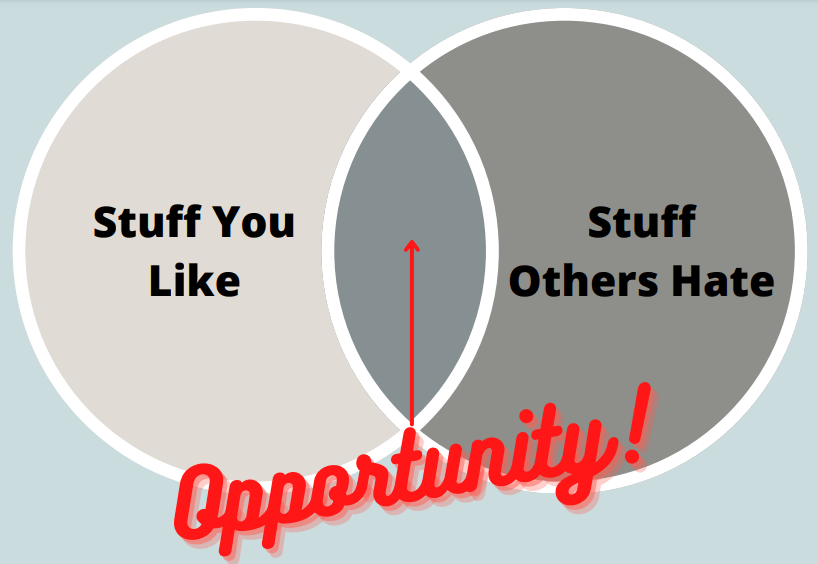
I’ve met folks who didn’t want to join organizations because the organization was bad at X, when X was the thing the person was good at. That’s not a reason to be frustrated – that’s like being a kid in a candy store! It’s opportunity as far as the eye can see.

Sometimes we don’t want to do, we want to have done. But doing is an essential part of getting done. Be happy when you can do a lot all at once – looking for problems is twice as much work as solving them, but only in solving them is the reward found.

Charm

Early, light conversations with new people are often an opportunity to make a great impression, and people often want to leave those conversations feeling as though they’re well-liked by the other party. Here’s an easy little reminder for how to behave in those conversations – use the acronym CHARM.

Care genuinely about the other person and what they have to say. This isn’t a trick or a con – none of this works if you’re just trying to manipulate. If you’re not in a good place to be ready to care about other people’s stories, then don’t focus on meeting new people today.

Hear the other person. Like, hear them. Don’t wait for your turn to talk by coming up with pithy things to say.

Ask questions. If your first response to anything they say is your own opinion on the subject or unsolicited advice, then you’re not going to come across as someone who actually connects with them.

React accordingly. You’re allowed to have facial expressions and emotional reactions! You don’t have to keep a “straight face” during a conversation just to make it look like you’re listening intently. Being able to read another person’s reactions makes it easier to communicate with them.

Meet them where they are. You don’t have to use every conversation as an opportunity to advance your own agenda, talk about your favorite subject, or get someone to give you some benefit. If a person just wants to vent about their sick cat, let them. Show a little empathy, tell them you’re sorry about their pet. If you talk again, you’ll have gained that much more trust. And if you never talk again, you’ll have brightened someone’s life a little.

That’s it. Go talk.