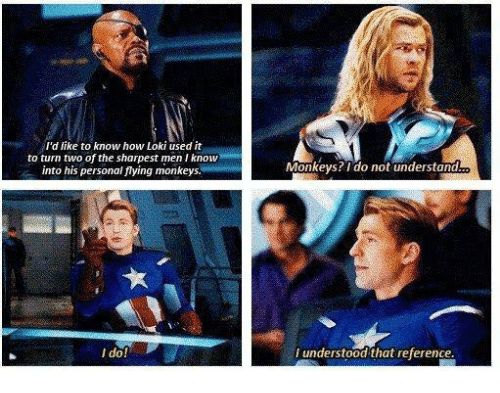
There’s a brilliant episode of Star Trek: The Next Generation called Darmok. The crew of the Enterprise meets a species that they can’t communicate with. The Universal Translator works fine – they can understand the literal words the aliens are saying, but the aliens’ speech is so riddled with cultural references that the crew of the Enterprise are just totally lost, since they have no shared cultural references to rely on.
One of the characters says it would be like referring to a woman as looking like “Juliet on the balcony.” In a culture that has pervasive knowledge of Romeo and Juliet, you’d get what they were saying. But if you didn’t know that reference, you’d be confused even if you understood the words.
And then, in turn, THIS is a reference!
Shared culture does a lot to facilitate communication. It can seem silly, but we constantly make references to our culture when we communicate, and the more of that culture you share with someone else, the better the communication can be. We often scoff and roll our eyes at corporate-style “team building” exercises, but the concept is sound – the execution is just off. Want to do some real team-building? Everyone in the office should watch the same movie.
I worked in an office recently where a lot of my co-workers hadn’t seen the brilliant comedy Office Space. As soon as I realized this, I made everyone watch it, and sure enough, there were references a-plenty afterward. Many of them are just jokes (not that some shared laughter ever hurt a team culture), but sometimes you’d be able to communicate an idea faster or more efficiently by making a reference. It can help someone grok your idea or message.
My favorite thing about this whole phenomenon of shared-culture-as-communication-grease is that the best word I can think of for it is “Darmok.” That word could summarize this whole blog post – if you got the reference.
In order for any endeavor to be successful, someone has to be in charge of it. If you’re doing something by yourself, then it’s easy – it’s you. But what happens when you tackle something as a team?
This isn’t just for work-related projects, either. In literally any activity where 2 or more people have to work together, you’re wildly more likely to be successful if one person has final authority.
You can (and should!) invest that authority with whatever restrictions the team feels is necessary. The person in charge might have conditions under which they’re no longer in charge – like an election or something of that nature. But as long as they are in charge, they need to be the final deciding vote.
Because sometimes, you’re just going to have to break a tie. Sometimes the normal collaboration process is just going to take so long that you need a decision within a particular window and you can’t get it otherwise. Even Steve Jobs and Steve Wozniak hired a third guy when they were first starting out for exactly that reason – you need a tie-breaking vote sometimes in order to get things done.
Of course, Ronald Wayne wasn’t their leader – so you can create a structure for decision-making that doesn’t necessarily require one ultimate person making every decision. But what you do need, is that kind of structure. A setup that tells you exactly who the final decider is under every circumstance.
If you get four people together and say “We’re going to build a house together,” you can see the problem when one of them wants bay windows and another wants French doors. Especially if they’ve all already sunk money into the project and can’t easily walk away. That’s a lack of foresight, sure. But the easiest way to avoid the problem is to say “We’re going to build a house, and since Susan has the most experience with this, we’re all agreeing to defer to her in final decision-making if there’s a disagreement. If you don’t trust Susan’s ability to lead or her design expertise, don’t sign onto this project.”
Clearly defined leadership from the start is also much preferable to assumed leadership mid-project. If a team is assembled for a project at a company and no one is defined as the leader, it’s very likely that one person will assume that role. It’s also very likely that that person won’t be the ideal choice for it, because they’ll take the leadership position on strength of personality rather than on expertise. Other people might become bitter and the project will suffer. But if right from the start you say “Okay, I’m assigning you six to the new marketing initiative, and I’m putting Randy in charge,” then you can get any objections up front, clearly lay out expectations, and avoid as much power-jockeying as possible.
When you have the opportunity, assign a leader clearly. When you are one, take all responsibility. When you aren’t one, respect the person who is until it’s time to walk, but don’t straddle the fence. It’s the only way things get done.
Sometimes you declare it from tyrannical governments. Sometimes just from little habits holding you back. It’s always good to be a little more independent than you were yesterday. Find your tiny victory today, and take it.
Tattoos jive very well with my two most firm beliefs about the human body:
The human body is not some sacred thing; it’s a life-support system for your brain, and its only purpose is to carry you around on adventures for 80 or so years until it wears out, and
You own it.
I don’t think you should disrespect your body, but that’s because replacement parts are very expensive, and it’s a sound investment to do regular maintenance. Plus, the generally healthier you are, the more adventures you’ll get to go on.
But you don’t have the slightest obligation to keep it unmodified in its original condition. Your body isn’t a John Deere tractor; you’re not leasing it. It’s 100% yours. And that means you can modify it, decorate it, or operate it any way you please.
I particularly like this quote: “You don’t have a soul. You are a soul. You have a body.”
Now, all this comes with the same caveats any choices come with – choices have consequences and every action you take tells a story about you. If you choose to operate your body by filling the tank with alcohol all the time, you’re within your rights to do so, but you might regret it later. And of course you have a responsibility to operate your body in such a way as to not harm anyone else. As long as you’re doing all that, though, I say have fun. Dye your hair. Get your nose pierced. Get that tattoo.
I always laugh when someone says “Don’t you know those things are permanent?” Permanent? Ha ha ha! All we are is dust in the wind, dude.
Like in all things, I give the advice to always be aware of what messages you’re sending with your actions, and to make sure they’re the messages you want to be sending. But that’s not any more true of tattoos than anything else you do. Go through life consciously and deliberately, and your other choices will be fine.
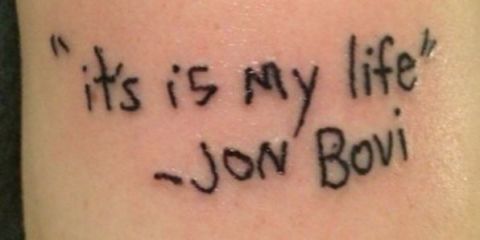
Oh, but please, for the love of all that is holy: Spell check.
But I don’t think they’re entirely bunk. I think there’s at least some merit to attaching our motivations to certain rituals, because it can give us the subconscious impression that they’re more important, more serious. It can add some gravitas to them.
However, rituals and traditions draw a lot of their power from how well they seem to work over time. Let’s say one day you found a cool-looking stone, so you picked it up and kept it. Later that day, you accomplished a major goal. Your brain might leap to a certain connection, making you say “Oh, this must be a lucky rock! I’ll keep it forever!” The next time you attempt something major, you succeed. Now you’ve got two whole data points supporting the “lucky rock” theory, so it naturally cements itself in your brain forever.
Every time you attempt something major, you rub your lucky rock for good luck. I absolutely, 100% support this superstition and wouldn’t discourage anyone from it. Why? Because even though it’s obviously hogwash, it’s probably helpful hogwash. You thinking you have a lucky rock doesn’t cause any harm, and it actually might be helping by giving you boosts of confidence that in turn result in actual performance improvements. It’s just a superstitious ritual, but it can be a good one.
The problem with New Year’s Resolutions is that they aren’t like the lucky rock. Your impression of them in your mind is probably not a positive one. You probably roll your eyes when you hear about them, associating them in your mind with three weeks of overcrowding at the gym in early January followed by an immediate drop-off. It’s so common to abandon New Year’s Resolutions quickly that it’s become a meme, a running in-joke. Which is why they don’t work. In order for a ritual or superstition to have any ability to help you, it has to be something your illogical brain can latch onto as maybe actually working.
Your logical brain (hopefully) will always know it’s just superstition. Your logical brain (hopefully) recognizes that there’s no better day than today to start a new goal or begin achieving something you want to achieve. But you can get a lot of extra motivation by harnessing the power of that subconscious, illogical, lizard-brained System 1.
(Why do you think sales offices so often have actual bells or gongs they ring when people make big sales? It’s to associate that noise with success, and then when you hear it all day long you’re more motivated. Did you think Pavlov only applied to dogs?)
Now, here’s my other problem with New Year’s Resolutions, besides the fact that they’ve been ruined culturally. My other problem is that once a year is a terrible frequency to set big new goals for yourself.
So let’s start a new tradition, you and me. New Month’s Resolutions! A month is a much better frequency to try things. Long enough to give you room to grow and make mistakes, but short enough for you to set attainable goals and reach them. And that’s at least 12 major accomplishments per year! You can do a lot in a month. You can start a blog. You can write a song; you can probably write a book. You can lose 5 pounds. You can get a new job, or a promotion. Or launch your own product. You can try five new foods, see a new city. Many things!
Let’s go for it! My New Month’s Resolution this month is to build something. Physically construct something that I don’t already know how to build. I’m thinking a swingset/playset for my kids in the back yard, but it could turn into something else. I’m flexible!
One of the weapons in that war is something I call “resume language,” which I’m absolutely sure you’ve encountered, or perhaps even used. In fact, you’ve probably gotten a lot of advice that you should use it, which is a symptom of the aforementioned arms race.
What is “resume language?” It’s words and phrases you’d never use in any other writing, professional or otherwise, made to inflate the appearance of your accomplishments and responsibilities.
I’m a career coach. I could say “I leverage cross-industry actionables, utilizing best practices and focused metrics to spearhead personal career development initiatives.” Here’s my real deal: I’ve been around the block a bunch, and I was a recruiter for a long time, so I know this game well and can help you beat it. That’s “resume language.”
Now, don’t get me wrong. You should absolutely describe your duties in detail, and focus on what actual skills you learned and what things you accomplished. If you’re putting your job as a cashier on a resume, you shouldn’t put “I was just a cashier.” You weren’t “just” anything. You should put that you learned the importance of combining accuracy, speed and friendliness. You should put that having to account for your own cash drawer made you focus on personal responsibility. And it’s fine to describe how those skills and traits will translate well into the job you want. But what you shouldn’t do is say you “pro-activated end-client fiscal transaction process.” Stuff like that sounds absurd and everyone sees through it immediately.
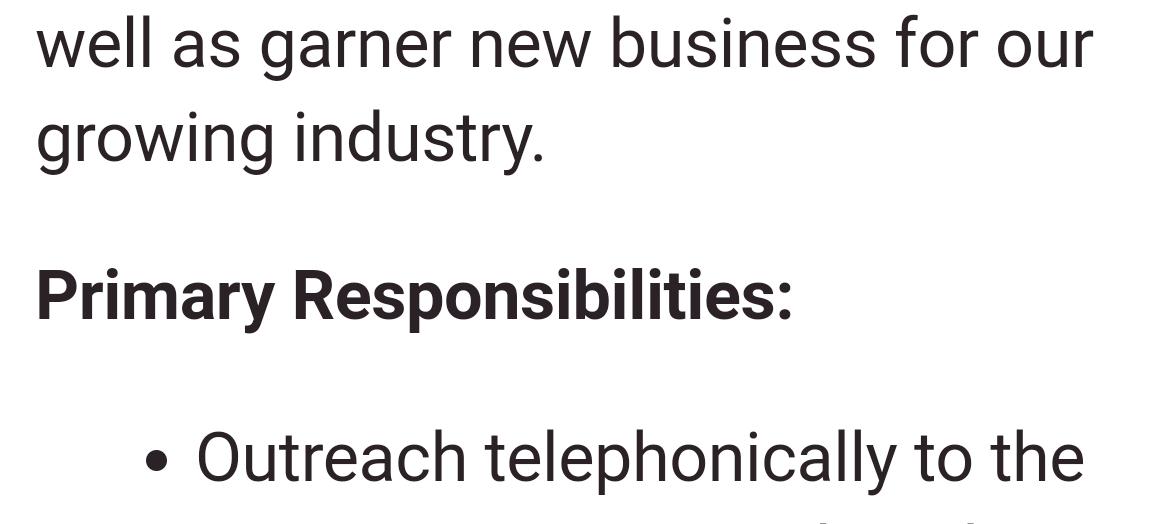
Now, anyone who has listened to me give career advice for more than 30 seconds has probably heard me say just how… freakin’… POORLY almost all job ads are written. They’re terrible. That’s because they have their own version of the “resume language” problem, where they’re trying to make the job sound much more complex or interesting than it really is. Some jobs are just simple and not exciting, and that’s okay. But recruiters, as part of the continuing arms race, are trying to both filter out lots and lots of candidates, while simultaneously trying to attract specific high-end candidates. As a result, they doctor their job ads with endless repetition, additional absurd requirements for skills, experience and credentials, and even their own version of “resume language.” For instance, check out this little snippet of a recent job ad I found:
Yes, you read that correctly. “Outreach telephonically.”
The primary responsibility is to call people. It’s a telemarketing role.
Why don’t they just put that? Well, because telemarketing has a bad rap (mostly deserved) and they won’t get as many applicants if they just say it’s a telemarketing job. But this ruse only works until… about the first 5 minutes of the interview. I guarantee you their conversion rate is horrible, not to mention their turnover rate for people they do manage to hire. If you think your job is so bad that you have to fake people out to even apply, you should probably look at why. Figure out why people don’t want to be telemarketers, then make it different at your place of employment, and then say so!
“This is a telemarketing role! ‘Oh no, no way,’ you’re saying. But we’re not like that soul-numbing job you had selling vacation packages to mid-West senior citizens on the Do Not Call list. First, 100% of our outbound calls are in response to a request made on our website within the last 24 hours, so it’s all people that have specifically requested a call for more info. Second, we’re not a scripted boiler room – we train you to be a subject matter expert, and then you interact with our customers like a human, answering their questions in normal conversation. We’re here to help people! If that’s the kind of team you would do great work with, we want you to outreach telephonically… I mean call us!”
That’s the sort of job ad I’ve written for companies when I do the hiring. Spoiler: It works really well. Skipping the arms race always does, regardless of which side of the hiring desk you’re on.
I’ll close out this post by telling you what I think the biggest, most central problem with the current state of the job market is. The arms race is horrible, but I think it’s a symptom. I think the central cause is this: Job seekers are expected to reach out to employers, instead of the other way around.
Before the era of the internet, there wasn’t really a better way to do it. If a person wanted a job, they had no choice but to “hit the pavement” and bring their resume to every employer in town, or start dialing down the phone book. An employer that wanted to hire someone had no good way of reaching out to specific candidates, so they had to just advertise that they were hiring, cast a wide net, and hope the best fish leaped into it.
Then the internet took over a lot of industries, including the old function of the “classifieds.” The replacement technology appeared, but out of habit we simply used it the same way as we’d used the old methods, instead of realizing the potential it had to change the game entirely.
I think job boards should work in the reverse of the way they do now. I think a board like Indeed should be all posts from job-seekers, to which employers respond. If I was a recruiter looking to fill an opening for a marketing specialist, I’d start filling in my keyword searches based on the expertise I wanted, and start looking through the postings from potential employees. Then I’d send out requests to interview to them.
Why do I think this would be a better method? Because a very small number of smart employers already do this, and it’s wildly successful. It takes a bit of effort, but it saves a lot of time and money in your search costs. As a recruiter, when I had to fill a particular vacancy, the first thing I did – way before posting job ads – was just search for people with the skills I wanted. You know… I recruited. Those people aren’t invisible anymore. They have blogs, websites, LinkedIn accounts, Twitter accounts. They’re active on Quora or StackExchange or any number of other places, and they’re already showing their work in an honest way, devoid of confusing “resume language.”
They’re ready to have an honest conversation about work. If you are as well, you’ll get them.
Once I get over my initial paranoia, I’m going to thoroughly enjoy turning all of my driving time into reading time. I spend a lot of time behind the wheel, and I’d much rather spend that time in a book.
I’ve tried audio books, but they’re painstakingly slow. I’ve tried adjusting the speed upward, but the issue is just that I can read much faster than I can listen. I can process written information faster than auditory information, so even speeding up the recording doesn’t help me. I get antsy.
I appreciate that there are people all over the world working on things like self-driving cars and hosts of other innovations to let me do more of what I love and less of what I don’t. I appreciate the great machine of the world economy constantly improving my life.
What new innovations have given you more time to do what you love?
All it takes is a paradigm shift in your thinking. When you attempt something, the outcomes aren’t success or failure. It’s not win or lose. It’s win or learn.
Learning is a lot less automatic than we hope it is. Experience is the greatest teacher, but we also have to mentally show up to those lessons. You can hit the same brick wall hundreds of times if you never stop to think about what’s happening.
But if you do think about it, you can change the rules. You can define outcomes as only being one or the other: You win, or you get better.
Imagine a new game at the casino. Fairly simple rules. You can bet a dollar on a machine with exactly 50/50 chances to win or lose. If you win, you win your bet back plus 1% – so you’d be up $.01 if you won. If you lose, you lose your bet, but the percentage you gain if you win goes up by 1 point. So you’d lose a dollar, but now you’re at 2% if you win next time. Lose again, and it’s 3%. And so on.
Do you see the way to win? The most you’d have to lose is $100 bucks before you’re at even odds. And after that it’s all gravy – the odds would be in your favor after that point, because you’d be betting a dollar if you lose against gaining an extra $1.01 or more if you won.
That can be your life! As you learn something new, early struggles may feel costly in lost time or discouragement. But that’s only the early setbacks. Those early days are also the days where you can gain the most knowledge the quickest, so if you push on, you can rapidly find out that you’ve leveraged those setbacks into huge future gains.
I’m going to tell an embarrassing story. When I was a teenager, I got scammed. The details of the scam aren’t super important, but I basically gave some money away online because I thought I was buying something of value that turned out not to exist. I lost about $180. Not a huge amount now, but to teenage Johnny it was a decent chunk of change. Despite my embarrassment, I told my dad about it, how I’d been scammed and had little recourse. I wanted to see if he had any tricks on how I might get that money back.
His advice was profound. He explained that in the time I might spend trying to get that $180 back, I could easily make that much again – or more, by doing more productive things. And I shouldn’t consider the $180 a loss in any case; I should consider it a payment to the universe for incredible knowledge. That’s a small price to pay to learn a LOT about how to spot scams and not get taken again in the future, considering that Future Johnny would have way more money. True enough, I’ve not only avoided ever being scammed again, but I’ve saved a few other people from similar schemes that I spotted when they didn’t see the warning signs.
I didn’t lose. I learned.
Back to that hypothetical casino game – if you gave it any thought when I presented it to you, you probably realized that it was very lucrative in the long term. Some people, however, don’t think in the long term, and in the short term that game seems horrible. The first roll of the dice you’re betting a dollar against a penny, a terrible deal. In the same way slaving over a deep fryer for minimum wage can seem like a bad deal, or doing some design work for free, or anything like that. Just like the casino game though, it’s a great deal – if you’re willing to put in the work and time.
And most importantly, change your thinking. Win or learn. You can’t lose.
“If I had asked people what they wanted, they’d have said ‘faster horses.'”
Regardless of whether or not ol’ Hank Ford actually said that (it’s pretty dubious), it’s a great quote and it gets to the heart of a great issue – identifying problems is not the same skill as solving them.
I try to live by the maxim that “there are no bad ideas in brainstorming.” Sometimes ideas spontaneously pop into your head, but there are other times when you’re deliberately turning on the creativity engine and trying to work through one or more issues, either by yourself or with a team. In those circumstances, don’t edit or censor yourself. Throw anything and everything at the wall to see if it sticks.
When you’re in the weeds of a problem or issue, you’re often in a bad position to judge whether an idea is good or bad. This is where multiple eyes and opinions are very helpful. Don’t gather together a think tank and then fail to use 100% of its power by not throwing out every idea! You never know which random thought will connect to something else and start a chain reaction to brilliance. Don’t be afraid of “sounding stupid.” It’s brainstorming; 95% of it will be unintelligible garbage and that’s just part of the process.
That goes both ways! If you’re on a team that’s doing some brainstorming, don’t be judgmental of ideas. Treat everything, at least initially, as gold. You want every brain firing on all cylinders, and not wasting precious processing power on self-censorship for fear of being chided. Our anxiety can be a powerful force against us, and if you want great ideas then you want to create an environment that lessens that social fear as much as possible. Practice saying “Awesome!” and writing stuff on a white board – you can pare it down later.
(Free leadership tip: When writing ideas from a team on a whiteboard or similar during a brainstorming session, don’t group ideas by contributor. Mash them all together; it’s a team effort. And that way later when you eliminate ideas during the refinement stage, it won’t look like you’re favoring or disfavoring any one person’s ideas.)
“Identify broadly; solve specifically.” When you’re identifying a problem, try to go as broad as you can. “Horses aren’t fast enough” is one issue, but going even broader you realize the real issue is “people want to get from point A to point B faster.” If you focus on the narrower problem, you try to improve the speed of horses. If you look at the broader problem, you see more potential solutions.
Solving specifically means you need to tailor an idea down to an executable concept. The broad problem of transportation speeds has many potential solutions, but you only need one good one. You won’t ever serve everyone, so get a solution that serves one niche really well and go from there.
Putting it all together: Identify a broad problem, brainstorm as if no one is judging, and then narrow down the best clear single solution and act on it relentlessly until you hit the next problem. Rinse, repeat. Call it the “faster horses” method if you want – an assembly-line for idea generation. Make the spirit of Henry Ford proud.

 The Opportunity Machine