Blog

Happy Father’s Day

Today is my first Father’s Day with what I assume is all my kids. My youngest was born this past August, and I don’t have any plans to have any more. Surprises can always happen, but I think these three are it. If that holds true, then today is the first Father’s day with my full set.

I am always reminded on Father’s day of my simultaneous great fortune and terrible misfortune. I have three wonderful children; the best I could ask for. Unfortunately, I also have an extremely awesome dad myself, and he sets an impossible standard I couldn’t possibly live up to.

He is a nearly-mythic figure. The stories about him are legendary. He’s hilarious, he’s fearless, he’s hyper-competent and he loves life. Like all real people, he has his flaws, but they pale in comparison to his virtues. They don’t make ’em like him anymore.

Happy Father’s Day to all those who are or who have fathers or father figures. Cheers.

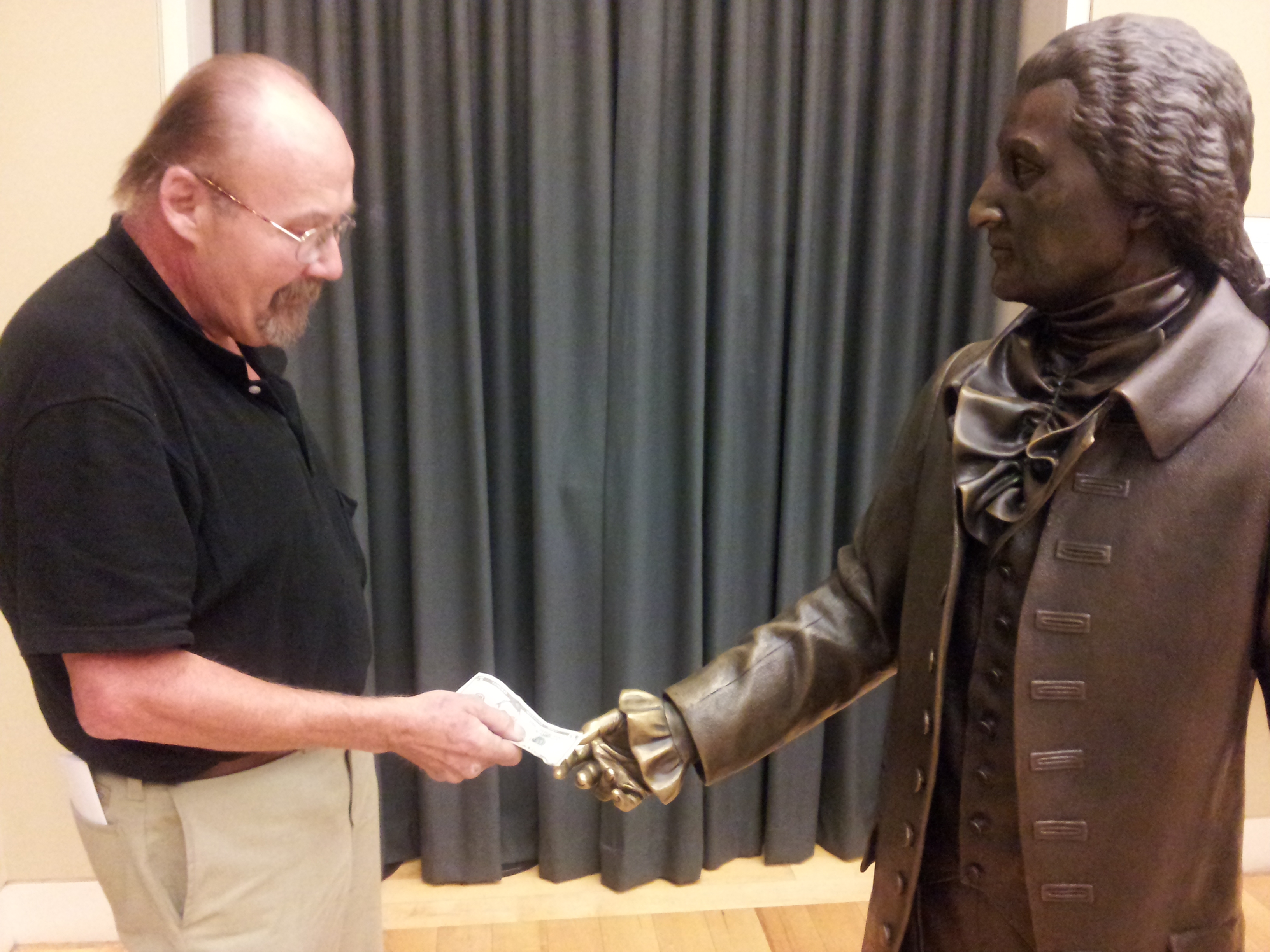
My father paying his debt to one of the fathers of our country.
The day I collected the whole set.

Your Politics

I read an interesting comment today: “Your politics consist of those things which you consider outside the realm of politics.”

That certainly strikes me as apt. Let me explain, for those of you that have never had the pleasure of visiting, how things work in the real world. No one ever gets exactly, perfectly what they want. Human wants and desires are infinite not only in their scope, but also in their specificity. They’re also all different – what you want is not the same as what I want, and resources are finite, so we can’t all have our cake and eat it too.

In the Real World ™, we maneuver and negotiate and bargain and work for what we want. I can’t have X if you have Y, so we figure out how we can both get close and still be happy. The best case scenario is the Win/Win, where I find someone else who wants Y and that actually gets me closer to X, so we help each other and we’re both better off. In some instances, people who are bad at all of this just hit someone else and take their X, but in the long run that rarely works out for anyone.

During this whole process is the explicit understanding that you wanting Y is okay even if I want X. If those are opposed we make deals. If they’re complimentary we have a win/win. If there’s no way to make a deal, maybe I give up Z to get something else instead.

That’s the real world. Then there’s politics.

There are two kinds of capital-P politics. There’s “political discourse” which is all the noise you hear when you accidentally walk past a television or your finger slips on Twitter. Then there’s Politics-As-It-Actually-Happens.

In political discourse, there’s no bargaining. What you want is common sense, universal, moral and just. What the other person wants is barbaric and disgusting and the death of civilization. You can’t bargain with the horde; they have nothing you want. They don’t even have wants themselves; they only want to destroy what you, the good people, want for the world. Everything would be perfect if not for Them.

Then, strangely, in Politics-As-It-Actually-Happens, all the people with any real political clout do as much if not more bargaining and deal-trading as anyone in the Real World, only they always refuse to admit that’s what they’re doing. Their outward rhetoric is exactly the same as the “political discourse” people, except then they quietly say yeah you can have X if I can have Y to other people in their realm wearing different colored ties.

So, “your politics consist of those things which you consider outside the realm of politics.” Whatever you think shouldn’t even be something political, that’s your politics. Unfortunately, in politics, that’s everything. Nobody says, “I believe healthcare is a fundamental human right, but I’m open to changing my mind based on the electoral process.” No one makes a sign saying “If they want my guns, they can come take them, which I’ll happily allow if a law is passed to that effect.” In politics, there are only two kinds of things: Things you care so deeply about and that are so obviously correct that they shouldn’t be touched by politics at all, and things you don’t care about at all.

Everything in life is trade-offs and opportunity costs. You build the best life you can for you and those around you out of the available pieces you have; that’s the whole game, start to finish. Playing that game makes you smarter; you’ve got skin in the game so you’re more likely to be correct about decisions. You’ll build a better world for yourself by helping others do the same. A beautiful series of overlapping bubbles that lift the whole world up.

One of the best trade-offs you can make? Trade the time you used to spend thinking about politics for time spent enjoying life.

Teach Me Something!

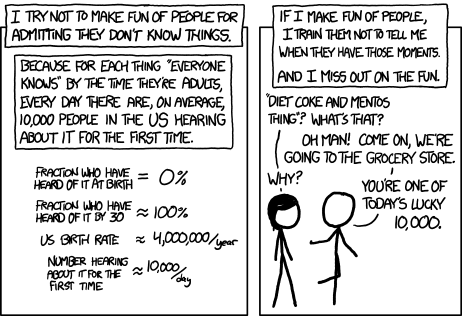
My favorite xkcd.

All knowledge is acquired.

We are, probably to both our tremendous benefit and our great peril, born knowing absolutely nothing. We don’t even have great survival instincts, as animals go. We’re blank slates.

All the knowledge we have, we have because of experiences. Sometimes it’s the experience of someone having told us something that we miraculously retained (and trust me, it’s miraculous when we retain anything someone teaches us), and a lot of the time it’s because we encountered some barrier between us and our goals that we could only overcome by learning a new tidbit. Those are the best ones.

But everyone’s journey is different, and the things you know, you know because of yours. When we encounter people that don’t know what we know, we often have the unfortunate instinct to deride them or at least inwardly consider them less intelligent than we are. We scoff and say “I can’t believe they don’t know that! It’s such an elementary fact!” But of course it isn’t.

Meanwhile, when we encounter people who know things we don’t know – like, for instance, literally everyone – we dismiss their information. “If I don’t already know it, it’s probably either untrue or so academic and obscure that it’s a useless bit of trivia. Surely I already know all the relevant and important things!” Hogwash.

The exchange of new information – facts, ideas, jokes, stories, anything – is one of the truly great and divine experiences we get to have, and it’s out there to be had every day of your life if you want it.

You should be thrilled at these opportunities! Every single person you meet, every conversation you have, is a chance to get smarter. Every time you meet someone who doesn’t know some “elementary fact” that you know is a chance for you to make a difference and improve someone’s life!

I’d love to know what you have to teach me. Tell me!

On Review

I think it’s a good thing to be public about your past failings.

I am constantly tempted to go back and erase things I’ve written publicly in the past, because they don’t perfectly demonstrate my current view. I like to think I’m the kind of person who readily incorporates new information into their life philosophy, but that means that something I wrote a year ago might not be perfectly reflective of who I am today.

It’s not wildly off; my core values are what they are. But how I’ve learned to wrap those values around the world as it is has certainly changed, and hopefully for the better. I’m always trying to learn and improve. One of the perils of being even mildly successful at continual self-improvement is that your past self can seem awful by comparison.

So, I sometimes go back and look at old articles I’ve written or posts on various sites. Some have aged like fine wine, and I’m still proud of them. Others make me cringe.

But I don’t want to erase that. That’s my journey. That’s how I got where I am. If I found anything so egregious that it would truly make me ashamed, I’d rather write about it now than erase what I did before. But for the most part, it’s not stuff that I’m ashamed of; more stuff that I’d shake my head at and say “you’ve got a lot to learn, kid.”

I did have a lot to learn. I still do. I love learning it. So I’m okay with leaving those bread crumbs. Maybe in a few years I’ll read this and cringe, but hopefully I’ll appreciate each step for what it was. Part of a greater journey.

Literally Anything

The other day I found myself in a stressful situation; I had a particularly long to-do list and most of them were fairly urgent. I found myself stalling out for a moment as I contemplated what order I should do those things in. How should I structure this? What should my plan of attack be?

And I had an “Ah ha!” moment. A clear voice in my head yelled at me: “Pick at random. Do literally anything.”

It was a wise voice.

See, there were several advantages to this particular method. First, planning isn’t doing. I needed to get stuff done, right away. When you’re trying to improve your situation, whether long term or short term, doing literally anything is almost always an improvement over doing nothing. So right away, the task got a little less daunting and I gained a little momentum.

But there was another big advantage. Stress clouds your thought process! When you’re under the gun, you’re not thinking clearly. That’s why “shower thoughts” are a real thing – when you’re relaxed and not actively trying to think about something, great inspiration and creativity can strike you. Sitting down and tackling one of those tasks took a lot of stress away, because I was now actively working on something. As a result, I was easily able to think through how I wanted to plan the rest of my tasks while I was doing the first one, and the rest of the day went by more easily. Mission accomplished.

So, you’ve decided that you want to get healthier. You have ideas about meal planning and calorie counting, balancing nutrients and maybe even consulting a dietitian or nutritionist. You want to join a gym, hire a personal trainer, build a fitness regimen and buy some equipment for that purpose. Hey, that’s all great. But that can all be so daunting that you don’t ever actually do it. The easiest way to get started?

Do literally anything. Walk around the block! Hooray, you did it! You got started! That’s all it took.

This is the greatest advice you’ll ever get, because it’s simultaneously really easy and applicable to every situation. No matter what your current status is, if you want to improve it – do literally anything. You can work out details as you go, you can improve your path as you walk it. Just dive in the deep end and swim around. Trust me, you’ll be fine.

“You don’t have to be great to start, but you have to start to be great.” – Zig Ziglar

The Smell of Success

Would you know what success looked like if you saw it?

People want to be successful. I’m a big proponent of ambition, so I don’t find anything wrong with that in itself. But that’s nowhere near enough of a plan to be actionable.

Before it sinks so deeply into your psyche that you can’t ever be rid of it, I want you to clear your mind of the idea of success that society has given to you. Maybe you want an $80,000/year salaried job to pay for your nice house in suburbia, where you and your spouse can raise your 2.3 kids and your dog in relative security. That’s a nice life, and I don’t begrudge anyone who wants it. But you shouldn’t want it by default.

You also shouldn’t think that there’s only one road to get there. Not only is there more than one road, there are millions.

Let me ask you a hard question: What does a successful person look like? Would you know them if you saw them? When people are posing for the cameras – when they’re posting their cultivated life on Instagram or showing off their latest toys in the neighborhood – you see what that person wants the world to believe success looks like.

Instead, just go to the DMV and watch people come and go. Some of them took nice vacations on their yachts last year. Others struggled to pay for necessities. You’d have a hard time telling which is which just by the very candid glimpse you get of them in this setting.

So that’s Step One. Get rid of the idea that “success” is a snapshot, a singular moment in time. It’s not a picture on social media or a signed deed to a house. There’s no finish line at all – except for The Big One at the end.

Knowing that, move onto Step Two. Redefine “success” as a particular journey. In other words, I’m not successful because at this moment in time I make X dollars or have such and such things or experiences. I’m successful because on a regular basis I do what I love without having to do very much that I hate. And I improve that ratio all the time. Early on, I had to do a lot of things I didn’t like in order to do a small amount of things I did like, but I was also investing in my future. Now, the mix is better. Over my life I intend to keep improving it until eventually I barely do anything I don’t like at all, and tons of stuff I love. But there’s no 100% – you can only approach infinity, you can’t reach it.

So now you’ve gotten rid of the idea of success as an imprint, and grasped the idea of success as a continuous journey. The last part, Step Three, is to decide what journey you’ll take. They’re all different. Find the one that matches what makes you happy and pursue it with all your might. Don’t judge others for theirs – they’re different than you. Help them if you can, love them for their journey.

Take the long way home.

Offer Me Solutions, Offer Me Alternatives

You’re in a rut!

Or at least, it’s very likely. Because we all are. We auto-pilot so many things; we have to or we’d go insane. We simply have too many things to do to consciously think our way through each and every one. But it’s worth adjusting that mental auto-pilot on occasion!

Let me give an example from my own life: My oldest daughter takes karate lessons. For a few reasons, I chose a school that isn’t conveniently located near our home (it’s awesome in every other way). When I was first taking the Beansprout to her lessons, I followed my GPS through the unfamiliar route until it became familiar enough to stop using the device; 2 or 3 trips maybe. The trip took a little over 20 minutes each way (yes, that’s a ridiculous commute for karate lessons, and yes, it’s absolutely worth it to everyone involved).

Ever since, I’ve been taking that same route. I never really thought about it. But one day, I happened to have to go somewhere that was very close to the karate school for unrelated reasons. I plugged that address into my GPS, and lo and behold the trip took barely over 10 minutes; it was mostly along one freeway, and the place was right off an exit. And sure enough, that place happened to be only a few blocks from the karate school. It turns out that the exit had been closed for construction for just about exactly the few weeks when I was first taking the Beansprout to her lessons; as a result, GPS was re-routing us through back roads that took nearly double the time. But I was on auto-pilot, and never really thought about it.

Once I had reason to re-examine the route, it turns out there was a way better one. I was already willing to take the longer route, so getting a shorter one was all upside!

The thing is, there are probably dozens of instances in our lives where we’re doing something on auto-pilot because we’ve done it that way for a while and haven’t really thought about it. And it’s true that if we try to actively, consciously think about every little decision in our day to day lives we’ll go mad from stress.

But pick one! Just today, pick one thing you do on auto-pilot and examine it. Your route to work? What you eat for lunch? A piece of software you use for a certain task? Your brand of deodorant? Anything! Just pick something and give some serious thought to whether or not there’s a better way. There might not be anything major to be gained, but then again there might be. Or there might be a minor improvement, and single drops of water make The River, after all. So pick something and improve it.

Then do it again tomorrow.

Starting Over

Of all the words of mice and men, the saddest are ‘It might have been.’ – Kurt Vonnegut, Cat’s Cradle

(By the way, if you’ve never read it: you should.)

We play in the land of “What If” frequently, but almost always in reverse. We let our imaginations wander to what could have been, but so rarely even glance in the direction of what could still be.

Let’s say you make $50,000/year right now. If it could lead you to being able to make $75,000/year in five years, would you switch to a $30,000/year role right now?

That’s a good deal. People should take it more often – and the deal is there to take. Why don’t they?

The deal is there because there are lots of people who could very reasonably make more money by switching industries or learning a new skill, but they’d have to “start at the bottom.” Lots of people won’t do that, for a variety of reasons. The two biggest, I think, are these:

  1. Status matters to people. I think a lot of people would trade being being rich for being perfectly perceived as rich/high status by 100% of the population. Even the temporary loss of status is too much for some people to bear.
  2. People often can’t afford to have their income decrease even a little. We have a terrible tendency to let our expenditures rise exactly to (or even past!) our level of income, such that a minor decrease is incredibly difficult to bear.

As much as possible, be mobile. That can mean a lot of things. It can mean not anchoring yourself to a physical location, but it can also mean being economically mobile. If you live cheaply but have lots of savings, you can afford to make more money in the long run.

I admit, this is a mistake I’ve made in the past. When the oil industry was booming in North Dakota between 2006 and 2012, I thought about how I could have packed up and jumped on it and made a lot of money, but I wasn’t mobile enough.

Stay flexible, and consider what can be, instead of what might have been.

The Plan

“I think a plan is just a list of things that don’t happen.” – Mr. Parker, The Way of the Gun (2000)

It’s good to have a plan. It’s also good to be prepared to deviate from it – or for it to deviate from you. When you think about a plan, think about the difference between cooking and baking.

When you bake, you need to be pretty exact. You can’t just add flour, water, eggs, etc. in any combination you like, adjusting as you go. If you don’t get it exactly right, you won’t end up with a cake – you’ll end up with a brick or a mess. Maybe a messy brick. But definitely not a cake.

Cooking is different – more art than science. When I’m cooking, I start with a basic plan, sure. But I can adjust as I go, add things I feel like, compensate for earlier mistakes. The end result is almost always delicious, even if it often ends up different from what I envisioned in the beginning. Sometimes I mess up a meal to the point where it isn’t good, but far more often I end up with something new and exciting that my family loves.

When you make a plan, think of it like cooking, not like baking. It’s good to have a plan to start – you need to have some vision to begin. But you can adjust, be flexible, roll with punches, add new ideas. When you bake, you can’t do that – if you realize halfway through the baking process that you forgot an ingredient when you put that cake in the oven 15 minutes ago, there’s no coming back. That’s why I don’t bake.

Be prepared to make changes as you need to. Stay flexible. You’re probably in the midst of one or more plans right now – plans for this week or month, maybe 5-year plans, or maybe even plans you’ve made for your life. When was the last time you sat back, evaluated your progress so far, and made a course correction? 5-year plans are great as visions. But 3 years in, you’re hopefully 3 years wiser than you were, and it’s worth it to take that new experience into account and adjust.

It’s more important that the end result is delicious than that it’s what you envisioned when you started.

The Cost

I want to take you through a thought experiment.

Let’s say I offered you one million dollars to shovel elephant feces for eight hours. In the hot sun. With no breaks. Would you do it? I certainly would – only eight hours, for a million bucks? That’s a great deal. Maybe you wouldn’t, but I’ll assume you would, if you’re able. If you’re physically unable to do this task, you can substitute any equally-unpleasant task that you’re physically capable of performing; doesn’t matter for the purpose of this hypothetical.

Okay, so you’d do Unpleasant Task X for eight hours for a million bucks, cool. How about for a week? 7 days straight, eight-hour days, no breaks. But you get a million bucks. Still with me?

How about a month? 31 straight days, eight hours a day– no, you know what, let’s make it 12 hours a day. 12 hours a day for 31 days, no breaks. But you get a million dollars. Maybe fewer people would do this. It still sounds like a great deal to me, but everybody isn’t me.

How about a year? A full year, 365 days straight. 12 hour days. No days off, no breaks. And to make it even harder – you don’t get the money until the year is done, AND if you miss even a minute you lose. If you’re 2 minutes late on the last day, you get zero. Would you still do it?

What if I made it ten million? Fifty million?

The point of this experiment is to realize that different people have different thresholds for what costs they’re willing to pay for what benefits. Some people wouldn’t even do the scenario as initially presented, and others would do even the last scenario. There might be a number that would make you do the year-long version that’s much higher than $50 million, or it might even be lower than a million.

Everything in life has a cost. Sometimes we pay too much attention to the cost and not enough attention to the benefit, and we end up not doing things that would actually be really great for us in the long run because we’re too focused on the short-term unpleasantness of that cost. Other times we focus too much on the benefit and not enough on the cost, and end up sacrificing too much to get something we think we wanted. It’s good to spend some time balancing the scales. Take some inventory of the things you’re working towards right now – are you paying too high a cost? And what things have you chosen not to strive for because the cost is scary – would the benefit outweigh it?

Take that step back and look at the whole picture. You’ll be better off for it.