
Enjoy your independence. Be more free, and free others along the way. Shine a light. Watch it glow.
Year: 2022
Honey & Vinegar
It’s time for another exciting edition of “Johnny dispels a folksy truism.” Today’s entry: “You catch more flies with honey than with vinegar.”
This is wrong for two different reasons! Three, if you count the actual literal interpretation:
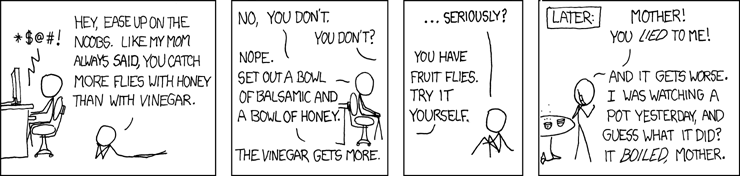
Funny as that is, it’s not the scientific inaccuracy I’m writing about here. I want to dispel the underlying concept. The advice embedded in the saying is this: you get more people’s attention and/or interest by being sweet than by being vitriolic.
False. Like… obviously false, for anyone who’s spent ten minutes around people.
If you want to attract a lot of attention and/or interest, acid is the way to go. Being horrible. Mean-spirited. “Controversial” is the most charitable way to say it, but it goes deeper. The people who tend to gain the most attention and interest are often very, very rotten. Most of the time they’re just tactical enough to be rotten to someone else besides the people they’re trying to attract. Demagogue politicians that constantly decry “the other,” social media influencers who pick a straw man to mock, or false prophets claiming doom and gloom is just around the corner and don’t we just deserve it.
So yeah, Senator Xenophile, Facebook Bully, and Fauxstradamus all get a lot of attention. More than the people who are just… nice. Saying things that are true, and helpful, and kind. But here’s where we get to the second thing inherently wrong with the advice.
The saying “you catch more flies with honey than with vinegar” implies that whatever the method, it’s somehow good to catch flies.
I don’t know about you, but my goal in life is not to be the center of a giant buzzing swarm of flies all the time. We do not generally associate “things flies want to be around” with, you know, positive qualities. In fact, I’m guessing that a particular substance came to mind that was neither honey nor vinegar.
The attention of flies isn’t doing anything for you except obscuring your view of the light of the world. Don’t try to catch them. Try to avoid them. Use honey specifically because it doesn’t catch as many flies. And because a life of sweetness is better, no matter what.
Borrowed Independence
When someone refers to something as a “house of cards,” they usually mean that while it looks impressive, it could collapse at any moment with even the slightest disruption. People often build their lives (or at least elements of them) this way – on borrowed independence.
When I was a teenager, one of my dearest friends was a homeless kid; a drifter about my age who I met in the weird ways kids meet. We became very fast friends and he grew to become like a brother to me. In many ways, he became like a literal brother because my saintly parents insisted that he live with us rather than on the street. We spent the final years of our adolescence together under one roof, and during that time he taught me many lessons that I might not have otherwise had cause to learn, due to my own more fortunate circumstances.
One of these lessons came in how he ate.
He was one of the family and every bit as much access to the household food supply as I did, but he ate exceedingly simply and consumed very little. One day I watched him make a very sparse peanut butter and jelly sandwich, then he cut it in half – putting one half away in the fridge and only eating half himself. I asked him if he wasn’t hungry, and he responded that he was very hungry, but that was all he was allowing himself. I misunderstood his motivations and said: “You know Mom and Dad don’t mind if you eat more!”
He laughed and said he knew, but that wasn’t why. He’d learned a hard lesson, which was that anything given could be taken away. At first I was insulted, but he explained that he didn’t mean that my family’s love was transient, but rather that the circumstances weren’t under his control. He had no way of guaranteeing anything, recognized that he wasn’t owed anything, and so he didn’t want to grow used to more and put himself in danger.
“In danger of what,” I asked. “Of having it taken away again?”
“That,” he said, “and of having to make bad deals to keep it.”
His reality was such that he could never be sure where generosity was coming from. What if he allowed himself to become comfortable on someone else’s generosity and then something turns south – what would he have to do in order to keep his stake?
In my adulthood, I’ve seen this happen again and again. People get a benefit from someone else, and they allow themselves to incorporate that into their lifestyle as if they’d earned it. Then, it either gets taken away and suddenly you’re in real trouble, or the source starts asking for more and more in order to keep it up, and you’re stuck. It’s a form of control, and it can be a form of abuse.
If you’re a young adult, first striking out on your own, don’t let your parents pay a thousand bucks towards your rent every month. Find roommates, live in a worse apartment, whatever it takes to not borrow that independence. If they’re kind and good people, let them put that same amount of money towards an emergency fund for you instead, but don’t let other people be responsible for part of your base lifestyle costs. You need that to be yours in order to grow, to change, and to make choices for yourself.
And as you age, keep it up. Find your own way in things, even if the path seems harder. Better a harder path on solid ground with your own feet and brain making the choices than a house of cards someone else has built.
New Month’s Resolution – July 2022
Happy New Month!
It is not a coincidence that my resolution this month is to be more independent. In fact, before realizing that today was the 1st and thus I needed to make my NMR post, I was going to write a whole thing on how we undermine our own independence in ways we should learn to avoid – so look for that tomorrow. But for today, I will leave you with my steadfast resolution to find at least one new way to lessen my dependence.
And by the way, “dependence” is not synonymous with “connection!” There’s a frequent misconception that being “independent” also means being isolated, atomistic, and a loner. I disagree. I think it simply means what it says on the tin: you are less dependent on others for your safety, your wellbeing, or your happiness. And I believe, under those conditions, your bond with others strengthens. When you know that I’ve chosen to make you a part of my life despite not needing to do so, it becomes more sincere.
That is what I strive for. Independence and sincerity. May you all get a little more of the same.
The Result of Intent
You shouldn’t judge the outcome of an action by the intent when the action began. You should just it by… well, by the outcome. By the results. If you let your toddler play with the nailgun because your intent was that he would learn valuable trade skills, you should still judge whether or not to do it again by whether or not he ended up with a nail through his foot. Good intentions, as I recall, pave a road to a very specific destination.
But there’s a corollary to this that I feel is too often ignored. While we shouldn’t judge results by the intentions behind them, it’s also important to avoid automatically judging the intentions by the results.
Sometimes, this is so easy that we don’t recognize it as a lesson. If a friend you’ve invited over for dinner drops a glass on the floor, you certainly don’t assume their intention was to come over and destroy your stuff. It was an accident, and you probably never think otherwise.
When the subject is someone more removed from you, you lose that perspective. A company makes a move that costs them millions of dollars, and social media is suddenly full of people asking why the company would intentionally throw away millions of dollars, as if that was the goal – instead of just a blunder on the part of people trying their best. We lose perspective.
Between your close personal friends and distant companies are loads of people you’ll interact with in the middle ground. Potential employers. Providers of professional services. Colleagues. And sometimes, the results of the choices they make will be poor. In those moments, we’ll be tempted to think that they intended to reach those outcomes, especially if those outcomes directly affect us.
“The hiring manager said he’d email me back by Friday, but it’s Tuesday! He’s clearly pulling a power play and doesn’t care about his candidates; what a jerk.” Nah. Maybe he got sick? Maybe his kid did? And yeah, maybe he should have made sure someone else emailed you – but him being less than 100% awesome at his job isn’t automatically a sign that he intended to do this.
Don’t take things personally. Evaluate the results objectively, assume good intent until you have reason to believe otherwise, and don’t make the mistake of assuming one is the other.
The Ball’s In Your Court
And you should keep it there!
No matter what’s happening around you, you don’t have to decide to be passive and wait to “see what happens.” You always have the option to initiate something, to change your environment in your favor. Someone or something might interfere, and that’s fine – roll with those punches, play the game. But don’t start the game without a goal of winning it.
Permission to Ask Permission
The power to say “no” and the power to say “yes” should be bundled. In especially bureaucratic organizations, they rarely are.
You’ve possibly encountered this frustration. You want to get permission for something – maybe building a new deck, maybe starting a new project at work, whatever – and so you talk to the person you’ve been led to believe is who can grant you permission. They’re resistant. After some hassle, you finally convince them to allow you to do whatever thing you wanted to do. The frustration mounts as you discover that the only thing this drone is giving you permission to do is to ask the next higher-up person for permission!
“If you can’t give me permission, why am I even talking to you?” you ask. They reply: “I can’t say ‘yes,’ but I can say ‘no.'”
I don’t usually feel stabby, but there are occasions.
Organizations are all better if there are fewer points where people need to ask permission for anything. “Permission Points” are all friction, all speed bumps. They may sometimes be necessary, but they should be used sparingly; nearly every organization over-uses them. The easiest way to reduce them is to make sure that no one has the ability to say “no” without also having the ability to say “yes.”
Think about the typical hiring process. You interview with 3 or more people, any one of whom can deny you further advancement in the process, but none of which can actually hire you. The only person who can hire you is the Final Boss, who barely phones in the interview as a formality and mostly just trusts what everyone else has said about you. This is a dumb way to do things, and it hurts the organization in invisible (but dire) ways.
Trust people. Trust people to say “yes” if you trust them to say “no.” Reduce your permission points in general, and especially reduce the ones that only go one way and therefore serve no purpose whatsoever.
Crib Notes
Sometimes doing a good deed is harder than not doing it. I get that, and I’m not being sarcastic. We only have so much juice, and sometimes we just don’t have enough to get through all our responsibilities and still have enough left over for good deeds with high costs.
Sometimes though, people find themselves working extra, extra hard just to avoid a good deed! The good deed is actually the easiest path, and yet people avoid it. But if a high cost is a viable reason not to do a good deed on occasion, then surely we’re hypocrites if we don’t let high costs steer us towards good deeds when it works out that way!
None of my children have slept in a crib for about two years now. But I still had (until yesterday) a very nice one in just about perfect condition. It was tucked away in a corner and not in the way, so it was a low priority to do anything about it. Finally yesterday I got around to disassembling it and, with passing curiosity, looked up resale rates.
Baby stuff tends to resell very well, and from my research, I could have gotten between two and three hundred bucks for it. Instead, I packaged it up neatly with all the hardware and put it on the curb, and posted a “curb alert” in my local Facebook group.
Giving it away to someone who needed it was way easier than selling it. Selling it would have involved making posts or loading it into my car or any number of other hassles I just didn’t have time for. Giving it away was a good deed, and in this case, much easier.
Lazy altruism!
People are more responsive to the pain of loss than the pain of foregone gains. I’m no exception. Pulling two hundred dollars out of my wallet and giving it to someone would have felt much more of a sacrifice than just giving something away that I could have sold for the same amount. This is a flaw in human reasoning, but I truly believe that when known flaws in human reasoning can be harnessed for good, we should just lean into it. Today, that meant painlessly giving a crib to an incredibly nice lady who came to my door and thanked me so much on behalf of her daughter, who is a brand new mom.
I said, “No problem whatsoever,” because it really wasn’t.
Walking Together
I am proud of myself for an unusual reason.
This past week, I took a vacation. And this time, unlike almost every other time I’ve tried to do that… I was good at it.
I actually relaxed. I did things I wanted to do, at a pace I was comfortable with. I had lots of fun. I felt genuinely good and not overburdened when I came home.
This is much more difficult for me than it may sound. I’m awful at this sort of thing. But this time, a lot of things came together. I’m going to jot them down here, in the hopes that this might be something I can repeat.
One, the actual work I was taking a vacation from wasn’t onerous. I think that’s a big deal – if you’re taking a vacation because you “need” it because your work is horrible, then you don’t need a vacation, you need to quit. But if you have a great team and work you enjoy? If you can actually unplug for a week and have everyone wish you well and know that you’re not coming back to three weeks’ worth of extra work because you took one week off? That’s a great feeling.
Two, limited travel. We only went to the seashore, which is about an hour’s drive from me. So the travel itself was long enough to feel like I’d really gone somewhere but short enough that it didn’t take an entire day at either end of the vacation just to do. Travel can be stressful (especially with three young children!), so ending a vacation with a huge amount of it sort of works against the purpose of a vacation.
Three, timing. Sort of related to number two, but I didn’t end my vacation the night before returning to work. I came back on Friday night, but I don’t start work again until tomorrow (Monday) morning. Being able to unpack leisurely, still have home time (both for chores that would bother me otherwise and relaxation), and readjust to my own environment again before getting back into gear did wonders for my enjoyment of the whole trip.
Four, the trip itself didn’t deviate too much from my normal routines. I still wrote every day (obviously), didn’t push myself to the point of exhaustion to try to “maximize” my vacation (what a silly concept, I now realize), and still sang my children to sleep every night.
And five, of course, was the company. This was a larger family gathering (more than just my children in attendance), we were all on the same page about what we wanted to do, and of course, I love spending time with them. The highlight though was all the time I got to spend just playing with my kids. Beach trips and rides and games and attractions, all in the name of us just having a great time together.
So that seems to be the formula. I’ll do everything I can to remember it, because I want to keep walking together with my family like this for a long time.

Shameful
I think that shame is a powerful and important tool in maintaining honor and integrity.
My daughter and I were having a discussion on the subject of certain moral rules. More specifically, we were discussing whether or not it was ever okay to steal. First, of course, I made sure to define our terms – this is important with discussions of this nature! “Stealing” is when you take, without permission, something that rightfully belongs to another. The “rightfully” is important here; it’s not (in my view) morally wrong to steal money from a thief. (Of course, if you keep that money when you know who it actually belongs to, makes you no better.)
So, I told my daughter: “It is never ever right to steal from another. It may, on occasion, be necessary. There are situations I could imagine where I would do it. But it’s never right.”
She asked me to elaborate, and I gave her this example: “If you had been bitten by a snake and the only way I could get you to the hospital in time to save you was to steal a car, I would 100% do it. I would do it without hesitation. But that doesn’t make it right. Once your life was saved, I would accept a just punishment for my actions, which should include at a bare minimum fair compensation for use and potential damage to the car. I would hope that the circumstances would make my punishers a bit more lenient, but I wouldn’t say that those circumstances meant that it was right to steal. Just necessary.”
Why is this an important concept?
I think there are quite a few reasons why it’s vital that we never let “necessary” automatically assume “right.” First, “necessary” is a matter of personal circumstance and judgment; it can’t be clearly defined. So we can’t make policy around it. You can’t have a moral code that says “it’s right to steal if you need to,” because… well, who decides?
And that’s the next reason – “necessary” is also very, very slippery. Snakebite, hospital 20 miles away, only car in sight? Maybe few people would argue. But how about someone who’s really cold, and might die of exposure, so I steal them a nice jacket? It edges and edges.
So look, use your personal judgment. Steal the jacket if you really think, in that moment, that it will save a life. But accept the punishment. That will keep you honest.
That’s the point of the shame. You need to shoulder a little bit of burden, something that says “at least part of why I needed to do this is because I didn’t find an alternate solution, didn’t prepare for this, etc.” That, like the honorable acceptance of punishment, also keeps you from abusing the temporary hall pass that “necessary” might otherwise give you.
Don’t take pride in the low road, just because you may have to take it on occasion. It’s still the low road, and you should be inclined against it. If you start to justify it to the point where you don’t see a moral difference, then you’ll never take the high road again.
 The Opportunity Machine