Blog

Count Your Blessings

Attitude is upstream from results. It’s not the other way around.

I’m sure you’ve encountered this, but many people anchor their attitudes as reactive; the result of things that happen. If things are going well, they’re positive – and vice versa.

The problem is that most stuff that happens to you happens because of you. Most, not all – but there’s very little point in focusing on the stuff you can’t control. You should focus on what you can.

When you make that distinction, you can realize how important a positive attitude is. Here’s the thing – neither a positive attitude nor a negative attitude will, by itself, do anything at all. You can’t sit around and wish good things into existence, no matter how upbeat you are. You need to work. But your attitude tremendously affects what you consider as viable pathways to work.

Now, some people will tell you that your attitude has no physical effect on the world around you, and therefore can’t make an impact. The world doesn’t know about your attitude and certainly doesn’t bend to it in terms of what opportunities are presented. This falls into a category of beliefs I call “unhelpful.” See, I don’t like to qualify beliefs as correct or incorrect, right or wrong. Instead, I use the terms “helpful” and “unhelpful.” A belief that your attitude doesn’t matter is an unhelpful belief, as is a negative attitude.

Why? Because the human mind is an imperfect computer.

Have you ever seen those cool pictures where it looks like a bunch of scribbled lines, but when you put on red-colored glasses to eliminate the red lines, the remaining blue lines form a clear picture? Your life is actually very much like that. Every day you actually see a thousand different things – good and bad, useful and useless, opportunities and dangers. And then your mind filters them. But every mind filters differently, and even the same mind can filter differently based on what you’re primed to see.

Your attitude is a high-impact way of priming yourself to filter out the bad stuff and see the opportunities. It’s like a bag of marbles of different colors – instead of picking them out at random, your attitude lets you look in the bag and grab the ones you actually want.

You can create an amazing feedback loop. Start with a positive statement – “Today I will find some success, no matter how small.” Then work. It’s almost guaranteed that you’ll find some success, no matter how small. Then your attitude statement was proven correct! Use that to prime your mind for greater statements and your work for greater successes.

Work backwards if you need to. Look for a recent success, no matter how small. Say, “I did that, so I can do this.” Then work. Rinse, repeat. Count your blessings, and watch them grow.

Dreamcatcher

Sometimes you have to do a little housecleaning on your dreams.

It’s wonderful to be aspirational and motivated, to let ambition drive you. And plenty of my posts here on The Opportunity Machine center around practical advice for turning dreams into realistic action steps. But there’s a less pleasant – but no less necessary – side of this.

Sometimes you have to cut a dream loose.

Why? Because an unrealized dream will eat at you, destroying you from within. It will cripple your motivation for other dreams because it will constantly serve as a reminder of your worst proclivities.

You will absolutely not achieve 100% of your dreams. That’s totally okay! But the more mental space you clear for the things you both really want to do and really have the juice to accomplish, the more focused you can be. Better to have one dream become reality than ten dreams that languish in your mind, in the dreaded kingdom of “Wouldn’t It Be Nice.”

But how – how can you give up on something, and have it be a positive step forward?

First, recognize that cutting a dream loose doesn’t automatically equate to saying “I can’t accomplish this, I never could, it was stupid of me to dream this.” That’s folly. Instead, recognize it as you saying “This dream was one of many seeds that could have taken root, but my life went in different directions – directions I am pleased with or am working to improve. I have had many dreams, and others deserve my attention more now.” You can’t do everything.

Next, examine the dream for what parts you can salvage! Let’s say you wanted to be an astronaut, but a realistic examination of your life reveals that you have passed the point where that’s attainable. Well – why did you want to be an astronaut? Was it because of a love of space, or because of a love of science, or because of a desire for fame, or because of the thrill of exploration? Those are four very different motivators, and there are many paths in life that can reward those motivators that aren’t “astronaut.” Cutting loose the dream of being an astronaut doesn’t mean cutting loose the dream of exploring or of a career in science. Recycle the best parts!

Lastly, recognize that dreams are an infinite resource. You will always be able to have new ones – you can even resurrect old ones if the time becomes right. But space in your psyche is decidedly finite. If your head is filled with unrealized dreams then you’ll constantly be thinking about what you don’t have, what you haven’t done, a million “what ifs” that will poison and control you.

It is far better to have clarity of thought and purpose to the best of your ability. When you dream, dream of things you can actively work towards; when you work, work on the things you dream about. The rest of your time, fill with leisure, laughter and love – not longing for dreams unrealized.

We’re All Conspiracy Theorists

How you react to your beliefs is more important than the beliefs themselves. Knowledge, information, and even conviction are only relevant if they actually change and inform the path you walk in the world.

This is why I think most “conspiracy theorists” aren’t playing with a full deck. It’s not the conspiracy theory itself! It’s the reaction. For instance, if I believed that an ultra-powerful, shadowy cabal of Illuminati controlled the world in secret, it would be absolutely bananas of me to loudly proclaim this belief. There’s a scene in The Dark Knight Rises (the second of Christopher Nolan’s Batman trilogy) where an employee of Wayne Enterprises has discovered evidence that Bruce Wayne is Batman. He approaches one of Wayne’s confidants with the information and demands money for his silence. The confidant, Lucius Fox, replies: “Let me get this straight. You think that your client, one of the wealthiest, most powerful men in the world, is secretly a vigilante who spends his nights beating criminals to a pulp with his bare hands; and your plan… is to blackmail this person? Good luck.”

But that’s what conspiracy theorists seem to do! They become convinced of a vast, powerful network of powerful agents and then start jumping up and down screaming about it, very publicly. It’s not the belief itself that disturbs me – it’s the extremely irrational behavior in response.

Maybe those things naturally go hand-in-hand – irrational beliefs couple well with irrational actions. But you don’t need one to have the other.

Some people have great beliefs but irrational actions. That’s a lot of people, in fact. Most good advice is obvious, but acting on it seems rare. Other people have crazy beliefs but seem to keep it together in their actions; sometimes this can result from simple societal pressure or it might just be that your irrational belief doesn’t really affect your day-to-day actions.

The deeper lesson to draw, however, is that simply believing in something isn’t enough. You need to translate that into actions. That can be difficult! Beliefs are easy to hold, but actions can be difficult and costly to take. Changing your life because of a belief is extremely rare. What most people do instead is to act however they want to act and then adopt beliefs that retroactively justify those actions.

Pretty much all of your nature as a human pushes you to be this way, so you’ll never be 100% successful in defeating that tendency towards ad hoc justifications. But you can certainly move the needle, and that’s absolutely worth doing.

New Month’s Resolution – September 2020

Happy New Month!

I write a lot. Probably more than most people, I would guess. In addition to this blog, I write pretty extensively for my work and I end up writing a lot of short essays for clients or publications as well.

In addition, I’m writing a book (even though progress got a lot slower due to changes in my work schedule and then a global pandemic changing how my days are organized, the draft is actually 80%-90% finished).

I really love to write, but despite how much writing I do, the amount of writing I don’t do absolutely dwarfs it.

The number of pages I have filled with ideas that have never become more is staggering. The biggest category of these is creative writing projects.

My writing focuses on essays and non-fiction, but I have a great love of literature and always have (fun fact about me: I have five tattoos, and all are quotes from works of fiction). Over the years I’ve done a lot of creative writing – short stories, novellas, even prose. Mostly just for myself. The bug bites me and the only way to fix it is to pour some words on pages for a while.

So this month’s resolution is to engage seriously with that process and try to do more than just scribble in a notebook. If I end up with something readable, I’ll let you know.

Reinventing the Wheel

Sometimes it’s good to lean into the tropes.

While we often strive to be creative, unique or original in our works, it’s inevitable that you’ll use well-established building blocks.

Let’s say you want to write an original song. Even if you try really really hard not to recycle musical concepts or lean too heavily into your influences, this just scratches the surface of how deep your foundations really go. You’re probably not inventing a new language with new phonemes for the lyrics. You’re probably not inventing new instruments to play the song on. You aren’t creating a new file type to store the digital version. And so on.

You’re using the tools that exist to create something new.

It would be silly of a critic to say that Frank Zappa wasn’t creative or inventive because he used existing instruments – how trite, right? Or to say that Frank Lloyd Wright wasn’t innovative because his buildings were constructed out of wood and nails – jeez, derivative much? I mean, Vincent van Gogh just used paint! What a copycat!

Stylistic elements are just that – tools. I see a lot of creators go through a phase where they feel like they have to throw away literally everything that came before in order to be original, but that’s like saying you want to be a famous painter who will never use brushes, canvas or paint. Some people do try to do that! They make art by smashing watermelons onto taxicabs or something and while that has its place (I’m no art critic, but I don’t fundamentally believe there’s any such thing as ‘not art’), it isn’t a substitute for actual creativity.

In fact, some of the people who did reinvent a few wheels as part of their creative process did so by really understanding them – knowing the rules is important to effectively subverting them or making your own. (J.R.R. Tolkien comes to mind, having actually created a language as part of his fantasy saga.)

Sometimes you just lean into it, hard, like in Snow Crash where the main good guy is literally named “Hiro Protagonist.” There’s nothing wrong with it – these are all tools in your tool box. Know them, and build the thing you really want to build.

The Gum Principle

This is The Gum Principle: “Whenever someone offers you a piece of gum, you should say yes, even if you don’t want gum or even hate gum. You should say yes, because ‘want a piece of gum?’ can also be an extremely polite and tactful way of saying ‘you have terrible breath’.”

The Gum Principle is broadly applicable to a lot of life, however. Sometimes people think we need help with something, but suggestions that we need help are unfortunately often seen as hostile or insulting. So helpful people who also have a sense of tact and decorum will frequently try to find ways to help solve the problem without ever calling attention to it as a problem, in so many words.

Maybe the world would be better if we were all more direct? I’d like to think so, but hurt feelings are a thing and we obviously developed social norms for a reason, so maybe it’s better that we improve our ability to navigate these nuances rather than try a brute force strategy.

I’ve heard of some really extreme examples of application of the Gum Principle. One story I heard was of employees at a business who got a new co-worker who seemed to have terrible personal hygiene, despite being a nice guy. He just… stunk, to put it mildly. No one wanted to be the one to tell the nice but awkward and shy new guy that he reeked, so instead they invited him to the gym with them, then afterwards when they all stank from an intense workout they shared personal hygiene tips with each other – loudly, and secretly for the benefit of the new guy. It worked, and the new guy started showing up to work perfectly fine.

That’s a lot of effort to spare someone a little embarrassment, of course. It was extremely nice of those guys, but the important thing is this – if the new guy had said “no thanks” to the gym trip, now the other guys are forced to just say “Okay, we were trying to be subtle, but dude you need to shower and buy some new deodorant. Or ANY deodorant.”

The Gum Principle means you should generally accept offers of help and assistance, even if you think you don’t need it. If your boss offers to pay for a sensitivity course for you “because you might enjoy it,” then you should say yes, because they might really be saying “you’re a huge jerk and if you don’t stop we’re going to fire you.”

Of course, sometimes gum is just gum. But what’s the harm in saying yes? You might accidentally do a bunch of self-improvement stuff that you didn’t plan on? Oh, boo hoo.

Once I embraced the Gum Principle, a nice side benefit for me was I started being more honest with myself, and even with others, about my weak points. Now, if someone offers me gum I’ll often make a joke out of talking about the Gum Principle, and then I can feel more comfortable just asking if my breath is bad. Sometimes they say “no it’s fine, I was just being polite” and sometimes they say “take the gum, dude. And stop eating liverwurst and onion sandwiches, dear lord.”

The Ocean Doesn’t Care

I had a friend, long ago, who would always bring his troubles to the ocean. It was a good place to reflect, he said, because it was easier there to remember how insignificant your woes really are.

The ocean doesn’t care. You could scream into it and thrash and flail and it won’t make a lick of difference.

There is a larger universe to which you belong, with its own patterns, and of which you are only a small part.

Don’t Be Mad At The Wall

It’s a wall. Your options are to go over, around or under it. I guess you could even give up and turn back if that’s your inclination. But getting mad at the wall for existing accomplishes precisely zip.

It’s perfectly natural to feel frustration, but that doesn’t mean it’s helpful or productive. Frustration is anger combined with powerlessness – but you are not powerless. Never.

You have brains in your head, and feet in your shoes. Frustration is what you feel when a solution has not yet presented itself, but the feeling of frustration is the very thing preventing a clear solution from manifesting. If you need to walk away from the wall for a minute, do so. But screaming isn’t climbing.

In other words – get over it.

Yes or No

There’s this old joke about “yes or no” questions, and it’s a short one. “Answer yes or no: have you stopped kicking your dog?”

The trap there, where either a yes or a no answer ends up with you admitting that you’ve kicked your dog at least once, is the point that the joke tries to illustrate. “Yes or no” might seem like clear, easy binary answers, but you can stack a lot of assumptions into the premise.

When that happens, it’s fine to point it out! Those are situations where it’s fine to say “I reject the premise of the question” or even to just keep quiet.

Not all questions are traps, however. Some are just honest – if direct – requests for information. The more dishonest someone is by default, the more they’ll tend to treat all yes or no questions as traps.

There is no reason for an honest person to fear direct questions. That doesn’t mean you always have to answer them – after all, it may be none of your business. But if you ask someone “do you like ice cream,” some people will just say yes or no, and some people will hedge.

What is hedging? Hedging is answering in such a way as to be able to deny that you answered either “yes” or “no” later. Lawyers and politicians do it all the time, for predictable reasons. They don’t want concrete positions that can be used against them later – they want to remain flexible.

Of course, you can remain flexible even while being honest. You can ask me if I like cake, I can say no, and then later if you see me eating cake and you think you’ve got some sort of “gotcha” moment on me, I can freely say “I’ve changed my position on cake; I’ve had some really excellent ones lately and it’s caused me to refine my opinion. Now I can say I like cake of a certain type and quality.” There’s nothing wrong with changing your mind.

But be honest and show conviction in your answers. You’ll breathe more.

The Last Place You Look

I’ve always vehemently hated the phrase “it’s always in the last place you look.” I get that it’s a joke and all, but it’s just so beaten to death. In fact, I dislike the phrase so much that one time when I was looking for something and someone nearby uttered the phrase, I actually vowed to look in two more places after I’d found what I was looking for just for spite.

And because I’m a man of my word, I did – I found whatever object I’d been hunting for, and then just for the gag I also looked under the couch and behind the TV.

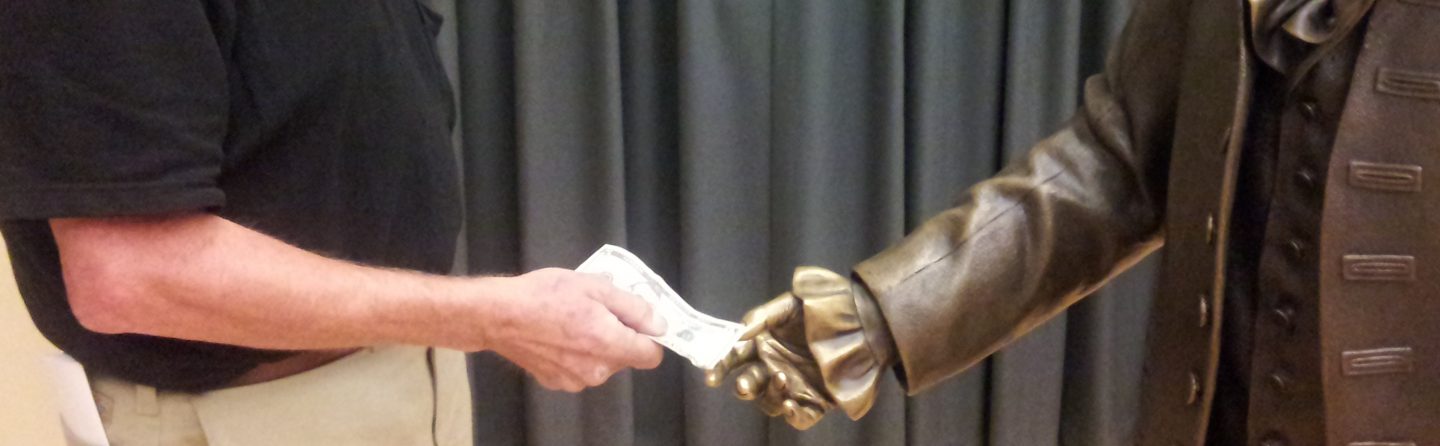
Behind the TV, I found a $5 bill that had fallen behind there however long ago.

The lesson, of course, isn’t “spite pays off.” If only! No, the lesson that I choose to draw from this wild event is that we shouldn’t necessarily stop looking for something just because we’ve found it.

Take job hunting, for example. We look for jobs and we’re so relieved when we find one that we stop looking – but why? A better job, or even just a new adventure, could come from continuing to keep your eyes open in those same channels.

Maybe we shouldn’t live our lives with our heads in the sand, only pulling them out to look for stuff when we’re in dire need. Maybe there should never be a “last place you look” because you’re always looking, always aspiring.

Or maybe I’ve missed the lesson here entirely.

Oh well. I’ll keep looking for it.