Blog

Other People’s Mistakes

One of the things I frequently advocate for is making more mistakes. This advice, like most of the advice I give, is inward-facing; this is, after all, a blog about personal development and self-improvement more than anything else. You should make more mistakes because it’s better for you to do so – your general level of output for whatever you’re trying to accomplish, from learning the piano to finding true love, will be higher if you make (and learn from) mistakes instead of being so risk-averse you never make any.

But today, we’re going to talk a little bit about other people’s mistakes. And how you should react to them. It’s going to be the exact same advice, just viewed from the outside. So let me tell you the story of two delivery drivers, Amy and Jane.

Amy and Jane both work for the same delivery company, but Amy is far more profitable. She’s constantly improving on her job – everything from how she packs her vehicles to the routes she takes around the city. She’s always trying to do better. She’s worth $10K in profit per month to the company. Jane is profitable too, but only to the tune of $5K per month; she’s a bit more conservative in her approach and doesn’t step out of her comfort zone much.

One day, Amy makes a mistake at work. She damages an item as part of her delivery, and the customer who receives it files the standard form that entitles them to have the delivery company replace it at their cost. This is a $100 mistake, though it wasn’t because of any special carelessness on Amy’s part. It was just a thing that happens because humans are fallible, though Amy’s boss notices that Amy’s truck isn’t packed according to the standard method and calls Amy into his office.

In his office, the manager tells Amy that he’ll be deducting the $100 from Amy’s paycheck. It was, after all, her mistake.

Amy considers this in silence for a moment. While the mistake wasn’t due to carelessness, there is some chance that her innovative packing techniques led to the damage. She takes responsibility and says so: “Okay, boss, I got it. You can take the $100 out of my last paycheck. I quit.”

The boss is flabbergasted. He wants to know why Amy is quitting over something so small.

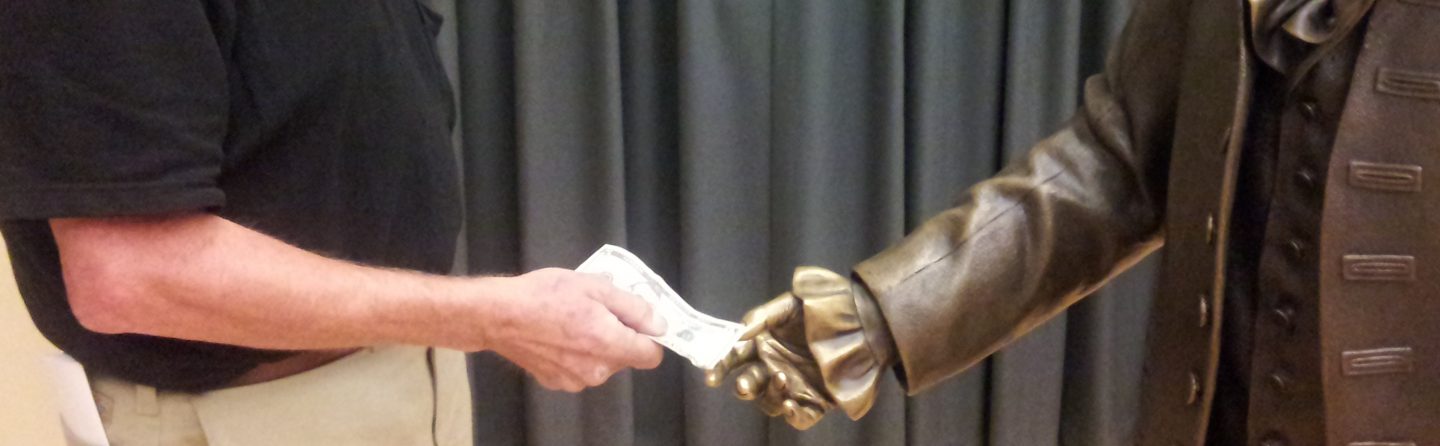
“That’s the point,” she says. “I’m very profitable. In fact, I’m more profitable than any other delivery driver here, though we all get paid the same amount. I’m more profitable because I’ve chosen to improve my skill by making mistakes; sometimes I had to work later to finish my deliveries because I tried a route that wasn’t quicker. Sometimes I had to work harder to repack my truck several times because the first configuration I tried didn’t improve my storage capacity. But I owned those mistakes and finished my route. And as a result, I got better and better until now I can deliver twice as much as anyone else in here. On average, a driver like Jane makes five thousand in profit for you a month, while I make ten thousand. You could have just been content to let me make you nine thousand, nine hundred in profit and been happy that I’m such a great delivery driver. But instead, you’re trying to put the cost of this mistake back on me without ever sharing with me the benefit of those mistakes. So now I’m taking that benefit with me when I go. I could work for a competitor, start my own delivery service, or even just find a new industry to learn. And you just paid thousands of dollars a month for a hundred-dollar bill.”

The lesson is a good one – mistakes aren’t just a cost of doing business. They’re what makes the business run in the first place. Often in a workplace you can hear a water-cooler complaint like ‘Jensen makes a ton of mistakes, but because he’s number one in sales they let him get away with it.’ The complainer has missed the point. ‘Jensen’ isn’t being given special treatment because of his high performance. Jensen’s manager just understands that the occasional mistake is an essential part of what makes that performance excellent in the first place. If you bus three times as many tables as everyone else, statistically you’ll break more plates. Obviously, you want to keep the average down, but if you take every plate out of their paychecks you’re just going to end up with a slow, risk-averse bus staff.

Everyone you interact with is going to make mistakes sometimes. Punishing people for individual mistakes is one of the worst things you can do. If you’re a parent, a spouse, a manager, a coach – always look at the net output of whatever you’re evaluating. Don’t make someone else’s mistake yours.

Cognitive

Behaviors you want to change need to be understood and addressed in the context of their past, present, and future.

Each incidence of a behavior you don’t like has a past cause. Something led to that behavior, and you won’t be able to change that behavior by maintaining the same causal chain and then hoping to make a sudden swerve at the last minute. If every time you go into the casino you gamble away your paycheck, then you need to not go into the casino in the first place. Of course, going into the casino is a behavior too – so what leads to it? Go back as far as you need to in order to find a behavior you’re strong enough to change.

In the present, you need an emergency triage system. Something more severe – something to realign your mind if you’ve slipped. A replacement behavior. This is why “sponsors” are effective for people struggling with addiction: Calling a trusted person is a good replacement behavior.

And you need to be able to recognize the future for what it is – a series of effects of the choices you make now. Bad decisions are often coupled with short-sightedness; you behave badly now because you aren’t clear about where your actions are leading. If you can’t see the consequences in the long term, it’s easier to choose poorly today.

When you look at all of these things in one great causal chain, it becomes easier to begin to alter its trajectory.

Taboo

When I was in kindergarten, our assignment in art class on some particular day was to “draw something beautiful.” Pretty standard stuff for that age. I drew (to the best of my meager ability) an angel.

This wouldn’t be notable in any way except for the fact that I got in some trouble for it. The teachers were touchy about religious stuff in school, and suggested that I draw something else. I was pretty stubborn and didn’t want to draw something else, and apparently, I put up enough of a stink about it that my father got called.

He came to the school for the ensuing parent-teacher conference and made it quite clear that he was not in agreement with the school’s position. The teachers said they were worried about making other kids uncomfortable if they either weren’t religious or maybe had other religious beliefs, which my father – rightly – pointed out was absolutely absurd. One kid drawing an angel for himself wasn’t an affront to any other five-year-old’s beliefs. Since I couldn’t name a single other thing anyone else drew, it was absurd to imagine that anyone else would even know what I’d scrawled on a piece of paper unless someone raised a whole stink about it.

The point my father was making, which was correct then and is correct now, is that your own self-expression is never impolite. No one else is forced to even look at your stuff, let alone grapple with the deeper implications of it. There is plenty out there that can be considered taboo; stuff you don’t throw at others unless they’ve agreed to step into that sphere with you. But taboo cannot exist between you and the page.

When you draw something, write something, even say something in no one’s company but your own, that’s nothing more than an external hard drive to your mind. It’s no one’s business, even if you’re doing it somewhere that someone else could conceivably be exposed to it. It still isn’t an attack, and is never harmful to others.

And a Diet Coke

There was this joke that went around when I was younger (maybe it still goes around, who knows) about a person who goes to McDonalds and orders this big meal, like a Big Mac, fries, apple pie, chicken nuggets, “…and a Diet Coke.” The joke is that ha ha, this person is suddenly concerned about health when it comes to the drink, after ordering all that garbage? Ha ha ha.

Even back then, I thought the joke was silly. Like sure, maybe Big Macs aren’t the healthiest thing in the world. But you know what’s worse for you than a Big Mac and a Diet Coke? A Big Mac and a regular Coke.

I worked out today. I also ate a cookie. And you could laugh and say “Why bother working out if you’re just going to eat a cookie?” Because look, I was going to eat that cookie either way. Cookie + exercise is definitely better.

Sometimes people make marginal improvements. Maybe a diet Coke is the first step. Next, they’ll get smaller-size fries. Then they’ll skip the apple pie. And soon they’re making themselves healthier meals entirely. Or maybe just making a few small improvements is good by itself, even if those decisions don’t necessarily lead to larger ones!

When people take marginal steps towards something better, don’t give them crap about it. Or at least, give them a little less, you know?

Your Own Applause

When you put in the effort to save the thing that no one else is willing to work on, you’re doing it because you hope that your effort will be recognized. You’re hoping that when the project pulls through because of your effort everyone will cheer for the person who did it.

Just remember – if they cared about the outcome enough to cheer for the person who saved it, they’d put in the effort themselves. Work on the things you’d cheer for yourself, and don’t chase the esteem of others. People who can’t lift a finger can’t clap.

Spicy

Most people don’t want to eat their favorite meal as their only meal. But what’s the ratio? How much variety do you need to spice up your favorites?

You can say “Having a cheeseburger now and then makes you appreciate steak more” (assuming, of course, that you prefer steak to cheeseburgers). But there’s diminishing marginal returns there, right? What’s the optimal burger-to-steak ratio in your life?

Being thirsty makes you appreciate water, too. But is being dehydrated more pain than a refreshing drink is pleasure?

Speculative

Some of the best and most interesting philosophy is done within the pages of really good speculative fiction. Exploring the “what if” realms and how we might react to them, when done well, requires an incredible mind. I doubt my mind is up for the task, but I’ve been struck by an idea, and I’m going to mess around with it some. Wish me luck.

Veneer

All my front teeth are fake. When I was young I used to fight a lot, and a few times I got them really banged up and never fixed them. As a result of both the damage and subsequent negligence, they got significantly worse and were a real eyesore.

When I talked, I was careful never to open my mouth much because of how awful they looked. I never smiled fully in pictures. I knew everyone would notice.

One day, finally, I got an expensive dental procedure done and had them reconstructed. It was arduous, but the end result was great. I finally had a nice-looking smile and was really happy to show it off. I went to a gathering of my friends and walked in with a big, toothy grin. I cheerfully called out hello to everyone as I walked in the room. Their response?

“Oh, hey Johnny. What’s up?”

That’s it. I stared at the room, smiling from ear to ear like an idiot, said smile becoming increasingly forced with each passing second. Eventually, someone said, “What’s wrong with you?”

I grinned some more, but my eyes didn’t have it. I said, “Really? Nothing?”

They all shrugged. Finally, I couldn’t take it and just yelled, “I fixed my teeth!”

And the universal response was: “There was something wrong with your teeth?”

These were people I’d known for years. So, there are a few lessons here. Maybe I was just really good at hiding my chompers. But probably not – what was more likely was that people really, really don’t notice stuff about you. It’s called “spotlight bias” – we think we’re the center of attention and everyone is scrutinizing us but in reality, we mostly slide in and out of other people’s attention without much real notice. A few people might pay attention (a girl walked into that gathering later and immediately said “Hey, you fixed your teeth!” which turned out to be my first clue that she liked me), but they’re the exception.

The other lesson though is this – fix the stuff that bothers you. Don’t carry burdens you don’t have to. You don’t have to fix everything, but once it’s clear that a problem is actually making you change your life for the worse to route around it, dig it out.