I’ve now written just over 25,000 words in my book, so my writing goal from last month was successful! A rough estimate for total length is going to be somewhere in the 40-50k range, so I think I’m halfway there or better on the raw writing!
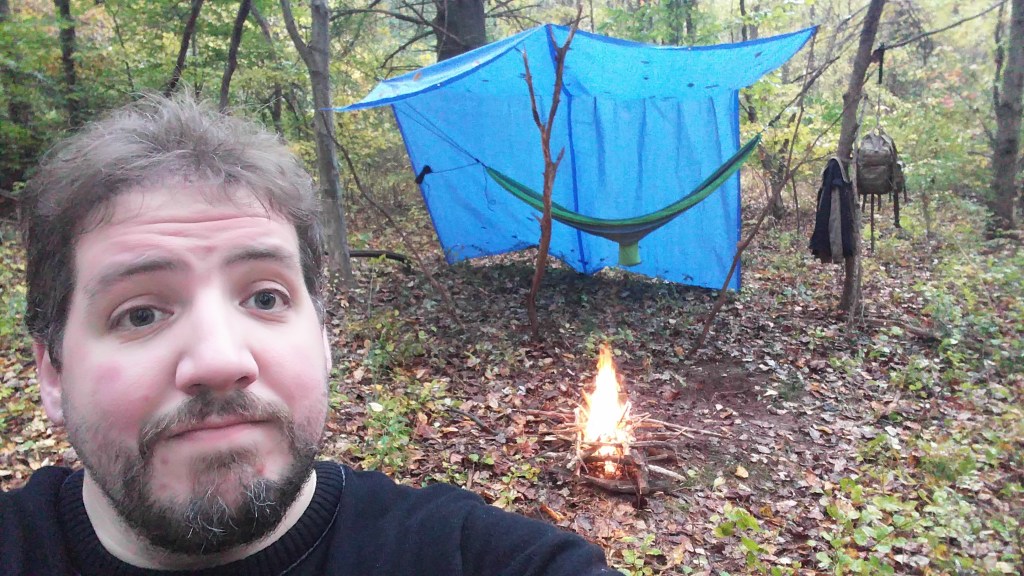
In addition, I went on a spontaneous new adventure in the “wilderness” (I mean, a state forest in Pennsylvania counts as wilderness, right?) that was a lot of fun, and I honestly can’t wait to go again.
And lastly, I accepted an exciting promotion at my company, which I officially started today!
So generally, things have been going pretty well! November promises to have a lot of action as well, and I’m excited for the challenges.
So my New Month’s Resolution for this month, in addition to maintaining the momentum on my other reading/writing goals, is to make a huge impact in the first 30 days of my new role. I’m headed out of town next week to visit the central office and put a lot of things into motion, and I’m sure that will create a few blog posts.
Imagine 30 people carrying water to fill up a pond. Since they’re pretty good at carrying water, they each transport an average of a gallon every ten minutes. The pond is filling up.
Now imagine 30 more people come along and want to help. They’re not as good at carrying water as the first 30, though. The members of this group, on average, only carry a quarter of a gallon each every ten minutes. So now that they’ve started helping, the average water-carrying speed for the whole outfit has dropped to half a gallon every ten minutes.
Oh no! It went from an average of a gallon every ten minutes to a half a gallon every ten minutes. So the pond is filling up more slowly, right?
Of course not. The average isn’t what’s important here – it’s the total. When only the first 30 people were carrying water, the pond was filling up at a rate of 30 gallons every ten minutes. With all 60 carrying water, now the pond is filling up at a rate of 37.5 gallons every ten minutes.
Those extra people didn’t improve the average, but they helped the total. Even if they carried a drop of water each, they’d still improve the end result.
That’s important to remember. There are many situations where the average doesn’t matter. I make myself write my book for 30 minutes every day. Some days that lets me clear more than fifteen hundred words, and other days I barely crack three hundred. A 300-word day pulls down my average, but it’s still pushing me towards my goal. The average isn’t important, what’s important is writing every day.
Don’t fall into the trap of thinking that averages always tell the whole story. Sometimes you need to remember that even a little drop of water raises the sea.
There’s this pernicious little phrase that floats in and out of almost everyone’s conversations at some point. The phrase is “someone should…”
You hear it uttered (or even utter it yourself!) in response to some problem or idea. “Someone should fill in these potholes,” or “someone should write a book about that!”
The problem is that when people say “someone” in this context, they clearly mean “someone else.” It’s easy to point out a problem or to have an idea. But it takes work to turn those things into positive change in the world. So “someone” really ought to be you.
Today I had an extremely minor version of this happen. Someone at work presented a bit of information that led me to say “oh, someone should extrapolate this into a marketing doc, it could be effective.” And while folks agreed, everyone’s plates are full! Their job isn’t to jump at every random idea one of their co-workers spouts off. It’s easy to be the idea guy, but the idea guy is useless on his own.
So I thought, “why not me? If I think it’s a good idea, why can’t ‘someone’ be me?” And then I thought “because creating marketing graphics isn’t even remotely in your skill set and it would probably be bad.”
To which, of course, a much smarter version of me said: “So what? Go figure it out.”
Having a good idea that “someone should” act on is actually a really great catalyst for figuring out a new skill, or a different application of an old one. It’s a chance for you to fiddle productively with some new tools because you can actually see the end result you want to create.
Two things are true: You are always moving, and you are carrying things.
In some sense those are probably literally true, but I’m talking metaphorically here. No matter how comfortable or boring you might think your life is, in reality things are changing every day. Whether big or small, those changes move you along your life’s path, and yesterday is not today is not tomorrow.
You can resist those changes or you can lean into them. Resisting them usually just means you change anyway, but you’re unhappy, adrift, and not in control. Life isn’t like a car on the road; it’s like a boat on the river. You’re moving whether you want to or not, but you can steer if you want to. It’s usually a good idea.
And controlling your canoe is easier if it’s lighter. You’re carrying a bunch of things – ideas, biases, attachments, preconceptions. Not all of that stuff helps you. Some of it weighs you down.
Love and joy are like rations and water – they keep you going. Morals and principles are like a compass and rudder; they help you go the right way.
But a lot of that other junk is just dead weight. Some of it might have been important at one point, but we cling to it far beyond the point where we should have just shoved it overboard in order to be lighter. The anger you feel gets in the way of your rudder. The attachments to things you have bury your compass and make it hard to see. The stress makes it hard to reach the rations.
Most things just don’t matter enough to be worth the drag. The river is one way only, but it has many fine sights to see along the way. You won’t always get to stay at any of them as long as you like, so make sure you can swiftly capture the moments you can.
“Okay, then you have to tell them about the joke I told you today and how funny it was.”
“Okay, I will.”
So The Beansprout comes up to me and says “Do you want to see me count to fifteen?” She’s got this huge grin on her face. I say “yes,” expecting her to surprise me by it being in another language or something (she can already count to ten in Korean, so I thought maybe it would be that).
Instead, she says: “One two three four five six seven eight ten eleven twelve thirteen fourteen fifteen!”
She’s smiling so proud.
I’m looking at her like she’s got two heads, and I say “you forgot ‘nine,’ silly.”
She says: “No I didn’t! Seven ATE nine!!”
I WALKED RIGHT INTO IT!
BAMBOOZLED!
I nearly split my sides laughing. It was the best delivery of that joke I’d ever heard.
She made me promise to blog about it, and it was well worth it. I love that little maniac.
Most people wouldn’t call me “outdoorsy.” I am what many might refer to as a “city slicker.” When I was a boy, my father and I would go camping a few times a year, but that was about the extent of my exposure to the natural world, and I haven’t been in many years.
Despite this, three things are true about me:
Despite not being woodsy, I’m handy and competent. (These are traits that I didn’t so much come by naturally, as much as my father hammered them into me as being essential.) So I didn’t think I’d be useless if dropped in the woods, just inexperienced.
I actually really enjoy nature on the off chance I get to experience it. I think very fondly of those boyhood camping trips.
I like doing things I don’t normally do.
So this weekend I drove into the William Penn State Forest, abandoned my car, and hiked out into the woods far away from any formal camping areas and got myself lost, to see what would happen.
I brought one backpack of limited and untested gear that I had actually put together a few years ago as a sort of emergency bag. That was about a third of my motivation, in fact: I had made an emergency bag but realized I had no idea if it would be worth anything in an actual emergency, and I wanted to test stuff. But the rest of the motivation was just because I hadn’t done anything like this before. As Captain Kirk said: “Because it’s there.“
I had a great time. I got well and truly lost on purpose, but kept track of my orientation and landmarks and such. I hiked for about 4 hours before I made a camp, and then was so exhausted from it that I slept in the early evening. I woke up at about midnight when it started to really pour, and since I didn’t think I’d get back to sleep anyway (turns out even this experience was no match for my persistent insomnia), I decided it was a good opportunity to see if I could find my way back off the mountain in the middle of the night, in the rain.
(Hey, I said I was handy and competent, not smart.)
So, in the woods in a state forest, in the middle of the night, in a rainstorm, it’s dark. But I had a compass and a flashlight, and a truly remarkable walking stick I’d found, so I was sure I’d be fine. Slick rocks on a mountainside, climbing over fallen trees, cutting through thorns; I’ll be fine.
Turns out I was right. It was actually really exhilarating to have no visual cues to my journey, using only orienteering skills I was mostly making up as I went along, hacking my way through dense forest. When I did spot a big landmark that I had previously noted as being unique enough to recognize later, a looming shadow black even against the prevailing darkness, it was a great thrill. I was able to navigate back to where I’d left my car in a shorter time than my initial foray, since I was moving with more purpose and not exploring. I left my walking stick propped against a tree; I hope someone else finds it as useful as I did – it’s not an exaggeration to say that it saved me from more than one fall down a mountain.
Today my oldest daughter (age 7) participated in her first sparring tournament. She’s been in karate for a few years now, but has never done this kind of tournament before, and she was very excited. In her bracket, she came in dead last.
I was so, so proud of her!
She fought like a champ. She got more points in every progressive round, so she improved every time. She absolutely never showed a hint of being disheartened or doing anything less than her best. She congratulated every other kid that beat her like she was cheering for a best friend, even the ones she’d never met before today. And when it was over, she bounced around grinning from ear to ear about how much fun she’d had.
We absolutely talked about what she can do better – she was quite realistic about her performance, but not negative. She had clear ideas about what to improve and how to practice. She focused on the positive aspects too, like how she did win her last round once she found her “zone.” She also noted that this was her first tournament, which wasn’t true of any of her opponents. She’s certain she’ll do better next time; so am I.
As we talked about all this, I told her I was so incredibly proud of her. Half-joking (but in that way where I knew the answer was important), she asked me: “Even though I came in last?”
I hugged her. “You didn’t come in last. You did better than every single person who didn’t even try, who isn’t pushing to do better every day, like you are.” She hugged me back hard.
The truth is, I’m glad she didn’t come in first. She’s naturally good at a lot of things, and sometimes I worry that if she doesn’t come up against enough resistance she won’t develop a strong sense of perseverance. Given how excited she is for the next tournament, now I’m worried about that a little less. Daddy didn’t raise no quitter.
Ideas are an input. As inputs go, they’re not all that valuable. For instance, they’re significantly less valuable as an input than hard work, or time, or tools, or really almost anything.
But at the same time, they’re essential. Great accomplishments require ideas, but ideas alone will never get you there.
Too often, I think, people feel like they need to start with a “Big Idea” in order to get anything done. If they don’t have some perfect, awe-inspiring idea they don’t ever get started. But while an idea is important, it’s not primary.
You can start collecting all sorts of other resources first. And you should! Train yourself on anything, save money, become healthier, meet people. The more juice you have to spare, the easier execution will become.
Once you have all those things, it’s easier to step back and say “Okay, what can I do with this stuff that makes sense? I know how to do X, Y and Z; I have this amount of money saved, and I’ve cleared out this much time in my calendar each day/week/month. I know these people with these skill sets. When you put all those jigsaw pieces together, what picture forms?”
That’s a lot easier than sitting down with absolutely zero resources and trying to come up with a great idea. Even if you do come up with something, you’ll be daunted by how much work you’ll have to put into it, and great ideas will sound worse.
The amazing comedian Mitch Hedberg once joked: “I write jokes for a living, I sit at my hotel at night, I think of something that’s funny, then I go get a pen and I write it down. Or if the pen is too far away, I have to convince myself that what I thought of ain’t funny.”
How true that is! If you think of an amazing idea that will take a ton of work, you’ll convince yourself it isn’t that great of an idea after all. But if you’ve already done the work because you were smart and collected resources all the time, then the idea is already halfway to fruition.
Train your ideas to work for you – you don’t work for them.
People often feel intense trepidation at the thought of a bold move when it comes to getting what they want. I understand why; for many people, being “noticed” is the last thing they want. People fear the spotlight and the scrutiny that comes with it.
The old adage, “Fortune Favors the Bold” is correct, though!
When it comes to achieving your dreams, bold moves just work. Putting yourself out there and exposing yourself to failure is impressive; ironically, it’s exposing yourself to failure that dramatically reduces the chances of failing!
One of the mental roadblocks for most people when considering a bold move is to equate the level of boldness with the amount you have to lose if you fail. But it’s not like that at all!
In a casino, if you want to win $5,000 you have to bet $5,000, which also means that’s how much you lose if your bet doesn’t pay off. But in the world as you know it, that’s rarely the case!
For example: Applying to a job. Right now, you don’t have that job. If you want to apply, you can do one of two things:
Do what everyone else is doing and click “apply” on the link provided, fill in some boxes, and hit “submit.” Not bold, low chance of success, and failure means you don’t get the job.
Do what no one else does and create something wildly impressive and unique and show it to them in a creative way. Very bold, high chance of success, and failure means you don’t get the job.
Now think about that. The failure condition in both cases is exactly the same. You don’t even have anything to lose in the first place, because you’re going for something totally new! There’s no “greater failure” to accompany your greater effort. You just increase your odds of success.
This applies to everything. Asking someone on a date? Do it in a fun and creative way. Aiming for a promotion? You won’t get fired for being too impressive, so the worst case scenario is just not getting it. Whatever you’re trying to get, if other people are involved, you have to impress them. No matter how uncomfortable, you have to seek the spotlight, at least a little – that’s where the winners stand.
In the casino analogy, imagine you had a “free play” token, and two slot machines to choose from: both paid out five grand on a jackpot, but one had a 2% chance of success, and the other had a 75% chance.
Same jackpot (the job, the date, whatever). Same cost (your effort). Same condition on failure (just being back where you started). The only difference is chance of success.
If time is a river, I’ve been swimming upstream all day.
I scheduled an appointment today, and when I got there it turns out I needed a document I won’t have for another week. Then I was an hour late to a video conference because I apparently don’t understand how British Daylight Savings Time works.
If I had known I would need the document, I wouldn’t have gone to the appointment. If I hadn’t gone to the appointment, I would have seen the notification that the video conference had started and been able to jump right on. And if I had known the video conference was actually starting an hour earlier, I would have been able to do a thing for my daughter that I had told her I wouldn’t be able to do because of the video conference.
Timing is everything, as they say.
None of these things were critical, and they all resolved fine. A rescheduled appointment is only the most minor of inconveniences. The host of the video conference was understanding and had no problem reviewing some information with me, and we’re meeting again in a week. My daughter is of course perfectly capable of waiting for this small favor, it just meant being a little more patient. So nothing burned down or exploded and nobody died.
But it was such a reminder of how important those small details are, and how quickly they can cascade when you miss even one.