Play

When I was a kid, both of my parents were huge music fans. My father more than my mother, but both had great taste. My father in particular had tremendously prolific tastes and listened to a lot of different stuff, much of which I absolutely loved.

However, as I got older a lot of that was lost. I’d find songs as an adult and suddenly remember that I had loved it as a child, because kids don’t have a lot of ability to hold tightly to the things they enjoy.

So I started a playlist for each of my three kids. Every time they express delight at a particular song they hear, I make sure to add it to the playlist. As they grow, I’ll let them take it over, but this way they can carry their joy through their adolescence and not have to go on a scavenger hunt later in their lives.

New Month’s Resolution – March 2021

Happy New Month!

It’s on the 2nd today for two reasons – one, I accidentally got really inspired on a different topic and forgot it was the first of the month yesterday, and wrote something else. And two, because today is my eldest daughter’s birthday and so that puts me in a ‘new beginnings’ kind of mood. Plus, I made up the whole ‘New Month’s Resolution’ thing anyway, so I can do it when I want!

February’s resolution was pretty successful – I managed to create my “relaxation zone” a handful of times and it was very nice. It also made me realize that more of my resolutions need to be in that direction; I’m not in any particular danger of accidentally not working hard. If anything, I’m more likely to push myself past the point of breaking, and I don’t want that to happen. I want to be around for a lot more of my kids’ birthdays.

So my resolution this month is something that comes very naturally for some, but for me requires deliberate action. I want to spend 10 minutes every day in direct sunlight, weather permitting.

I don’t commute to work, and the days have been short, cold and dreary of late. I haven’t had a lot of natural reasons to go outside. But sunlight makes me strong as it does you, and so I’m going to just go let it cover me and fuel me for ten minutes of nothing else each day that the sun chooses to show itself.

This is where it was when I became a father. It’s worth noting.

Unshakeable

In response to my post yesterday, a frequent reader asked a keen question relating to facts and principles. In thinking about a response, I realized that I had more to say than the medium of his question would allow, so here’s another post!

First, I think of facts and principles as different things. Fundamentally different. I don’t think a fact can be a principle. I think that if facts are like books, then principles are like bookshelves. They’re where you put your facts so you know how to reference them, how to use them, and how they fit together. Facts are static. Principles allow you to turn them into dynamic fuel for a good life – if the shelves are sturdy, that is.

If you don’t have principles, then every single fact will cause some reaction in you. Either it will fit with the existing pile of books on your floor or it will cause it to topple. If it threatens to topple it, you may bat it away instead. With solid shelves, however, I never live in fear of any book. Any fact, no matter what it is, can fit onto my bookshelf without threatening its integrity. That means I don’t fear facts or information.

For instance, one of my rock-solid, core foundational beliefs is that people own themselves, and are owned by no other. I don’t believe that I’m infallible, so I won’t say I would never change that belief, but let’s just say it would take an enormous philosophical effort to convince me otherwise. That core principle allows me to absorb other facts without fear.

For instance, let’s say I hear a statistic about drug addiction that (after verifying that it’s true and accurate) would lead me to believe that the problem is significantly worse than I would have guessed. I don’t have to be reactive. I don’t have to build a whole new worldview on the spot, as many people do. People with no foundational principles might hear that fact and suddenly have an entirely new outlook on life, something like “We have to do a bunch of draconian things to prevent people from getting their hands on drugs,” but that outlook is entirely reactive. They had no foundational principle guiding their impulse – they simply reacted to a single new fact that they heard. On the other hand, I would say “People own themselves, and that includes the right to do bad things to themselves. I don’t agree, but I don’t have to. Any resources put towards this issue should be spent on education and/or preventing spillover effects such as theft, not policing the use of drugs themselves, which would also punish many otherwise innocent people.” Now, I’m not saying that I’m absolutely always right or anything, but at least my view is guided by an underlying principle, rather than a reaction to the single fact.

Having an underlying principle also allows you to be “constructively wrong” more often. For instance, let’s say you heard that fact about drug addiction rates, and on that single fact you built your entire reactive worldview about draconian anti-drug efforts. You stack more and more books on top of that one, creating a shaky tower. Facts that don’t fit in the tower are conveniently discarded. And then one day… one day someone shows you conclusive evidence that the original statistic about drug addiction had a mathematical error and was actually an order of magnitude lower. What happens? Does your whole tower come crashing down and you admit your worldview was incorrect, revising it as appropriate?

Hahahahahaha. No. You dig in your heels and reject the correction. Because you can’t ever change whatever is at the bottom of the stack.

But the bottom of my stack isn’t a fact – it’s a shelf. A principle. If I found out that statistic was off by an order of magnitude, it wouldn’t shake me at all, and I would have no problem incorporating the new, updated information. I could safely say that my reaction overall wouldn’t be different, though I’d support a proportionately lower volume of resources being put towards the issue. Otherwise I’d be able to shrug at my past mistake and move forward.

The really tricky, insidious thing is this – despite the analogy I’ve crafted, everyone has a principle underneath the pile of facts. The floor, if you will. Because there is a default principle that all humans possess. We’re not blank slates; we don’t have chosen principles or nothing. If we have chosen principles, we’ve used them to replace the default one, but that default one exists in all of us unless we do so.

The Default Principle is this: My Tribe Is Correct.

Humans are tribal, social creatures. We will organize into cliques no matter what, along any subject. And absent some other principle that we learn to impose on ourselves through reason and discipline, that one will rule us. It might be your political affiliation, it might be your chosen profession, it might be your religious belief, or it might even be your musical sub-culture. But whatever you think of as your identity, you will think of other people who share that identity as the ingroup and you will defer to them, seek status with them, defend them, and rationalize their behavior no matter what.

One of my principles is this: Tribalism is fundamentally dangerous and any inclination towards it should be viewed with deep suspicion.

Sure, society is good. People are good. It’s good to have friends and family and community. But when you start to feel yourself pulled towards the average view, feeling your emotions riled up when you hear things counter to it – alarms should start sounding. At least, I believe so.

Whenever you find yourself on the side of the majority, it is time to reform (or pause and reflect).” – Mark Twain, 1904

Unbelievable

One way to always be believed is to always say reasonable, believable things. Things that other people already mostly believe or at least want to, whether it’s about you, the world, or themselves. If you limit yourself to always staying neatly within the lines of “believability” in this way, then likely most people will nod their heads in agreement when you speak.

Of course, you’re likely not saying anything that’s true, relevant, interesting, or important if that’s the case.

People like to think they’ve got it all right. That their world view and collection of facts, even if incomplete, isn’t incorrect. Sure, there might be things I don’t know, but those things all would fit neatly with what I do know if I learned them.

But a fact that not-so-gently nudges one of my existing thoughts out of place, never to find a comfortable resting place again? Well, that’s just unbelievable.

So don’t take it personally. People are people. You could spend a lot of time fruitlessly trying to convince them – or you could spend much more productive time acting on the things that are true in your own life.

Escapism

Today, as part of her birthday celebration, I and a few other relatives took my oldest daughter to her first ever Escape Room. She had no idea that’s where she was headed; the whole thing was a surprise for her.

Watching her unleash her glorious mind on the puzzles surrounding her in that environment was incredible. Last night I watched her fly through the air and break a board with a kick. Today I watched her not only complete an Escape Room, but she got the all-time high score for that room at the place we went to.

I’m not raising a kid. I’m training a superhero.

Vending Machine

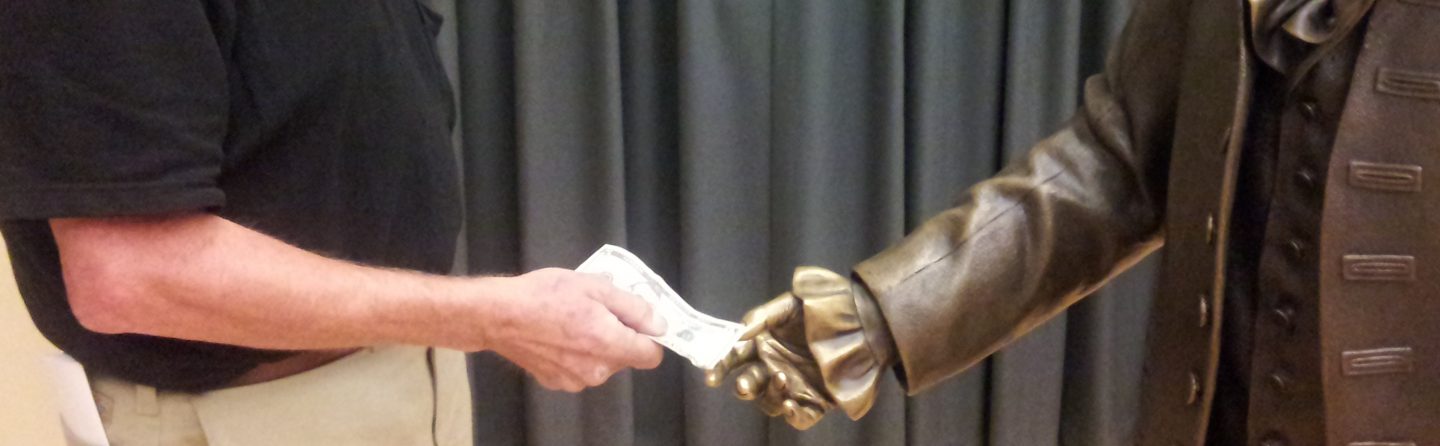
You see someone walk up to a vending machine. They open up their purse or wallet or whatever, and inside is a stack of dollar bills. They carefully examine the stack to select the best possible dollar, then on top of that they take extra care to smooth it out and maybe even clean it before inserting it into the machine. Then, once the dollar goes in, they mash the keypad at random and take whatever the machine spits out. Then they look at it, sigh in a sort of disappointed manner, and hope for better next time.

You would think you were looking at a lunatic, wouldn’t you?

Imagine being so totally consumed with being meticulous about what you’re giving away while putting absolutely zero effort into determining what you’re getting back in exchange. It certainly sounds like lunacy, but people live their lives this way every day.

I see it constantly – people are consumed with their own performance at work, making sure they’re giving away huge amounts of time, effort, and juice, but then just sort of vaguely hoping that their efforts will be rewarded in a way they find satisfying. But never once do they actually tell anyone what a satisfying reward would be or what they want. They might not even know themselves.

It’s good to work hard, of course. It’s good to take pride in what you do and to put in effort to do it well. But that’s focusing on what you’re putting into the vending machine of life. You also have to focus on what you want to get out of it! Don’t fall into the trap of just working hard at working hard. Carefully consider what you actually want and put in the focused effort to actually get it.

Confusion

Confusion is so great! Think about it, what is being confused? It’s being surrounded by knowledge you don’t yet possess within your own framework of understanding. Could you imagine a better situation?

It isn’t lack of knowledge. It’s being bombarded by knowledge! If you watch a film in a language you don’t understand, you may be confused. But you’re also getting tons of information thrown at you! If you catch even 5% of it, you’ll learn so rapidly.

Being confused is like being thirsty in a lake. You’re surrounded by the thing you feel like you don’t have! When you change around that framework, you see the answer. Don’t close yourself off, as so many do when they feel confused. Open up! Drink deeply!

I Always Do

Just remember – you have survived 100% of your days so far. Nothing has managed to kill you yet. You’ve been knocked down a few times, but never out. You have made it through everything life has ever thrown at you.

Overall, you have a great track record. And it makes sense! After all, you come from a long line of survivors. Literally every single one of your ancestors going back to the dawn of your lineage has survived at least long enough to produce an heir, so it’s no wonder that you’re a hero.

Look, this is absolutely survivorship bias. But it’s motivational, too – you’ll survive this. You always do.

Chronicle

Think about someone you admire. A historical figure, a current person of significance, maybe even a family member. Imagine the deep richness of their life, how many valuable moments happened in all the days stretching into their past.

Imagine you could step into those days and look around. That you could pick up individual moments and learn from them. Instead of just having to absorb the broad strokes and brief summaries of their exploits, you could peek under the hood and really see how the machinery grew and changed.

Someday, someone will wish that of you. You may even wish it of yourself.

Chronicle what you do now, however mundane it may seem. It isn’t all building to something important. It is something important, right now.

Doomed to Repeat It

How much of history is made up of individual decisions and their effects, and how much is made up of an endless cycle of what is inevitable given human nature?

A molecule of water is nothing like an ocean. Yet, the latter is made of the former, and given enough knowledge about the starting conditions, the movement of the ocean is predictable within certain error bars. We know when the tides will come in and out.

That doesn’t let us stop them.

I don’t think the lessons of history can help prevent repeated mistakes. I think that the lessons of history serve a different and vital purpose: they let a small few know when to sail and when not to. You can’t change the tides with all the predictive power in the world, but you can avoid them.