

When you pull weeds, you have to get the roots. Don’t treat a symptom of your problem and then lose focus. Even in the face of other problems, stay on target. Get those roots first, then you can plant everything else.
Month: October 2026
Has To Get Done
Emergency supplies are needed in a disaster area. You try to jam them all onto a small plane, and the pilot tells you the plane will crash with all that weight, if it even takes off at all.
“The supplies have to get there,” you respond, ignoring the warning. Later, no supplies reach the destination at all.
You have so much work to do that you’re staying until 9, 10, 11 PM, and going in again by 7 every day. A colleague tells you to cut back on the work a little before you burn out.
“The work has to get done,” you respond, ignoring the warning. Later, no work gets done at all.
My Mistake
There is a world of difference between making an excuse and explaining the cause of a failure.
The difference is responsibility, accountability, and ownership.
Let me give you two examples of bad ways to respond to making a mistake which resulted in a failure of some kind:
- Sue misses a deadline at work and an important client is left in the lurch. When Sue’s manager asks her why this happened, Sue says: “The system was being buggy and so it was impossible for me to complete the tasks in the time I had, so even though I worked hard, I couldn’t meet the deadline. This isn’t my fault at all and so I shouldn’t be held accountable for the client complaints.” Sue is making an excuse: she’s explaining the cause of the failure fully but taking no accountability for the result.
- Christine misses a deadline at work and an important client is left in the lurch. When Christine’s manager asks her why this happened, Christine says: “I’m sorry, I know it’s totally unacceptable. I’ll reach out to the client and smooth things over and let them know I’ll be able to have the deliverable to them by first thing tomorrow. This won’t happen again!” Christine is owning the failure and taking responsibility for both the outcome and the solution, but did you notice what she didn’t do? She didn’t explain the cause of the mistake!
If the system used to perform the work is having technical difficulties, that is valid! But often people with good work ethics are so intrinsically opposed to “making excuses” that they never even explain the circumstances because it sounds like an excuse.
As a manager, things like technical issues with my team’s main tool are of vital importance for me to know, and fixing them would genuinely go a long way towards ensuring that the original mistake doesn’t repeat. The problem with Christine wasn’t that she didn’t work hard enough, but she’s treating it like it was – and applying “work harder” as a fix. But the system is still going to be buggy, and Christine is still going to have a hard time.
The correct approach, of course, is both. You need to take accountability for the result even when there were valid obstacles, because of course part of your job is solving those kinds of problems and proactively communicating about them. But you also need to actually explain what would give you the ability to correct the mistake in the future. As long as you’re owning that future, you’re not making excuses – you’re making progress.
Alight
To land, gently, on the branch. That is your finish line, and your starting position. Your moments of rest between moments. There is nothing else; there is no ‘done,’ no tomorrow to postpone to. There is moment and moment, a nest for an egg, a moment and a moment again.
Spiritual Exercise
Lifting weights, swimming, hiking – these are exercise for your body, to keep it lean and functional.
Sudoku, poker, reading – these are exercise for the mind, to keep it sharp and creative.
What is exercise for the soul?
What’s the equivalent? Something that challenges your spirit in a way that strengthens it?
Perhaps it’s embracing sadness and grief; confronting the pain you’d like to ignore. Maybe it’s charity: pitting your altruism against your selfishness in the same way that lifting weights is pitting your endurance against your sloth. Maybe it’s simply driving yourself to love others that you’d rather not love.
I believe that the things that make your body and brain stronger come from challenge, and so I believe the same must be true for the spirit. And I believe that letting your body or your brain rot is a recipe for great despair in life, and so I believe the same must again be true for the spirit.
Bayesian Doctors
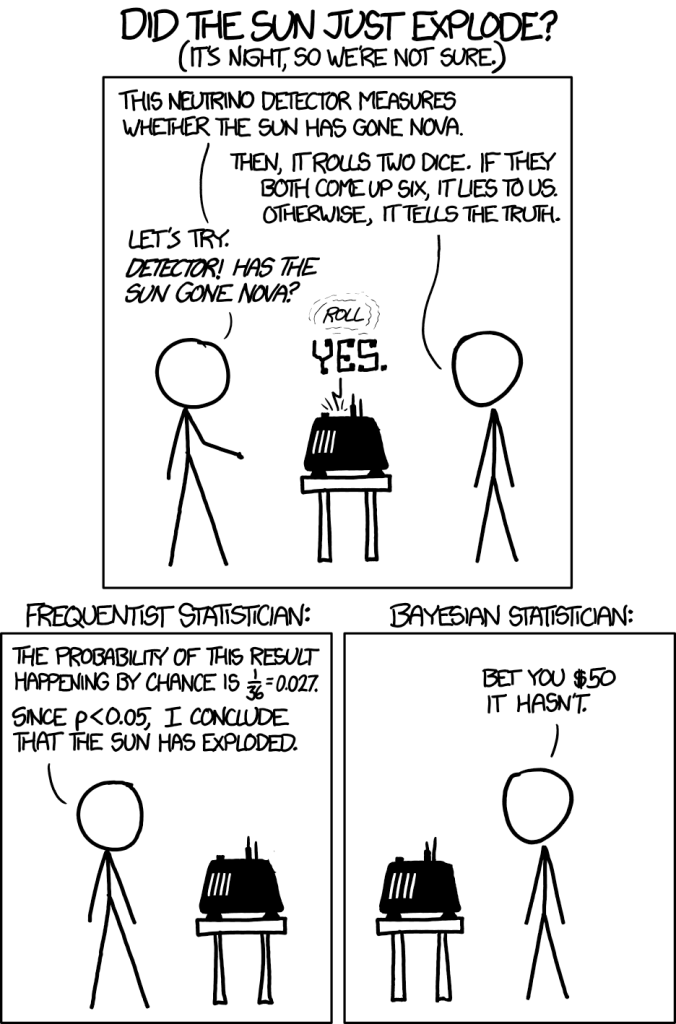
This is a problem in medicine.
Imagine a particular disease, Disease X, has a 1 in 50,000 incidence in the general population, but 1 in every 100 people with MS also have this disease. If you show up to your doctor with symptoms of Disease X, the doctor will often say “Well, there’s only a 1 in 10,000 chance you have that, so it’s probably something else.”
Even when you say you have MS, the doctor will frequently not update his view! The Bayesian response is to change his view dramatically once he has this new information, making it 100x more likely that you have Disease X. But most doctors don’t.
Why not? Well, for one, because they’re doctors, not mathematicians. There are probably lots of other reasons, but that’s the one we’re focusing on here.
The point is this: other information matters whenever you’re looking at the likelihood of an event. The odds of getting hit by lightning are very low, but if you’re standing at the top of a metal tower in a thunderstorm you should really update your prior judgement of your danger level.
The Key Response
Bad things happen to everyone. And everyone has a different “key response.”
What I mean is: For any given person, there is a type of reaction to a bad event that will make that event instantly easier to deal with, mentally and emotionally. Most other reactions will make it worse. This applies equally to reactions from others as well as internal reactions from the person in question. The “key” is knowing what the right reaction is.
For instance, my personal “key reaction” is planning. If something bad happens in my life, I instantly feel better if I can establish a sense of control. This almost always comes from a quick run-through of how I can mitigate the damage and ensure that the bad event doesn’t repeat. Once I do that, I feel much better, and I can take care of whatever I need to with a clear head. If someone (perfectly well-meaningly!) instead tries to comfort me or offer words of validation, I get frustrated, annoyed, and immediately things start to get harder for me.
Many people have the exact opposite response, and that is okay! I know people who will panic and spiral if you offer any constructive advice in response to a bad event, but if you just say, “that sucks, I’ll give you a hug and get you a cookie,” they feel almost instantly better and begin to address the problem with a cool head mere minutes after.
There’s no wrong response, only responses you might not intuitively think of because they aren’t your own “key response.” But that’s the secret – every lock is opened by a different key. Figure out the ones for the people and relationships you care about, including yourself.
Inputs
I’ve been thinking a lot this year about how our emotions and senses connect to our reason and intellect.
Think about electronic devices like a television or computer. Often they have more than one input – electricity plus signal (like cable or internet) at a minimum, but sometimes other things too, like information from auxiliary devices. Those inputs are essential to the operation of the device, but they need to be carefully installed.
You need the right amount of electricity. You need a compatible signal. You need those things, crucially, to go into the ports meant for them. If you try to jam the power cord into the ethernet port, at a minimum the television won’t work. You might even break it or start a fire.
So we, as people, have all these inputs. We have senses that connect to emotions that connect to actions. Those things aren’t bad; in fact, they’re vital and necessary. But they’re also very subject to error.
Imagine that when you were a kid, a mean bully put on a Mickey Mouse mask and then jumped out at you in the dark, scaring you terribly. Maybe they even physically hurt you. As a result, somewhere in your brain, the “cartoon mouse” sensory input got plugged into the “fear and anger” emotional port in your brain. Now, as an adult, you hate cartoons, mice, or both.
In real terms, that’s like plugging the ethernet into the power port. It shouldn’t be there! It’s a mistake. A miscalibration. That’s not a thing you should be afraid of, and whatever actions you take as a result of that fear aren’t helping you live your life.
That might be a minor example, but there are much larger ones, and cumulatively they’re doing incredible, unseen damage to your life. The output – a healthy, happy existence – depends on our senses and emotions feeding properly into the brain that controls our actions.
Mutations
The introduction of random chance into any process is how the process improves. Sure, it’s a potential for error – but it’s also the potential for grand discovery.
Tonight I was making a dish I make frequently for my family. I discovered too late that I was out of a key ingredient, so I made a substitution. My kids told me it was the greatest version of the dish they’d ever had!
I’d have never deliberately thought to make that substitution, but a happy little accident caused a change with very positive results. If the results had been bad, it would be easy to just not duplicate that change. But when they’re good, the results are lasting.
Don’t make things too perfect; the margin of error is where brilliance lives!
Make Some Noise
Why we talk is more important that what we say, most of the time. And misunderstanding that leads to more trouble than misinterpreting the actual contenct.
Is someone telling you about a cool movie they heard about because they’re trying to sell you tickets to it, or because they’re trying to ask you out to see it? In one instance, getting over-hyped about the movie might be off-putting, while in the other instance it can mean they’re eager to share their interests with you. And if they mean one and you interpret the other, there’s likely to be a lot of friction in the communication!
Sharing ideas is one of my favorite kinds of bonding, but there aren’t too many people that can just hear a totally new idea and immediately engage with it with curiosity and intelligent discussion. If they think instead you’re trying to convince, or judge, or anything else, the kind of philosophical discussion I’m after isn’t likely to manifest.
Don’t worry about that sort of stuff. Those moments will happen when they do. If someone just wants to make some noise at you, let them. They’re sharing, too.

