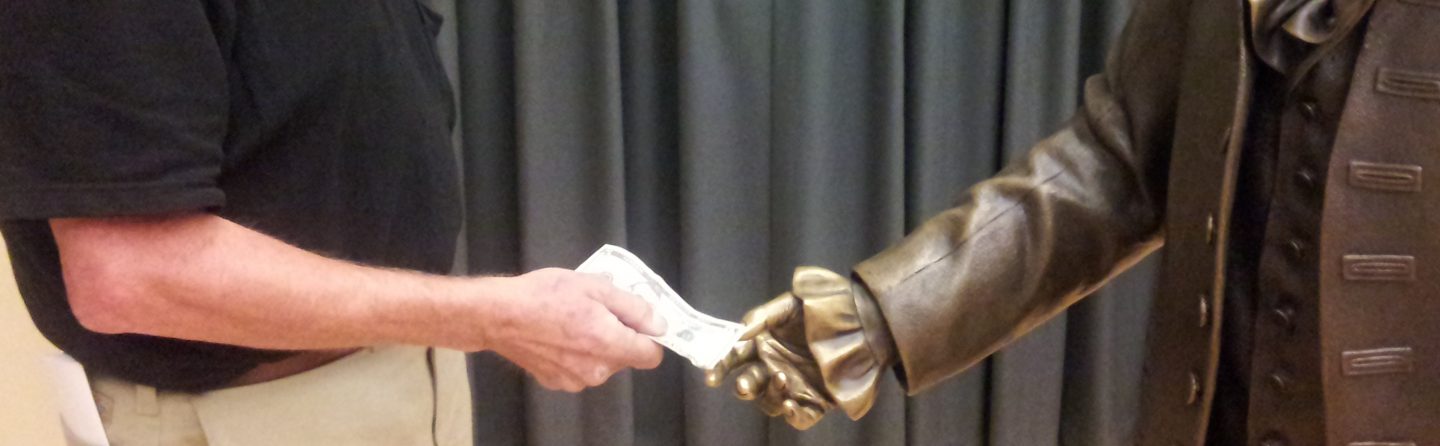

What was different? What unique thing happened today that never happened before, and never will again? What special glimmer of the universe, like pi eternal but never repeating, appeared before you?
Did you miss it? Look harder tomorrow. It’s there.
What was different? What unique thing happened today that never happened before, and never will again? What special glimmer of the universe, like pi eternal but never repeating, appeared before you?
Did you miss it? Look harder tomorrow. It’s there.
I think a small amount of intentional failure can do wonders to reinforce good habits. Like a controlled fire clearing away underbrush.
If you have a habit you’re trying to form, try breaking it for a day, but intentionally so. Pay very close attention to how you feel as, and after, you do so.
Making my bed, eating healthy, working out – these aren’t just things I do because I believe in their long-term benefits. I don’t like how I feel when I don’t do them. Indulging in a sugary snack doesn’t make me feel pleased or sated – it isn’t a guilty pleasure. It makes me feel gross.
Part of that is the necessary check. If you don’t feel good in the short term about your habits, it will be hard to maintain them. It also may not be worth it! What’s the point of working out every day to make your life longer, if working out makes you abjectly miserable?
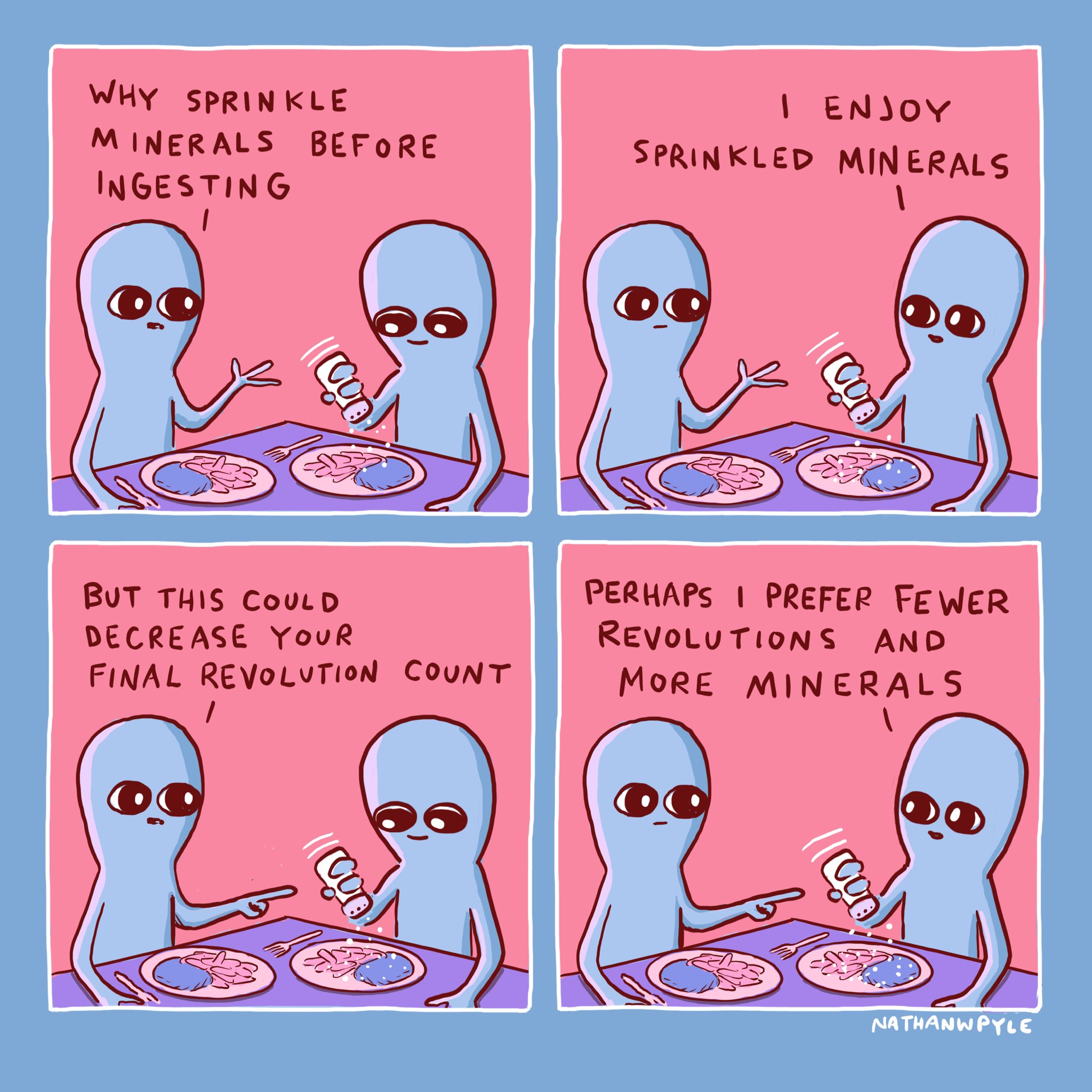
“Form the healthiest habits possible, within the realm of staying at least 51% happy day-to-day,” is, I believe, pretty actionable advice. Find the best things you can do today, that also enable you to keep doing them.
And if that means stress-testing your choices here and there, that’s always good practice.
Today was a nice day, so I took my kids on an outing to a local park that they like. One of the other kids there, a lad of about 8, had a red, faux velvet attaché case, of the kind you might find cluttering the back of a thrift store.
He was more than willing to show me its contents. Here’s what he had inside this fabulous accessory:
All I’m saying is, some people figure out life early, man. They know what they like, and they put it in a red faux velvet attaché case and take it with them to the park.
There are, very very broadly speaking, two types of good things you can do in the world. You can provide a material benefit to someone, or you can make someone feel good. They aren’t mutually exclusive, of course. But ultimately those are the two outcomes you’re going for if you’re trying to do good in the world.
You can solve someone’s medical problem. You can build something for them. You can create financial opportunity for them. And so on – useful things. Everything from mowing someone’s lawn to saving them from a heart attack is useful. But usefulness does not have to be the only thing we judge by – in fact, to do so is a hollow measure.
We should also strive to make others happier. A kind word or a pleasant song carry very little in the way of usefulness per se, yet they bring tremendous value to a life. My two youngest children are pretty useless in terms of material benefit (though of course they’re a huge investment in future utility, as evidenced by the chores being performed already by my oldest), but all of my kids bring me so much joy it’s hard to describe.
You can see this dynamic playing out in micro versions everywhere. Go into any workplace with more than a few dozen employees and you’re likely to be able to find at least one who has their job not because they’re good at it, but because everyone enjoys working with them. People who slip through the performance evaluation cracks quarter after quarter because they’re kind, funny, pleasant, and endearing. The reverse is also true – sometimes you see someone in a workplace who’s a real jerk, but they don’t get fired because they’re an incredible performer at their profession. Both of those scenarios have limits at the extremes, but the general pattern pervades: you have to at least be one or the other.
As much as possible you should strive for both, of course. You should try to be useful and you should try to be pleasant. But there are lots of reasons that people might find it difficult to be useful. It happens. What amazes me is how often people who have trouble being useful also quickly default to becoming jerks.
People put a lot of their self-value into their own self-perception of usefulness. It’s natural, and I get it. And when that self-perception wanes because they feel like they aren’t being useful in whatever context matters to them, they get defensive and lash out. That’s also natural, and I also get it. But they shouldn’t. Being kind matters so much more than being useful. And you can always be kind.
There’s this common hallmark of guys that consider themselves “masculine” or “macho” (and I hasten to point out – common, but not universal), which I strongly dislike. It’s when guys concern themselves at all with how masculine another guy is.
I’m going to put this out into the world as a personal principle: a vital component of “manliness” is that you are only concerned with the concept as it relates to you.
I actually enjoy and find nobility in a lot of the tropes of my gender. I like fixing things. I like standing in the way of danger. I like protecting, I like providing. Many of these things are “old fashioned,” but I temper them with an important, even vital, caveat: I do not use these values as a place from which I subject others to judgement.
Once at a wedding, my father picked up a piece of quiche to eat, and someone said (probably tongue-in-cheek), “real men don’t eat quiche.” My father’s instant response was telling: “Real men eat whatever the f^%@ they want.”
Growing up, my father was about as much of a “man’s man” as you could imagine. Except for the fact that he bore no judgement on others who didn’t act as he did. If someone acted immorally, he had plenty of judgement on that, but he didn’t consider it a moral failing to not know how to fix your own lawnmower. It was important to him that he be able to do it – he absolutely would consider it a moral failing in himself. But his standards for himself (and me, his flesh and blood) were different than his standards for others.
It wasn’t because he thought of himself as better. It was because he knew people were different, and it’s not the mark of honor or nobility to judge others.
He once told me as a young man about the “Sheep/Wolves/Sheepdogs” theory of humanity. The theory goes: people are in one of those categories. If you generally need protecting and watching over, you’re a sheep. If you protect others, you’re a sheepdog. If you prey on others, you’re a wolf.
I won’t debate the flaws and merits of that worldview here (maybe in another post), but my father had an extremely salient point about it: if you judge others for being sheep, then you are a wolf. No questions beyond that point. Whatever else you do, if you are protecting or serving others but simultaneously condemning them for their need to be protected, then you aren’t a noble person. You’re a protection racket in the making.
Your own ideals of manliness – or of femininity, or of nobility, or of any other ideal to strive for – must be your own. You must live your ideal and be the example. If others wish to follow, they will – and if they ask for your advice on how to do so, feel free to answer. Pass the lessons on to those who are close to you, especially your kin. But do not hold the hearts and souls of others in judgement on that scale. It was custom-made for you, and only for you will it be accurate.
The difference between whether damage will slowly destroy something or make it stronger is whether that thing is alive.
Every time you lift weights, you damage your muscles. In a few days they heal, stronger than before. The damage causes growth as a response. Things that can grow will do so in response to challenges – they quite literally rise up to meet them.
Compare that to a block of wood. Damage it a little bit, and it stays damaged. Even if the damage is minor each time, and the incidents of damage are spread out, they’re all cumulative. Eventually the block will break.
In this same way, conflict can strengthen a relationship – if the relationship is living.
Think of two business partners that hate each other. They’re bound by their initial contract, but they’ve long since grown to loathe their arrangement. Every tiny slight or mistake by one adds to the contempt by the other until eventually it boils over and their partnership detonates.
Now think of two business partners with a healthy respect for one another. They make the same slights and mistakes, but each one prompts discussion and communication that gives them new insights and strengthens their bond. Every year they’re stronger partners because the conflicts are dealt with in a healthy way that enables growth.
The first scenario is a dead block of wood. The second is a healthy muscle.
The foundational difference must be the way you treat and view the relationship. If you don’t have the underlying care and respect, then the relationship is “dead” – and it doesn’t matter how careful you are, because even minor damage will add up over time and there’s never any healing or growth. But if the respect is there to begin with, then all but the most severe and catastrophic damage can be recovered from, stronger than before.
If you have faith in the life of any relationship, don’t be afraid of conflict within it. Approach it in a way that honors that life, and the conflict will be healthy. And thus too, the relationship.
I think it’s extremely rare that you make a mistake that you can’t correct. Rare, but not impossible.
Maybe a small handful of times in your life will you do something that you truly can’t undo and wish you could. A mistake that actually has some real impact. Now, first and foremost you have to just accept that fact – you can lose a lot of extra ground by dwelling too long on the immutability of time and history. Don’t dwell. But you should learn!
Now, here’s the question I’m grappling with – let’s say the mistake can’t be undone, and because of the extremely rare nature of the event, it’s unlikely that you’ll encounter it again. So you can’t fix the mistake, and “learning” from it may be moot to some degree. In those instances, what I’d like to do is bottle the wisdom gained from it and pass it on; to help prevent others from making that same mistake.
What’s the best way to do that?
To use an extreme hypothetical example: let’s say one day you’re fishing and an alligator tries to take your lunch. Instead of just letting him take it, you try to fight for your ham sandwich – and you lose a hand. Now, that’s a pretty big mistake and there’s no going back. That hand is gone, and your life is definitely different. Gaining the wisdom “don’t try to fight an alligator for your lunch, it’s not worth it” isn’t doing you much good, but it could have a high degree of impact on the next person!
So how do you get information like that to people that don’t already have it? It seems simple to just show people your missing hand and tell them, but I’ve found that people rarely listen to that sort of advice. But I don’t think trying to improve the lives of others is a lost cause.
We can hand lessons over to our children, but they have to learn a lot of lessons on their own. In fact, it’s essential that they do, for their own growth. As a parent, the challenge is just making sure they only learn lessons the hard way if “the hard way” doesn’t mean losing a hand.
Okay, get ready for a super, SUPER geeky post.
One of the many, many Star Trek spin-off shows was called Star Trek: Voyager. It had a really neat concept, several really amazing actors, and was generally a terrible show. But I’m not going to talk about how terrible it was, I’m just going to talk about the central concept.
The background of the show is that a starship and it’s crew get thrown to the other end of the galaxy by The Plot Monster, and then they have to just travel back the normal way. The normal way will take about seventy years. That’s obviously an issue, but they approach it in a uniquely genre-savvy way: the captain basically says, “Look, it’s a weird sci-fi universe we live in, and all sorts of weird stuff happens all the time, so we’ll just head in the direction of home and every time we encounter some weird other plot device that lets us shave a little time off the trip, we’ll take it. And it’ll add up and we’ll get home.”
(By the way, despite the overall lack of quality on the show itself, that concept is so incredibly great with it’s meta nods at the genre that it deserved some sort of award all by itself. It’s a shame there’s no Emmy for “Great Idea, Poorly Executed.”)
But anyway, there’s a really tremendous lesson there. If you pick a long-term goal and you advance towards it, life is going to happen in the meantime. Lots of events will occur. Some of them will be obstacles, and will hinder and distract you – or at least conspire to. Some will be shortcuts and wormholes that give you a boost towards your goal.
In that sense, a single-minded determination can actually work against you. If Captain Janeway had said “Look, we have to get home, nothing else matters, so ignore everything else we pass. Turn off the sensors, turn off the communicators, and everyone get comfortable,” then the trip would have taken 70 years and most of the crew would be dead before they ever got home. Yes, some things they encountered made (or could have made) the trip longer; dangers and diversions. But proper navigation – through life or through space – involves analyzing each of those events.
Obstacle or opportunity?
A clear vision of where you want to go is essential for this analysis. It’s impossible to tell if something is a help or a hindrance if you don’t know where you’re trying to go. But even if you know where you want to go, you can’t just ignore the journey. Not just because you should stop and smell the roses (even though you should), but because the journey itself will provide its own help if you pay attention, and separate the good from the bumps.
When a particular tragedy or disaster is bad enough, you can feel a deep sense of internal guilt or even externally-imposed shame for trying to find the silver lining. It’s as if certain times are so dark that no light is permitted; you must dedicate every emotional receptor to experiencing the pain, sparing none for even a spark of joy.
I reject that notion.
I think it’s important to pay tragedy the pain it’s due. I think it’s important to feel and acknowledge loss. But in those darkest times, that’s exactly when it’s most important that you find any tiny shred of positivity. That’s the rope to pull you out of the hole.
Don’t be flippant. Don’t be callous. But it is absolutely okay – good, even – to allow yourself the comfort of small miracles.
And don’t judge others for them! Many of us have had very bad years. But if someone has found a small positive within it, don’t begrudge them. Don’t make remarks like “oh well, I’m glad at least YOU made out great in a global pandemic, that makes it all worth it.” People need moments of hope. Don’t dump on them when they get them, especially when they’re few and far between.
If surrounding you are 359 degrees of darkness and 1 degree of light, it’s good to turn your face towards that one ray of hope. That’s the direction you want to walk, after all.
A few people I know have a small tradition where whenever something really, really bad is happening, they’ll look for some incredibly minor but positive result, and then they’ll all enthusiastically yell “Upside!” They might be rushing someone to the hospital, but then after they’ve gotten them safely inside someone will say “hey, that really good Mexican place is right near here,” and then they’ll all yell “Upside!” It puts a smile on their faces, chases away the darkness a little. Only a callous jerk would accuse them of wanting the hospital trip just to get a chance to visit an otherwise inconvenient restaurant. But if you can build up a little resistance to the crushing weight of despair that can be brought on by grave enough tragedies, I consider that a very good thing.
An upside.
I think it’s okay – good, even – to expect more from yourself than from other people.
An easy mental trap to fall into: take all the things you do because you want to, and then blame or condemn anyone else who doesn’t do those things. People fall into this trap frequently. A common example: you text or call your friends frequently to stay in touch, because you consider that to be something that good friends do. Not everyone is good at that, so you end up getting mad at your friends that don’t reach out frequently.
But that’s just imposing your exact, nuanced worldview onto every other person. People have their own lives and their own motivations and their own moral values, and those won’t always translate into the exact set of actions you would take. In fact, that will never happen.
For good or ill, I expect pretty much nothing from every other human. I never expect anyone else to ever voluntarily take an action that might benefit me in any way. It’s a pleasant surprise when it happens, but largely I treat the world as something I have to rise above. I think it’s better to be pleasantly surprised by a kindness than to be constantly disappointed.
But that doesn’t give me an excuse to act as I expect the rest of the world to act. I can, and do, hold myself to a higher standard. I rarely give advice, because other people need to find their own way most of the time. So even though I have a set of principles by which I live, and I might want to think that everyone would be better off if they also lived by them, I wouldn’t try to impose it. I’ll answer if asked, I’ll write my posts, but I will never judge nor expect. It’s difficult enough to run one life.

