Optimism, Preparation, and Creativity

Those are the three ingredients. The magic recipe. With those three things, the world is possible.

Optimism: There IS a solution.

Preparation: I have the tools to make the solution real.

Creativity: I have the ability use those tools to build anything I can imagine.

Keep all three as watchwords. Without belief that something is possible, nothing is. If you believe in failure, that’s what you’ll get. If you always believe you can win, you’ll be right some, even most of the time. If you always believe you’ll lose, you’ll be right 100% of the time.

Always be preparing. You don’t have to know what you’re preparing for. Save money, read books, expand your network, work out. Be ready.

And then solve the puzzle. The solution is there.

There truly isn’t much else you need to know. Seasons may change. But you’ll have those three things, and combined with a little juice, you can do anything.

Sharks!

Did you know that different kinds of sharks have different types of teeth, based on what sort of prey they eat? And that sharks will take a “test bite” of their prey, then swim away if they don’t like it? And that sharks don’t actually have bones, just cartilage?

I didn’t know any of that stuff! Now I do! Because my daughter is sitting next to me, in my office, recording videos of herself reciting facts she’s researched about sharks.

Learning is awesome. Putting yourself in the path of other people’s learning has tremendous benefits; I got all those facts about sharks even though I wasn’t researching sharks at all, just because I was adjacent to someone who was learning.

There are things all around us stressing us out and weighing on our way of life. There are reasons to be scared and anxious. But in the midst of all that, there are still cool facts about Sharks to learn. Don’t give up on that.

Wrapped Up

As a general rule, most people don’t listen enough. I’m definitely included in “most people.”

You’ve probably heard this before (and maybe you even listened!) in the context of your personal life, but I want to talk about it in a professional context.

When it comes to our personal life, our reasons for being bad listeners are usually self-centered ones. We’re waiting for our turn to speak, we’re too excited about our own stuff, or we’re honestly not that interested in what the other party is saying. Maybe we’re distracted, tired, hungry. Sometimes we talk more than we listen, but honestly more often we just don’t do either. We wall off.

In a professional setting, I think our lack of listening prowess has more to do with feeling like every single second has to be a direct input to a tangible output. At least, that’s what happens to me! We’re all trying to hustle and move needles, and that pushes us into all sorts of short-term productivity traps.

There is a tremendous amount of great information, freely available. You don’t even have to look for it most of the time; people are trying to share it with you. But we avoid it because we’re wrapped up in our own things. We pack our hours tightly and over-schedule because we’ve all got deadlines to hit and quotas to meet. And there’s no getting around it – we do have to do those things. But maybe we can do them better.

A few hours a week of justified content consumption can really pay off dividends in terms of your abilities as a professional. Business insights, leadership development, and overall professional acumen might be hard to measure – the impact of any one piece of content’s impact on that doubly so. But I think it’s obvious that we improve through learning. I think when we stop learning is when we start failing.

If you have a few extra hours (and right now, a lot of us do), go listen. Don’t seek anything in particular, don’t have an agenda, and don’t fall into a justification trap. Just go learn a little. It’s a way to connect us, to increase the total sum of all knowledge, and to improve your own life. Give it a try.

Checkbox Mentality

It’s amazing how often we fall into the trap of focusing on process over results.

There’s a long-running inside joke in the corporate sales world (where I spent quite a few years) that sales managers are always focused on “KPIs” (that’s “key performance indicators” for the uninitiated) to such a slavish degree that they’ll ignore the results entirely. You could be the top-producing sales rep in the company, but if you’re not sending enough emails or logging enough site visits or whatever you can still have a pile of unpleasantness roll downhill onto you.

Now, I’m a pretty process-driven guy. I believe in action goals as opposed to pie-in-the-sky vague ambitions. And I think that it’s good to have a plan; a guidebook for decision-making in the here and now. But there’s a world of difference between having a plan and being so obsessed with the process of that plan that you ignore the reason for the plan in the first place.

What I call “checkbox mentality” is when you have some sort of plan (whether of your own creation or handed to you by someone else), complete all the steps in that plan, but then get mad when you don’t necessarily get the result you want.

Want an example? How about someone who got good grades in high school, went to a good college, graduated… and is now unemployed or tragically underemployed, and blames everyone but themselves. They rail against unfairness while doing nothing to improve – or if they do anything, it’s go back to school for a higher degree.

Or how about the person that faithfully shows up to work every day, never late, and performs their job without demerit. They’re nice to everyone, but year after year they’re passed up for a promotion. They start hating their co-workers who move past them, never realizing why.

Or what about the person who can’t get a date, despite the fact that they’re “nice,” and clean, and respectful, and employed, etc. They’re passed up again and again, and start getting bitter.

All of those are examples of “Checkbox Mentality.” The idea that there is a certain set of correct behaviors, and if you check off all the right boxes, you should just get your due reward handed to you. The person with the good grades and college degree thinks they deserve a good job because they “did everything right.” The person who showed up every day thinks they should get promoted and the single guy thinks he should have a girlfriend. Where is their mistake?

It’s a simple one – so simple and so pervasive it’s invisible to many people. The mistake is not realizing this: the so-called ‘checklist’ is just a path towards what you want, not a map to what you want.

To get a job, you don’t need a college degree, or even a high school diploma. You don’t need anything except the ability to demonstrate that you would do well in the job. Because people can’t read minds or predict the future, people in charge of hiring are trying to guess if that’s true about each candidate, and your mission is to give them lots of clues to that effect. A diploma or degree are clues, but they’re not proof. You still have to paint the whole picture; think of a degree (or certification, or prior experience, etc.) as tools in your toolbox – but you still have to build the bridge.

That person that doesn’t get promoted? They don’t realize that getting promoted isn’t about checking off boxes – it’s about demonstrating readiness, ambition, drive, and value. Not showing up on time or being impolite will count against you, but good attendance and attitude are just the minimum requirements to even be considered.

Being nice, respectful and all that are definitely great qualities in a potential mate, but they’re really the barest minimum to even be going on dates, not compelling reasons to attract potential partners.

People with checklist mentality are self-centered and self-absorbed. They’re not focused on the most important question you face every day: “what does the other person want?” Instead, those people are focused only on themselves, believing deep down inside that there’s some arbiter of cosmic justice that will magically reward them for “paying their dues.”

When you realize that 99% of life is just figuring out what the other guy wants and finding a way to provide it in exchange for what you want, you also get a fantastic realization along with it: the checklist isn’t even necessary.

In reality, the big picture is simple: Figure out what you want. Find out who has it. Find out what they want. Give it to them. Do it all with a smile, and the world is yours. The rest is details; action plans and detailed processes can help you get there, but they can only come after you get the big stuff down. Don’t start with the KPIs.

Bigger Fish to Fry

Sometimes, strange as it may seem, we can actually find ourselves relieved to have a giant problem in front of us. Despite the difficulties it presents, it also tends to clear away the smaller stuff. All of our focus shifts to the One Big Thing and smaller issues fall away.

If your car engine explodes in your driveway and your entire car starts burning, you have a big problem. But for the duration of that problem, you’re not worried about whether you watered the petunias today or got around to replacing that light bulb in the basement. You aren’t worried about whether you’ll make bonus this year or if you’re calling your mother frequently enough. You’re just, you know, pretty focused on the inferno in your driveway.

Of course, the Big Problem didn’t solve the smaller ones – it just shifted your focus. Those problems are still there. When the fire dies down and you’ve filed the insurance claim and removed the flaming wreckage from your property and everything else is taken care of, all those other issues will get bigger again.

Except… maybe not all of them.

Once you’ve solved a big problem, you have a good opportunity in front of you. Your mind is still “focused big,” and your thoughts haven’t yet re-aligned with the smaller scale of those other problems. Viewed from that lofty height, consider: what isn’t actually that important? What problems would you just not go back to?

What parts of your life aren’t worth the headache? Maybe you hate those petunias. Maybe you don’t really care about making bonus; in fact, maybe you don’t even like that job.

We do so many things because we’ve always done them. Inertia is a powerful force. Once something has shaken you out of your comfort zone, don’t go happily back to it. If your car insurance writes you a check for the car you lost, there’s no rule that says you have to buy the exact same make and model again. Now is a good time to evaluate what you really want.

Sometimes life kicks over your sand castle, and that sucks. But in exchange you get freedom, the ability to build anew. It still sucks that your life was disrupted – but this view can definitely make it suck a little less.

One Pleasant Day

Go all-in on the nice moments. Really embrace them. You won’t get as many as you want or deserve, so take them for all they’re worth when you get them.

I’m not a big photograph guy. Some people are so obsessed with taking pictures of things that they don’t really experience those things. Not everyone, of course – some people manage to strike a great balance and experience things with the aid of their lens. But I know plenty of people (and you do, too) that are so obsessed with capturing things on film that they don’t ever live in those moments.

I’ve never really been one of those people; I’m a pretty “in the moment” person so I don’t worry much about posterity. Still, occasionally a picture just gets taken of me that makes me glad it exists, knowing I’ll appreciate it down the line.

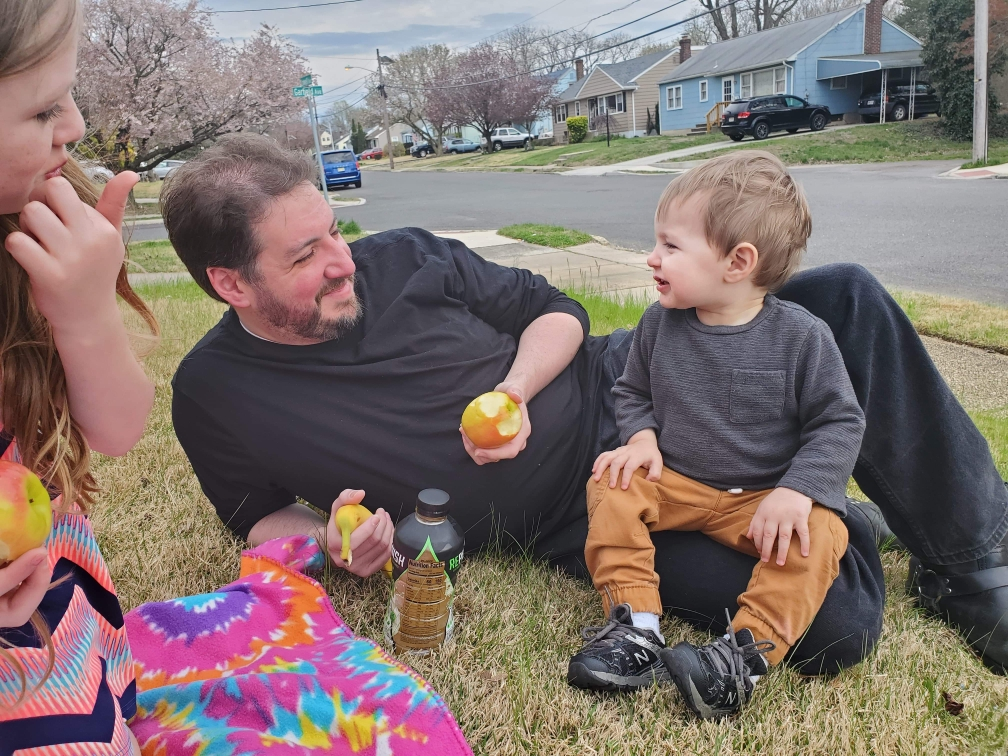
Today was an excellent day. It was beautiful out and I walked around, watching my children frolic (that’s not an overly-prosaic word in this case, either – there’s really no other word for the way they literally picked wildflowers and giggled through the grass). We ordered pizza from our favorite place, then my children piled onto my lap and we whiled the evening away watching a movie in my theater – and I’m so glad I’m able to pass on my love of the silver screen to my kiddos.

Go all-in on these kinds of days. You won’t have as many as you want.

Fuel

Nothing happens in a vacuum. All action requires a catalyst; something you use to start the creative process. Problems aren’t solved in your head, they’re solved out in the world – that’s why you need frequent (if not constant) exposure to new information in order to make progress.

Sometimes your typical lines of fuel become so embedded that you take them for granted. Maybe you read particular news websites, maybe you just have interesting conversations with intelligent people, or maybe you just visit the local library. These things become a normal part of your life.

But what happens when something like that disappears? Sometimes we see these things as frivolous or entertaining, so we don’t recognize how important it is to replace the information flow. Some sources of information become comfortable and routine. But not only does that create an echo chamber that limits growth, it also makes it so you don’t realize how important any information – even routine sources – can be to your progress.

Information is fuel. It gives you the ability to make changes, decide on courses of action, and adapt to new circumstances. Don’t take it for granted, and when one line falters, get more – quickly.

Happy Hour

My company hosted a virtual happy hour today as a way to keep everyone connected and share a little camaraderie. We’re all scattered across the country (and some even outside of it!), so it’s nice to hop on a video call and share a little face time.

Also, can we just appreciate for a minute how awesome it is to live in the future? I mean sure, we have our complaints. But video calling specifically was something that was firmly sci-fi within my own lifetime, and now it’s so mundane that we’re annoyed when specific sub-features don’t work flawlessly, like adding an imaginary background.

Everything is a frame of reference. Sometimes it’s really beneficial, especially in times of stress, to think about how much better equipped you are to deal with your problems than you would have been a hundred years ago – or even five.

There will always be problems, big and small. They all seem the same size when you’re in them. But there are happy times, too – even if just an hour here and there. You’ll solve the big problems, don’t worry. You will. If you need a little help, I’m here.

Meatballs

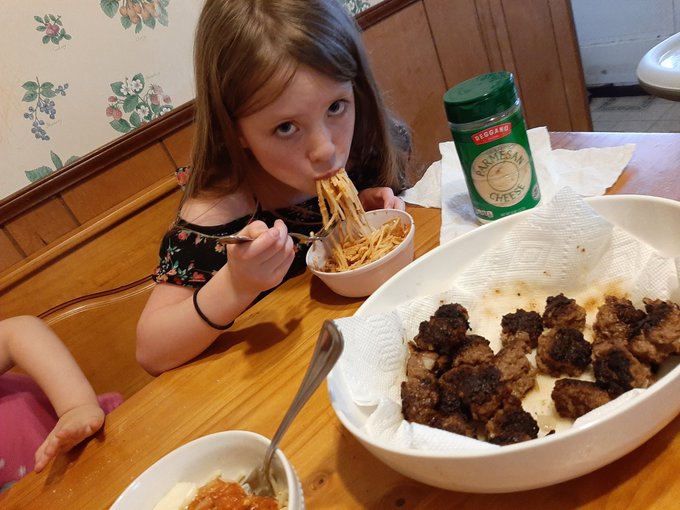
Yesterday, my oldest kid decided she wanted to take over dinner duties in order to create one of her favorite dishes: spaghetti and meatballs.

She’s eight. In her flower-print dress she set to work, chopping onions and cracking eggs into the ground beef, adding bread crumbs and spices, and rolling them up by hand. She got the water boiling for the pasta while she created her own gravy, standing over it with a wooden spoon as she continually stirred and adjusted ingredient levels.

I’m not biased when I say these were the best meatballs I’ve ever had. They were absolutely delicious. A big hit all around as her younger siblings devoured their portion and I ate about a dozen meatballs myself (her hands are small! so they were small meatballs! I swear!).

Something I admire greatly in my daughter (and want to continually encourage) is her ownership of her activities. She wants to do as much as is physically possible herself, because she wants to be able to legitimately claim the success. But she’ll also own the failure, if it happens. When she tackles a project, if it doesn’t turn out good, she doesn’t blame that on the 5% I did. She acknowledges it as hers and works harder.

This wasn’t one of those times, though. She absolutely nailed this.

We underestimate other people by at least 10%, on average. Children, at least 50%. Your kids are capable of amazing things. And since you’re all trapped in the house with them right now (for posterity: this was written during a global pandemic that required a ton of self-imposed quarantining and isolation to combat), make everyone’s lives better and give them tasks. There’s never been a better time to rely on them as full contributors.

And you might just get the best dinner of the year out of it.

Image

New Month’s Resolution – April 2020

Happy New Month!

So last month my resolution was to try to form a better morning routine. Well, for anyone reading this in the future, last month the world also ended.

I mean it didn’t really, but to say that there’s been some upheaval would be a pretty major understatement.

So my sleep schedule hasn’t gotten much better. There’s a lot of noise in a house with three kids, especially if those kids generally can’t leave and are crawling up the walls. But that’s okay – we roll with those punches. Life won’t always stay neatly packaged, and that’s the beauty of the “New Month’s Resolution” paradigm instead of “New Year’s.” You only lose 1/12th of the time & momentum when you need to make a pivot.

So here’s my resolution for April – survive. Keep my kids’ lives as normal as possible given the disruption, finding things to do with them despite the challenges. Get outside with them as much as possible while still being safe and dry (oh yeah, on top of everything else, this is major rainy season where I live). Things will return to baseline, as long as we stay sane. So that’s what I’m planning to do.

Stay safe, everyone.